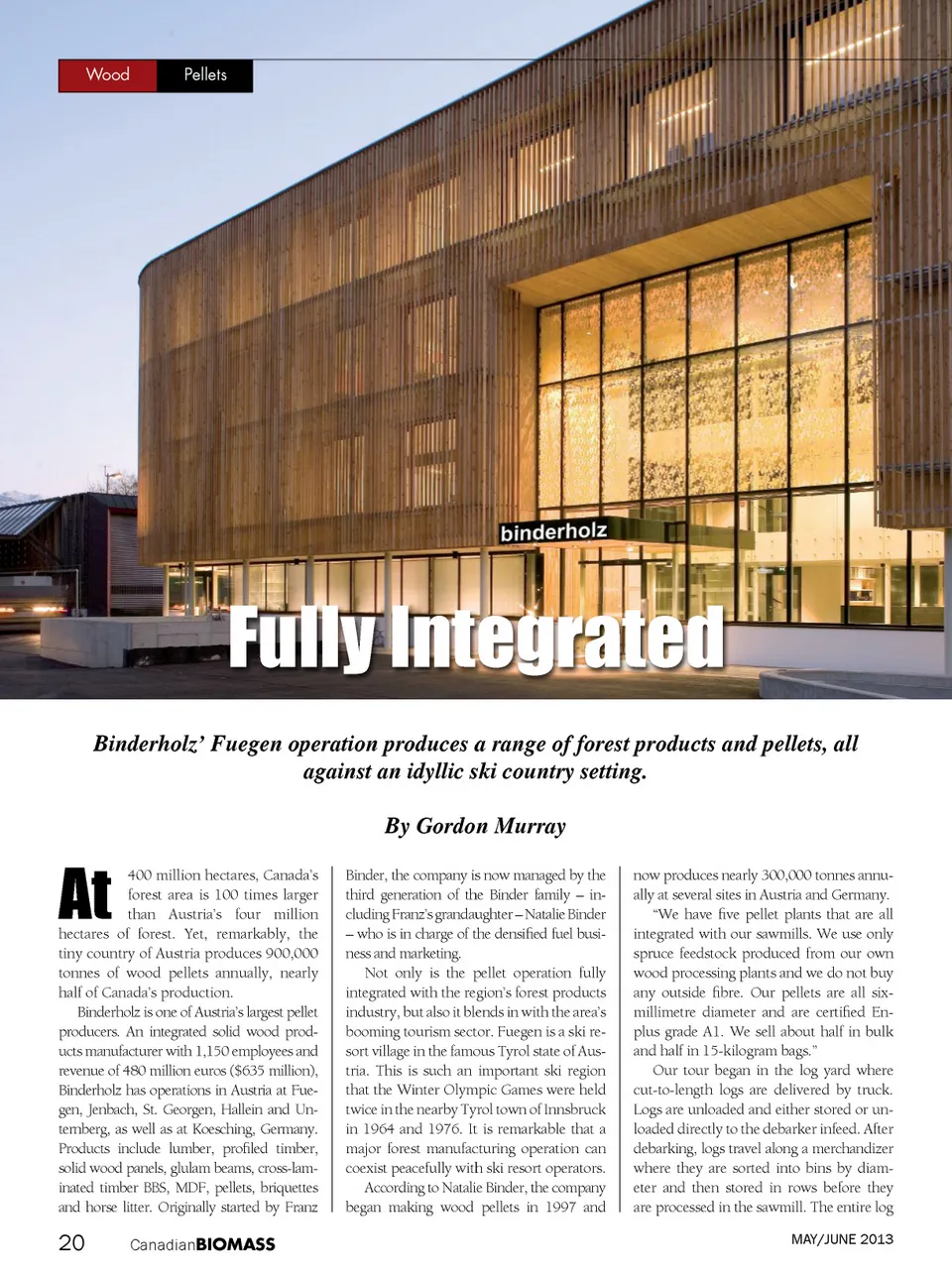
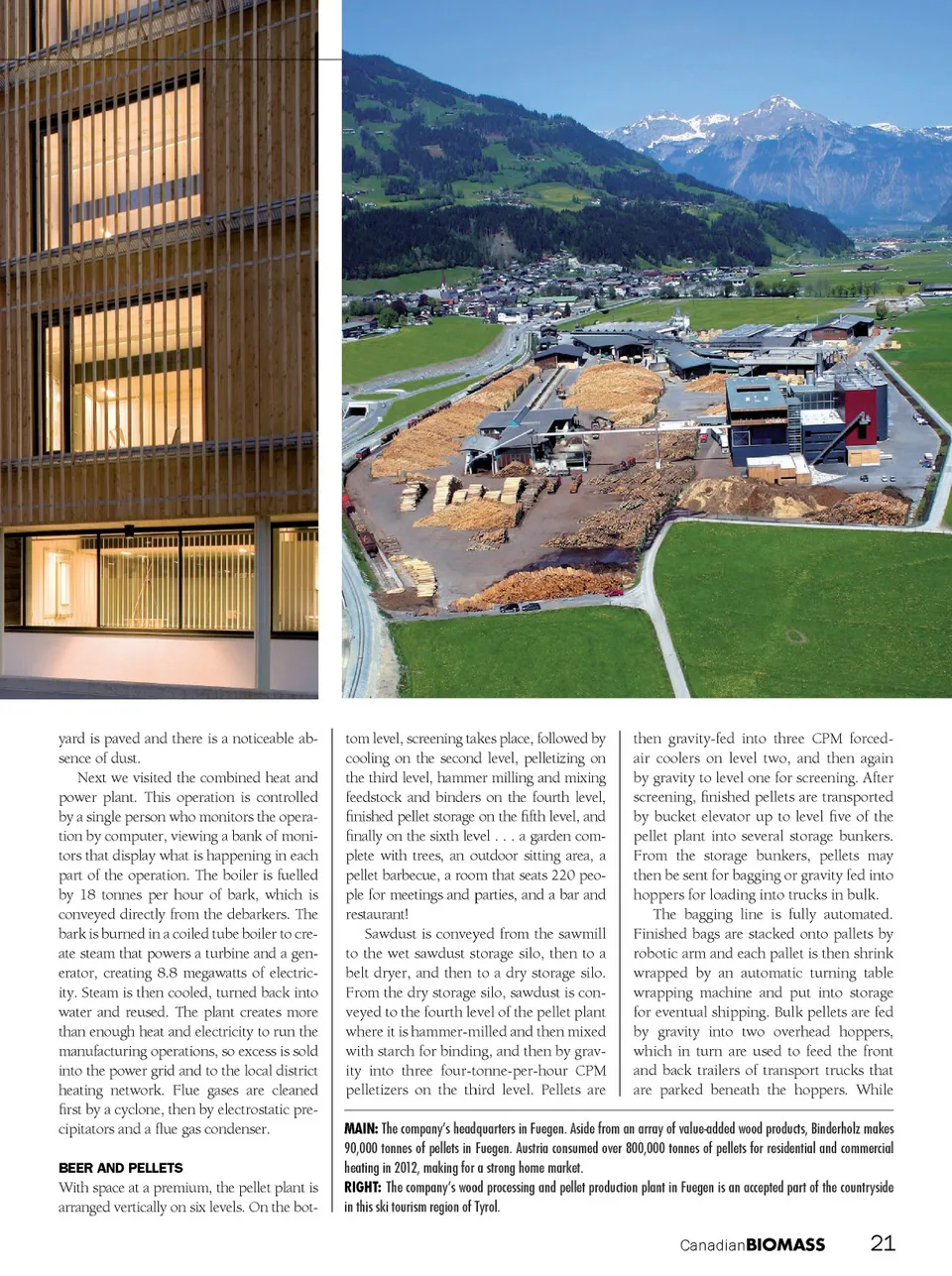
Wood Pellets Fully Integrated Binderholz’ Fuegen operation produces a range of forest products and pellets, all against an idyllic ski country setting. By Gordon Murray 400 million hectares, Canada’s forest area is 100 times larger than Austria’s four million hectares of forest. Yet, remarkably, the tiny country of Austria produces 900,000 tonnes of wood pellets annually, nearly half of Canada’s production. Binderholz is one of Austria’s largest pellet producers. An integrated solid wood prod-ucts manufacturer with 1,150 employees and revenue of 480 million euros ($635 million), Binderholz has operations in Austria at Fue-gen, Jenbach, St. Georgen, Hallein and Un-ternberg, as well as at Koesching, Germany. Products include lumber, profiled timber, solid wood panels, glulam beams, cross-lam-inated timber BBS, MDF, pellets, briquettes and horse litter. Originally started by Franz at Binder, the company is now managed by the third generation of the Binder family – in-cluding Franz’s grandaughter – Natalie Binder – who is in charge of the densified fuel busi-ness and marketing. Not only is the pellet operation fully integrated with the region’s forest products industry, but also it blends in with the area’s booming tourism sector. Fuegen is a ski re-sort village in the famous Tyrol state of Aus-tria. This is such an important ski region that the Winter Olympic Games were held twice in the nearby Tyrol town of Innsbruck in 1964 and 1976. It is remarkable that a major forest manufacturing operation can coexist peacefully with ski resort operators. According to Natalie Binder, the company began making wood pellets in 1997 and now produces nearly 300,000 tonnes annu-ally at several sites in Austria and Germany. “We have five pellet plants that are all integrated with our sawmills. We use only spruce feedstock produced from our own wood processing plants and we do not buy any outside fibre. Our pellets are all six-millimetre diameter and are certified En-plus grade A1. We sell about half in bulk and half in 15-kilogram bags.” Our tour began in the log yard where cut-to-length logs are delivered by truck. Logs are unloaded and either stored or un-loaded directly to the debarker infeed. After debarking, logs travel along a merchandizer where they are sorted into bins by diam-eter and then stored in rows before they are processed in the sawmill. The entire log MAY/JUNE 2013 20 Canadian BIOMASS
Canadian Biomass May/June 2013: Page 20