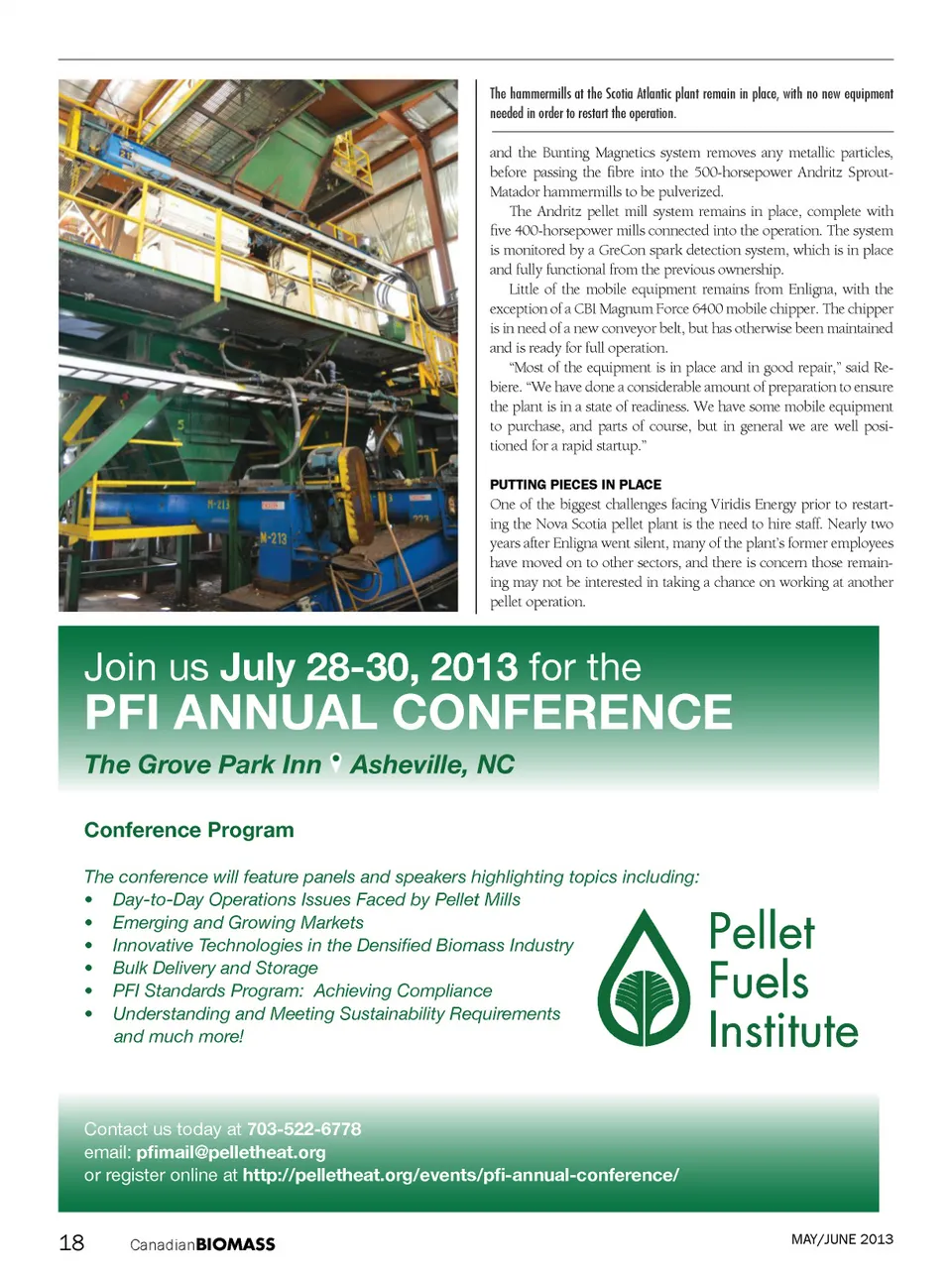
The exterior of the Scotia Atlantic Biomass Plant shows minimal signs of aging, other than a little rust. Yet even with the hiring challenges facing the company, the management team at Viridis Energy is optimistic that the staff they require to create an efficient operation is available to them in the region. “We have spoken to some former em-ployees and we would like to bring as much expertise back to the plant as we can, while balancing that with some new ideas and new faces,” said Rebiere. “We will be hiring a num-ber of millwrights, lead hands, and operators. Our core management team is already in place, so it will be the primary labour posi-tions we hire. Then we will ensure that we have all the right safety training and certifica-tions in place.” Another challenge facing Viridis is the availability of fibre in the region. Many saw-mills in Nova Scotia have shut down since the decline in the U.S. housing market. Also, there are concerns in the province already that fibre supply will continue to decline thanks to recent moves by the Nova Scotia govern-ment to limit the amount of clear-cutting that can take place in the province. But after initial consultations and inquiries made by Viridis with companies that previously supplied the former Enligna facility, they believe that there is enough fibre available to meet their expect-ed annual production of between 100,000 and 110,000 tons per year. “We expect to work with the fibre pro-viders, sawmills and wood lot managers that previously provided the plant with raw mate-rials and any additional sources that are avail-able,” said Rebiere. “Our long-term plan is to expand this plant and it will be highly de-pendent on the availability of large volumes of fibre. We will be looking for government and private wood lots to become actively in-volved. We believe Nova Scotia has the po-tential to become a very significant player in this high-growth sector.” the roAd to euroPe Viridis Energy is also working hard to learn from the difficulties faced by Enligna when dealing with the European market. That includes taking a better look at sales (off-take) agreements, shipping arrangements and the currency being used to complete the transaction. “European offtake agreements must be carefully considered and our aim is to de-risk those contracts as much as possible,” said Rebiere. “For instance, we will only sell in Canadian dollars as to avoid the currency risk. We also intend to sell FOB Halifax, so the five-to 10-year ocean freight risk is with the customer.” Viridis Energy is confident that the chal-lenges remaining will be overcome in time to meet its self-imposed deadline of late June 2013. The company expects that only a short time will be needed before it gets on track to meet its production expectations. If it is able to do so, it will become just the second pellet production facility operational in Nova Sco-tia, and will provide the small town of Middle Musquodoboit with a renewed hope that the pellet industry can once again thrive in their community. • For more on pellets, visit www.canadianbiomassmagazine.ca More Than Just Results Wood Pellets Quality Analysis Biomass Fuels Quality Analysis Consulting Services P: 800 373 -2562 F: 715 392 -7163 www.twinportstesting.com Over 30 years of fuels testing experience. ISO 17025 accredited for both ASTM and CEN/EN standards. ASLC accredited for Pellet Fuels Insti-tute pellet quality testing. Both regional and overseas markets. Canadian BIOMASS 19
Canadian Biomass May/June 2013: Page 19