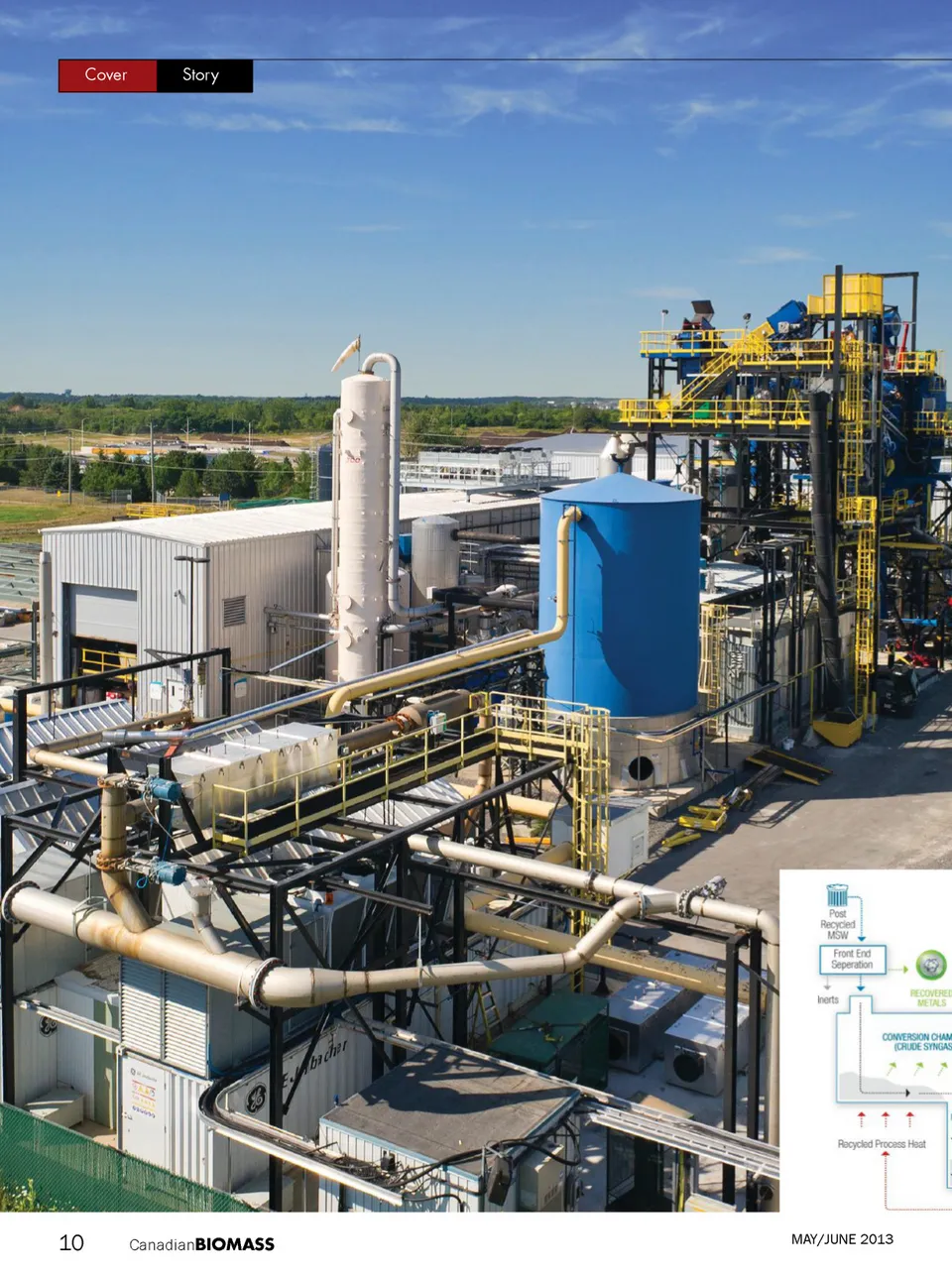
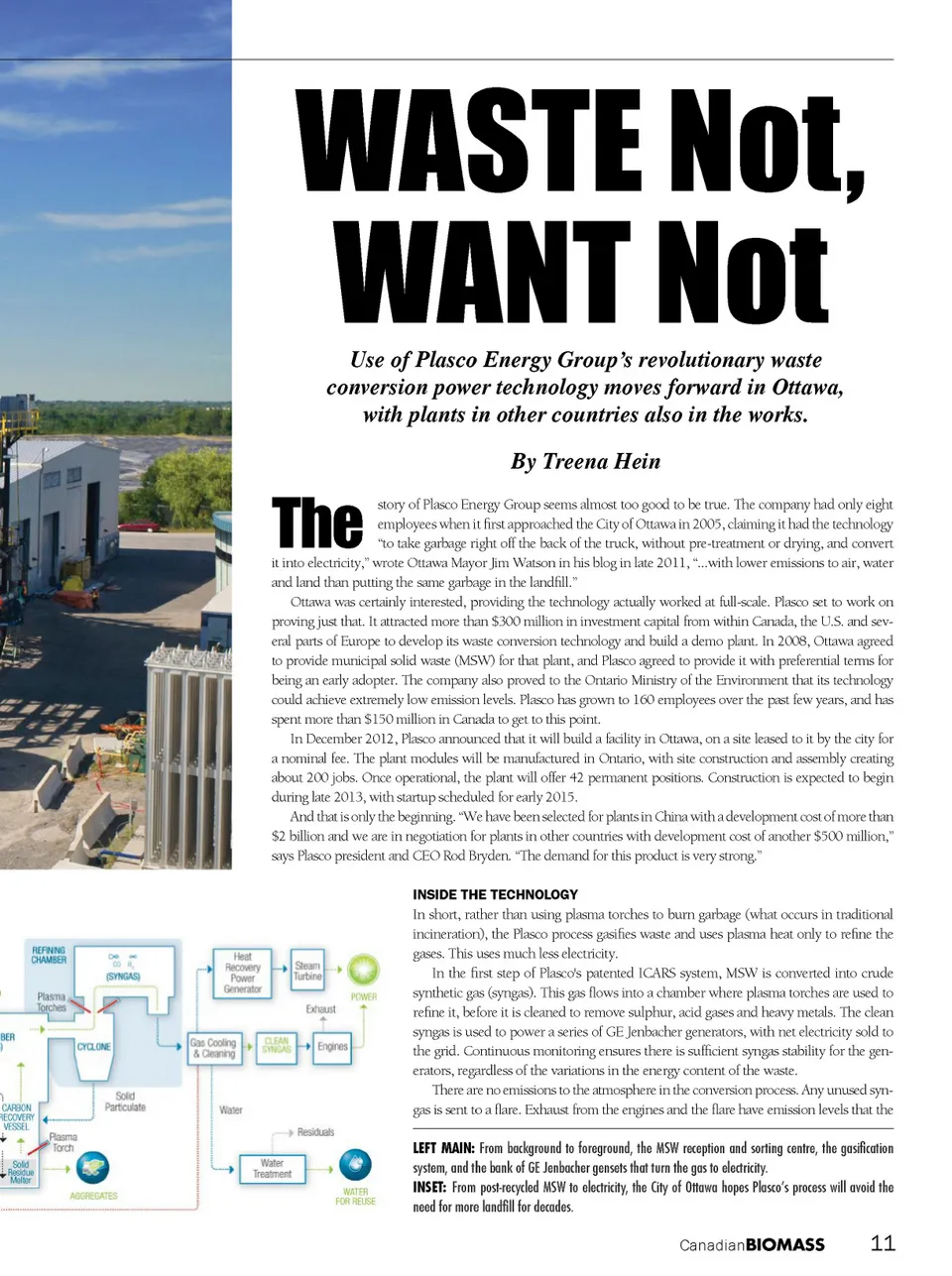
WasTe Not, WaNT Not Use of Plasco Energy Group’s revolutionary waste conversion power technology moves forward in Ottawa, with plants in other countries also in the works. By Treena Hein story of Plasco Energy Group seems almost too good to be true. The company had only eight employees when it first approached the City of Ottawa in 2005, claiming it had the technology “to take garbage right off the back of the truck, without pre-treatment or drying, and convert it into electricity,” wrote Ottawa Mayor Jim Watson in his blog in late 2011, “...with lower emissions to air, water and land than putting the same garbage in the landfill.” Ottawa was certainly interested, providing the technology actually worked at full-scale. Plasco set to work on proving just that. It attracted more than $300 million in investment capital from within Canada, the U.S. and sev-eral parts of Europe to develop its waste conversion technology and build a demo plant. In 2008, Ottawa agreed to provide municipal solid waste (MSW) for that plant, and Plasco agreed to provide it with preferential terms for being an early adopter. The company also proved to the Ontario Ministry of the Environment that its technology could achieve extremely low emission levels. Plasco has grown to 160 employees over the past few years, and has spent more than $150 million in Canada to get to this point. In December 2012, Plasco announced that it will build a facility in Ottawa, on a site leased to it by the city for a nominal fee. The plant modules will be manufactured in Ontario, with site construction and assembly creating about 200 jobs. Once operational, the plant will offer 42 permanent positions. Construction is expected to begin during late 2013, with startup scheduled for early 2015. And that is only the beginning. “We have been selected for plants in China with a development cost of more than $2 billion and we are in negotiation for plants in other countries with development cost of another $500 million,” says Plasco president and CEO Rod Bryden. “The demand for this product is very strong.” InsIde the teChnoloGy In short, rather than using plasma torches to burn garbage (what occurs in traditional incineration), the Plasco process gasifies waste and uses plasma heat only to refine the gases. This uses much less electricity. In the first step of Plasco's patented ICARS system, MSW is converted into crude synthetic gas (syngas). This gas flows into a chamber where plasma torches are used to refine it, before it is cleaned to remove sulphur, acid gases and heavy metals. The clean syngas is used to power a series of GE Jenbacher generators, with net electricity sold to the grid. Continuous monitoring ensures there is sufficient syngas stability for the gen-erators, regardless of the variations in the energy content of the waste. There are no emissions to the atmosphere in the conversion process. Any unused syn-gas is sent to a flare. Exhaust from the engines and the flare have emission levels that the LEFT MAIN: From background to foreground, the MSW reception and sorting centre, the gasification system, and the bank of GE Jenbacher gensets that turn the gas to electricity. INSET: From post-recycled MSW to electricity, the City of Ottawa hopes Plasco’s process will avoid the need for more landfill for decades. The Canadian BIOMASS 11
Canadian Biomass May/June 2013: Page 11