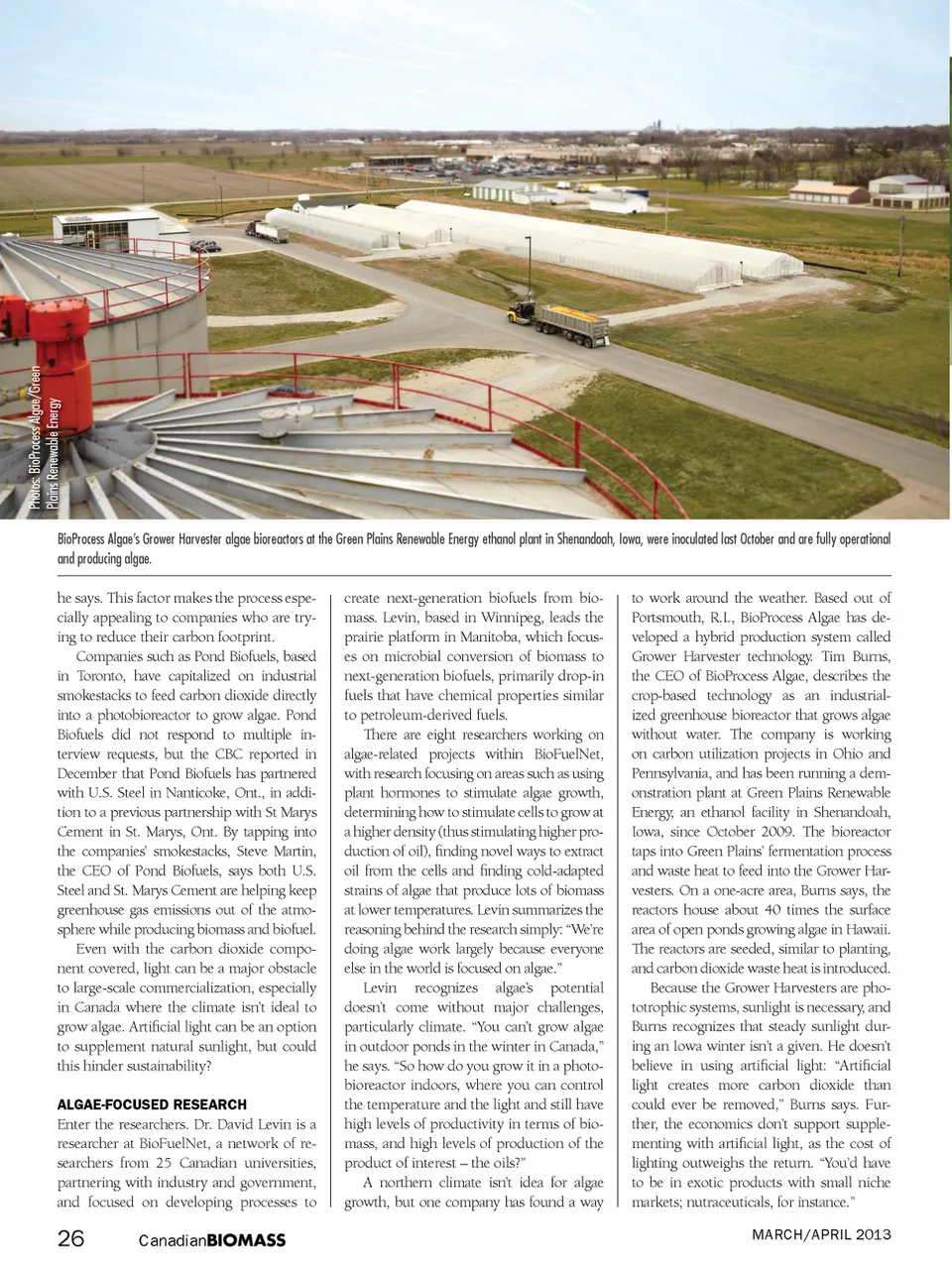
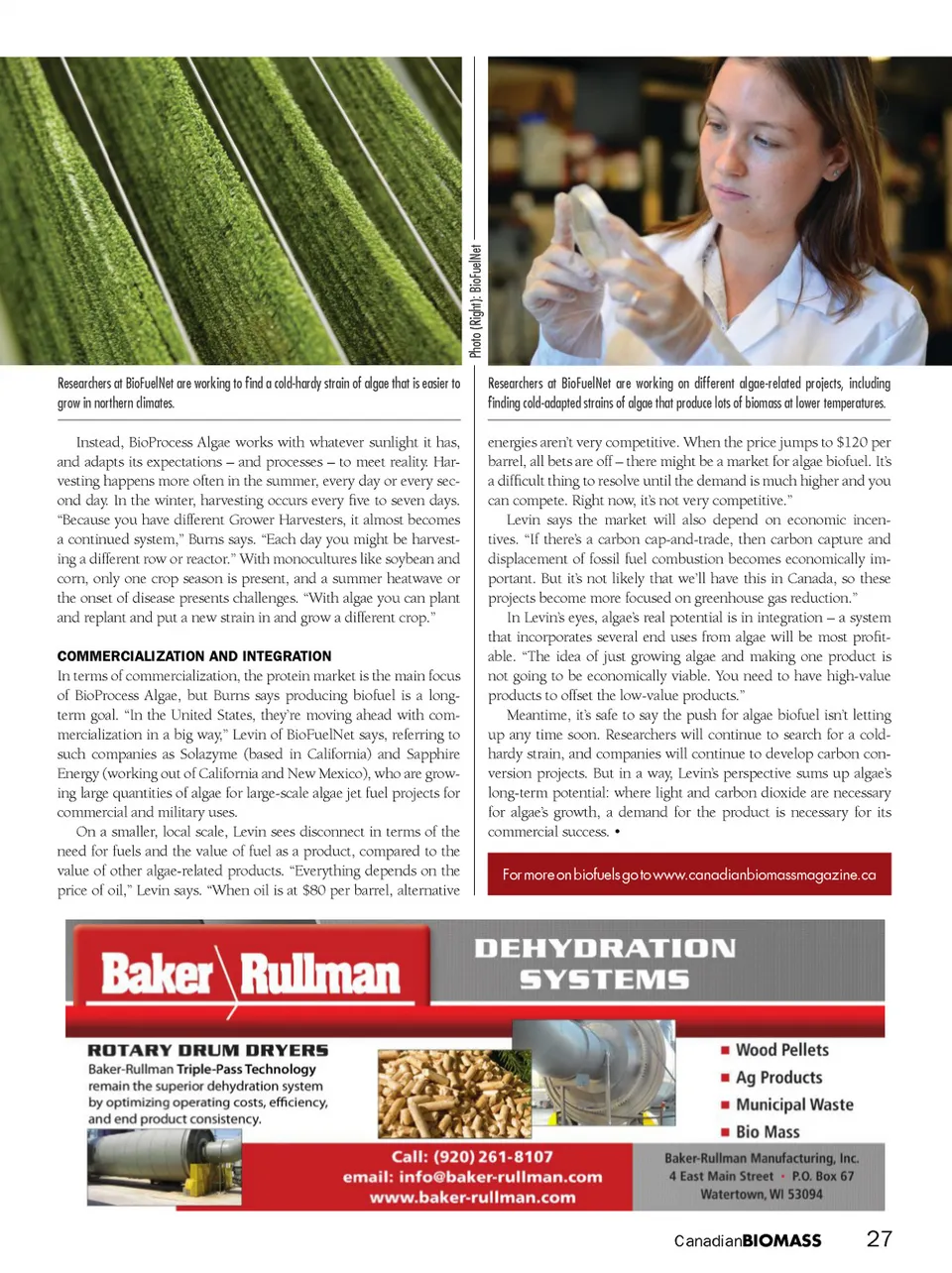
Researchers at BioFuelNet are working to find a cold-hardy strain of algae that is easier to grow in northern climates. Photo (Right): BioFuelNet Researchers at BioFuelNet are working on different algae-related projects, including finding cold-adapted strains of algae that produce lots of biomass at lower temperatures. Instead, BioProcess Algae works with whatever sunlight it has, and adapts its expectations – and processes – to meet reality. Har-vesting happens more often in the summer, every day or every sec-ond day. In the winter, harvesting occurs every five to seven days. “Because you have different Grower Harvesters, it almost becomes a continued system,” Burns says. “Each day you might be harvest-ing a different row or reactor.” With monocultures like soybean and corn, only one crop season is present, and a summer heatwave or the onset of disease presents challenges. “With algae you can plant and replant and put a new strain in and grow a different crop.” COMMERCIALIzATION ANd INTEGRATION In terms of commercialization, the protein market is the main focus of BioProcess Algae, but Burns says producing biofuel is a long-term goal. “In the United States, they’re moving ahead with com-mercialization in a big way,” Levin of BioFuelNet says, referring to such companies as Solazyme (based in California) and Sapphire Energy (working out of California and New Mexico), who are grow-ing large quantities of algae for large-scale algae jet fuel projects for commercial and military uses. On a smaller, local scale, Levin sees disconnect in terms of the need for fuels and the value of fuel as a product, compared to the value of other algae-related products. “Everything depends on the price of oil,” Levin says. “When oil is at $80 per barrel, alternative energies aren’t very competitive. When the price jumps to $120 per barrel, all bets are off – there might be a market for algae biofuel. It’s a difficult thing to resolve until the demand is much higher and you can compete. Right now, it’s not very competitive.” Levin says the market will also depend on economic incen-tives. “If there’s a carbon cap-and-trade, then carbon capture and displacement of fossil fuel combustion becomes economically im-portant. But it’s not likely that we’ll have this in Canada, so these projects become more focused on greenhouse gas reduction.” In Levin’s eyes, algae’s real potential is in integration – a system that incorporates several end uses from algae will be most profit-able. “The idea of just growing algae and making one product is not going to be economically viable. You need to have high-value products to offset the low-value products.” Meantime, it’s safe to say the push for algae biofuel isn’t letting up any time soon. Researchers will continue to search for a cold-hardy strain, and companies will continue to develop carbon con-version projects. But in a way, Levin’s perspective sums up algae’s long-term potential: where light and carbon dioxide are necessary for algae’s growth, a demand for the product is necessary for its commercial success. • For more on biofuels go to www.canadianbiomassmagazine.ca Canadian BIOMASS 27
Canadian Biomass March/April 2013: Page 27