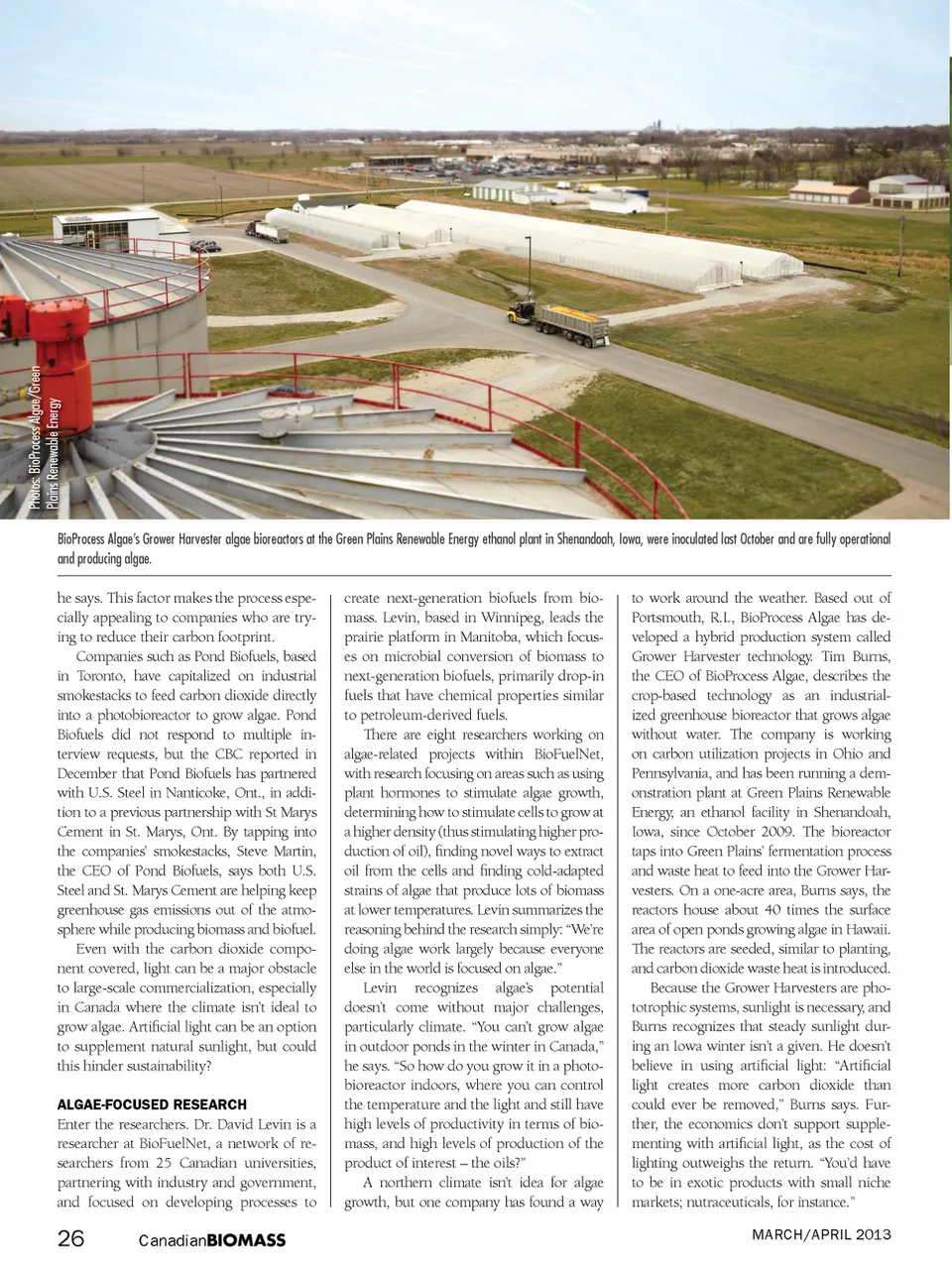
Photos: BioProcess Algae/Green Plains Renewable Energy BioProcess Algae’s Grower Harvester algae bioreactors at the Green Plains Renewable Energy ethanol plant in Shenandoah, Iowa, were inoculated last October and are fully operational and producing algae. he says. This factor makes the process espe-cially appealing to companies who are try-ing to reduce their carbon footprint. Companies such as Pond Biofuels, based in Toronto, have capitalized on industrial smokestacks to feed carbon dioxide directly into a photobioreactor to grow algae. Pond Biofuels did not respond to multiple in-terview requests, but the CBC reported in December that Pond Biofuels has partnered with U.S. Steel in Nanticoke, Ont., in addi-tion to a previous partnership with St Marys Cement in St. Marys, Ont. By tapping into the companies’ smokestacks, Steve Martin, the CEO of Pond Biofuels, says both U.S. Steel and St. Marys Cement are helping keep greenhouse gas emissions out of the atmo-sphere while producing biomass and biofuel. Even with the carbon dioxide compo-nent covered, light can be a major obstacle to large-scale commercialization, especially in Canada where the climate isn’t ideal to grow algae. Artificial light can be an option to supplement natural sunlight, but could this hinder sustainability? ALGAE-FOCUSEd RESEARCH Enter the researchers. Dr. David Levin is a researcher at BioFuelNet, a network of re-searchers from 25 Canadian universities, partnering with industry and government, and focused on developing processes to create next-generation biofuels from bio-mass. Levin, based in Winnipeg, leads the prairie platform in Manitoba, which focus-es on microbial conversion of biomass to next-generation biofuels, primarily drop-in fuels that have chemical properties similar to petroleum-derived fuels. There are eight researchers working on algae-related projects within BioFuelNet, with research focusing on areas such as using plant hormones to stimulate algae growth, determining how to stimulate cells to grow at a higher density (thus stimulating higher pro-duction of oil), finding novel ways to extract oil from the cells and finding cold-adapted strains of algae that produce lots of biomass at lower temperatures. Levin summarizes the reasoning behind the research simply: “We’re doing algae work largely because everyone else in the world is focused on algae.” Levin recognizes algae’s potential doesn’t come without major challenges, particularly climate. “You can’t grow algae in outdoor ponds in the winter in Canada,” he says. “So how do you grow it in a photo-bioreactor indoors, where you can control the temperature and the light and still have high levels of productivity in terms of bio-mass, and high levels of production of the product of interest – the oils?” A northern climate isn’t idea for algae growth, but one company has found a way to work around the weather. Based out of Portsmouth, R.I., BioProcess Algae has de-veloped a hybrid production system called Grower Harvester technology. Tim Burns, the CEO of BioProcess Algae, describes the crop-based technology as an industrial-ized greenhouse bioreactor that grows algae without water. The company is working on carbon utilization projects in Ohio and Pennsylvania, and has been running a dem-onstration plant at Green Plains Renewable Energy, an ethanol facility in Shenandoah, Iowa, since October 2009. The bioreactor taps into Green Plains’ fermentation process and waste heat to feed into the Grower Har-vesters. On a one-acre area, Burns says, the reactors house about 40 times the surface area of open ponds growing algae in Hawaii. The reactors are seeded, similar to planting, and carbon dioxide waste heat is introduced. Because the Grower Harvesters are pho-totrophic systems, sunlight is necessary, and Burns recognizes that steady sunlight dur-ing an Iowa winter isn’t a given. He doesn’t believe in using artificial light: “Artificial light creates more carbon dioxide than could ever be removed,” Burns says. Fur-ther, the economics don’t support supple-menting with artificial light, as the cost of lighting outweighs the return. “You’d have to be in exotic products with small niche markets; nutraceuticals, for instance.” MarCh/april 2013 26 Canadian BIOMASS
Canadian Biomass March/April 2013: Page 26