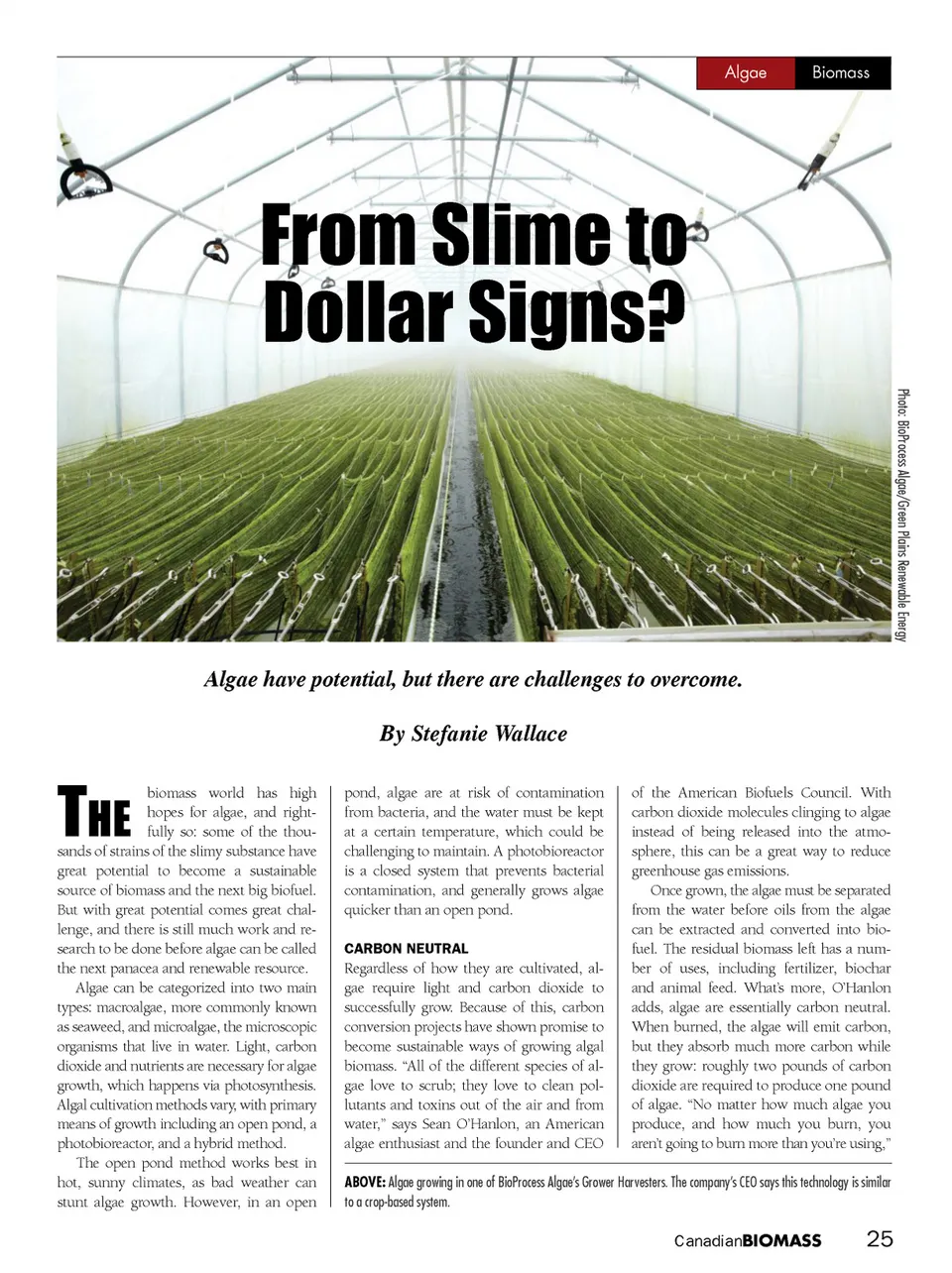
Algae Biomass From Slime to Dollar Signs? Photo: BioProcess Algae/Green Plains Renewable Energy Algae have potential, but there are challenges to overcome. By Stefanie Wallace biomass world has high hopes for algae, and right-fully so: some of the thou-sands of strains of the slimy substance have great potential to become a sustainable source of biomass and the next big biofuel. But with great potential comes great chal-lenge, and there is still much work and re-search to be done before algae can be called the next panacea and renewable resource. Algae can be categorized into two main types: macroalgae, more commonly known as seaweed, and microalgae, the microscopic organisms that live in water. Light, carbon dioxide and nutrients are necessary for algae growth, which happens via photosynthesis. Algal cultivation methods vary, with primary means of growth including an open pond, a photobioreactor, and a hybrid method. The open pond method works best in hot, sunny climates, as bad weather can stunt algae growth. However, in an open T he pond, algae are at risk of contamination from bacteria, and the water must be kept at a certain temperature, which could be challenging to maintain. A photobioreactor is a closed system that prevents bacterial contamination, and generally grows algae quicker than an open pond. CARBON NEUTRAL Regardless of how they are cultivated, al-gae require light and carbon dioxide to successfully grow. Because of this, carbon conversion projects have shown promise to become sustainable ways of growing algal biomass. “All of the different species of al-gae love to scrub; they love to clean pol-lutants and toxins out of the air and from water,” says Sean O’Hanlon, an American algae enthusiast and the founder and CEO of the American Biofuels Council. With carbon dioxide molecules clinging to algae instead of being released into the atmo-sphere, this can be a great way to reduce greenhouse gas emissions. Once grown, the algae must be separated from the water before oils from the algae can be extracted and converted into bio-fuel. The residual biomass left has a num-ber of uses, including fertilizer, biochar and animal feed. What’s more, O’Hanlon adds, algae are essentially carbon neutral. When burned, the algae will emit carbon, but they absorb much more carbon while they grow: roughly two pounds of carbon dioxide are required to produce one pound of algae. “No matter how much algae you produce, and how much you burn, you aren’t going to burn more than you’re using,” ABOVE: Algae growing in one of BioProcess Algae’s Grower Harvesters. The company’s CEO says this technology is similar to a crop-based system. Canadian BIOMASS 25
Canadian Biomass March/April 2013: Page 25