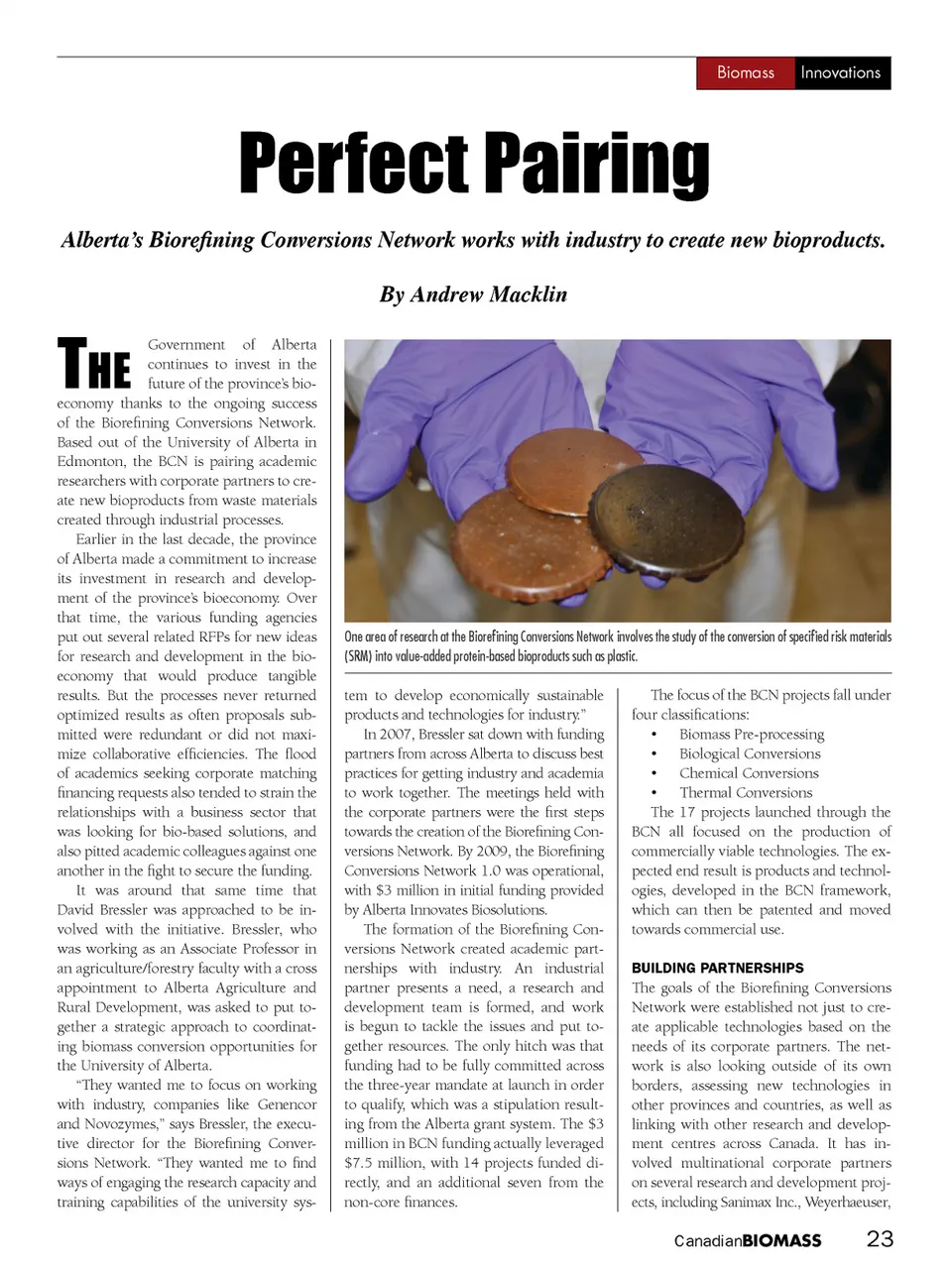
Biomass Innovations Perfect Pairing Alberta’s Biorefining Conversions Network works with industry to create new bioproducts. By Andrew Macklin T he Government of Alberta continues to invest in the future of the province’s bio-economy thanks to the ongoing success of the Biorefining Conversions Network. Based out of the University of Alberta in Edmonton, the BCN is pairing academic researchers with corporate partners to cre-ate new bioproducts from waste materials created through industrial processes. Earlier in the last decade, the province of Alberta made a commitment to increase its investment in research and develop-ment of the province’s bioeconomy. Over that time, the various funding agencies put out several related RFPs for new ideas for research and development in the bio-economy that would produce tangible results. But the processes never returned optimized results as often proposals sub-mitted were redundant or did not maxi-mize collaborative efficiencies. The flood of academics seeking corporate matching financing requests also tended to strain the relationships with a business sector that was looking for bio-based solutions, and also pitted academic colleagues against one another in the fight to secure the funding. It was around that same time that David Bressler was approached to be in-volved with the initiative. Bressler, who was working as an Associate Professor in an agriculture/forestry faculty with a cross appointment to Alberta Agriculture and Rural Development, was asked to put to-gether a strategic approach to coordinat-ing biomass conversion opportunities for the University of Alberta. “They wanted me to focus on working with industry, companies like Genencor and Novozymes,” says Bressler, the execu-tive director for the Biorefining Conver-sions Network. “They wanted me to find ways of engaging the research capacity and training capabilities of the university sys-One area of research at the Biorefining Conversions Network involves the study of the conversion of specified risk materials (SRM) into value-added protein-based bioproducts such as plastic. tem to develop economically sustainable products and technologies for industry.” In 2007, Bressler sat down with funding partners from across Alberta to discuss best practices for getting industry and academia to work together. The meetings held with the corporate partners were the first steps towards the creation of the Biorefining Con-versions Network. By 2009, the Biorefining Conversions Network 1.0 was operational, with $3 million in initial funding provided by Alberta Innovates Biosolutions. The formation of the Biorefining Con-versions Network created academic part-nerships with industry. An industrial partner presents a need, a research and development team is formed, and work is begun to tackle the issues and put to-gether resources. The only hitch was that funding had to be fully committed across the three-year mandate at launch in order to qualify, which was a stipulation result-ing from the Alberta grant system. The $3 million in BCN funding actually leveraged $7.5 million, with 14 projects funded di-rectly, and an additional seven from the non-core finances. The focus of the BCN projects fall under four classifications: • Biomass Pre-processing • Biological Conversions • Chemical Conversions • Thermal Conversions The 17 projects launched through the BCN all focused on the production of commercially viable technologies. The ex-pected end result is products and technol-ogies, developed in the BCN framework, which can then be patented and moved towards commercial use. BUILdING PARTNERSHIPS The goals of the Biorefining Conversions Network were established not just to cre-ate applicable technologies based on the needs of its corporate partners. The net-work is also looking outside of its own borders, assessing new technologies in other provinces and countries, as well as linking with other research and develop-ment centres across Canada. It has in-volved multinational corporate partners on several research and development proj-ects, including Sanimax Inc., Weyerhaeuser, Canadian BIOMASS 23
Canadian Biomass March/April 2013: Page 23