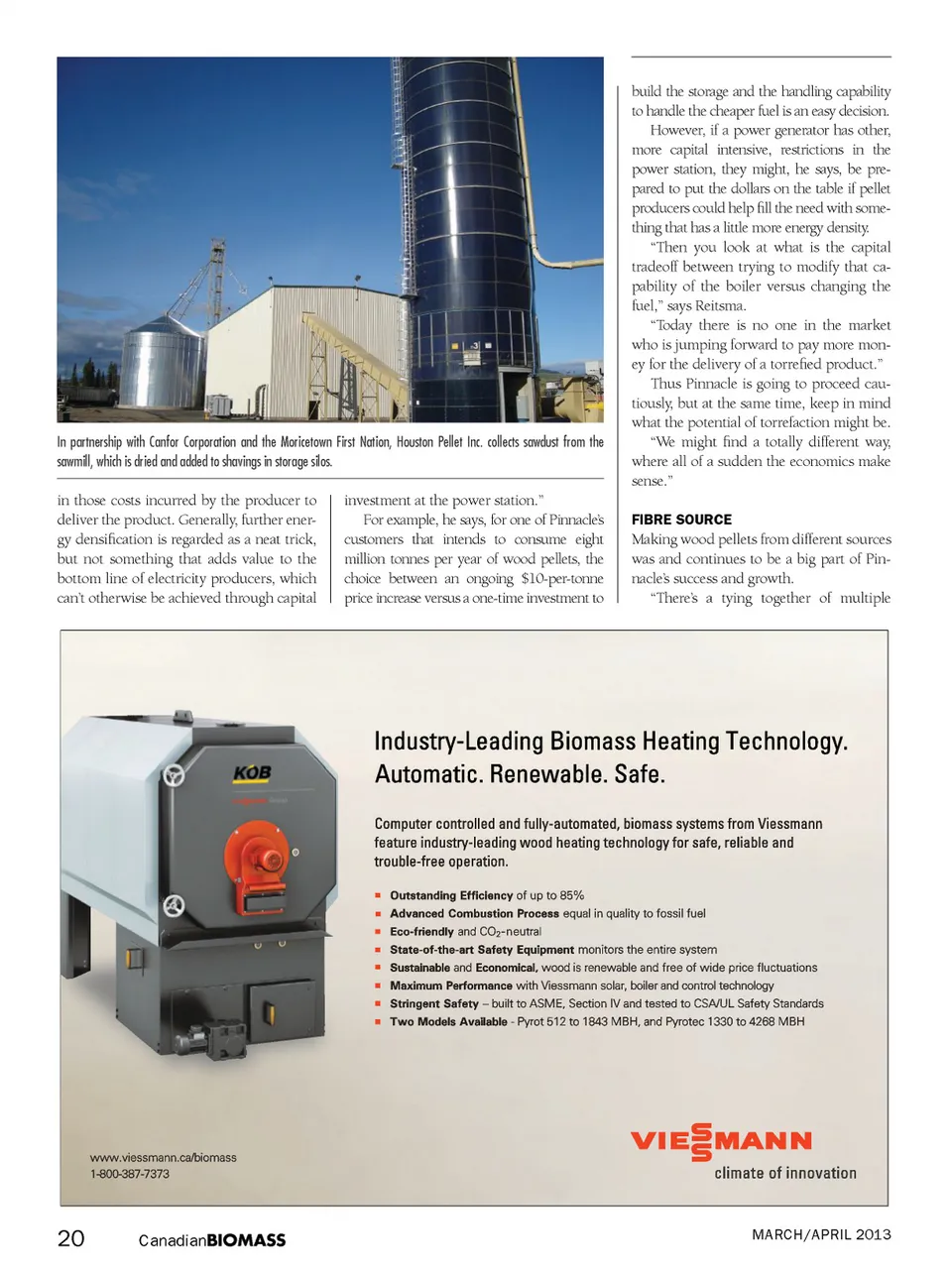
factors in any growth story and for us I think the biggest part of our story is that we were able to develop a process whereby we could handle a full spectrum of wood,” says Reitsma. “We had to evolve first into being able to dry sawdust and make a good pellet out of that and then we learned how to handle bark and treetops and various other things. “Then, as a result of the sawmill indus-try downturn in 2009, we had plant capac-ity in excess of the fibre supply. As a result, we went about trying to diversify our ability to process material, while still making sure that we produced a high-quality product.” Alongside of a rebalancing of capacity in the sawmill sector reside the implications of the mountain pine beetle, which has pre-sented both another challenge and another opportunity for Pinnacle to diversify and grow, says Reitsma. “In any growth strategy, you need an ex-panding market and an ability to acquire both the raw materials and the logistical tools to meet the markets price demands. In British Columbia we’re quite fortunate to have the makings of the required combination.” Pinnacle’s Meadowbrook plant’s production process features six Andritz Sprout pelletizers that process the wood fibre into quarter-inch pellets. CERTIFIEd PROdUCT When it comes to product certification, Pin-nacle has been and continues to be at the forefront in meeting the sustainability re-quirements of the European export market. “Pinnacle’s recent contribution has been to take the standards and then find a way to make a wood pellet out of the full spec-trum of wood that would comply with the standard. This builds on the work that was done in the early 2000s by the Swaan brothers, including John (who later took KAHL Wood Pelleting Plants Quality worldwide. AMANDUS KAHL GmbH & Co. KG, SARJ Equipment Corp., Mr. Rick B. MacArthur, 29 Golfview Blvd., Bradford, Ontario L3Z 2A6 Phone: 001-905-778-0073, Fax: 001-905-778-9613, [email protected] www.akahl.de Canadian BIOMASS 21
Canadian Biomass March/April 2013: Page 21