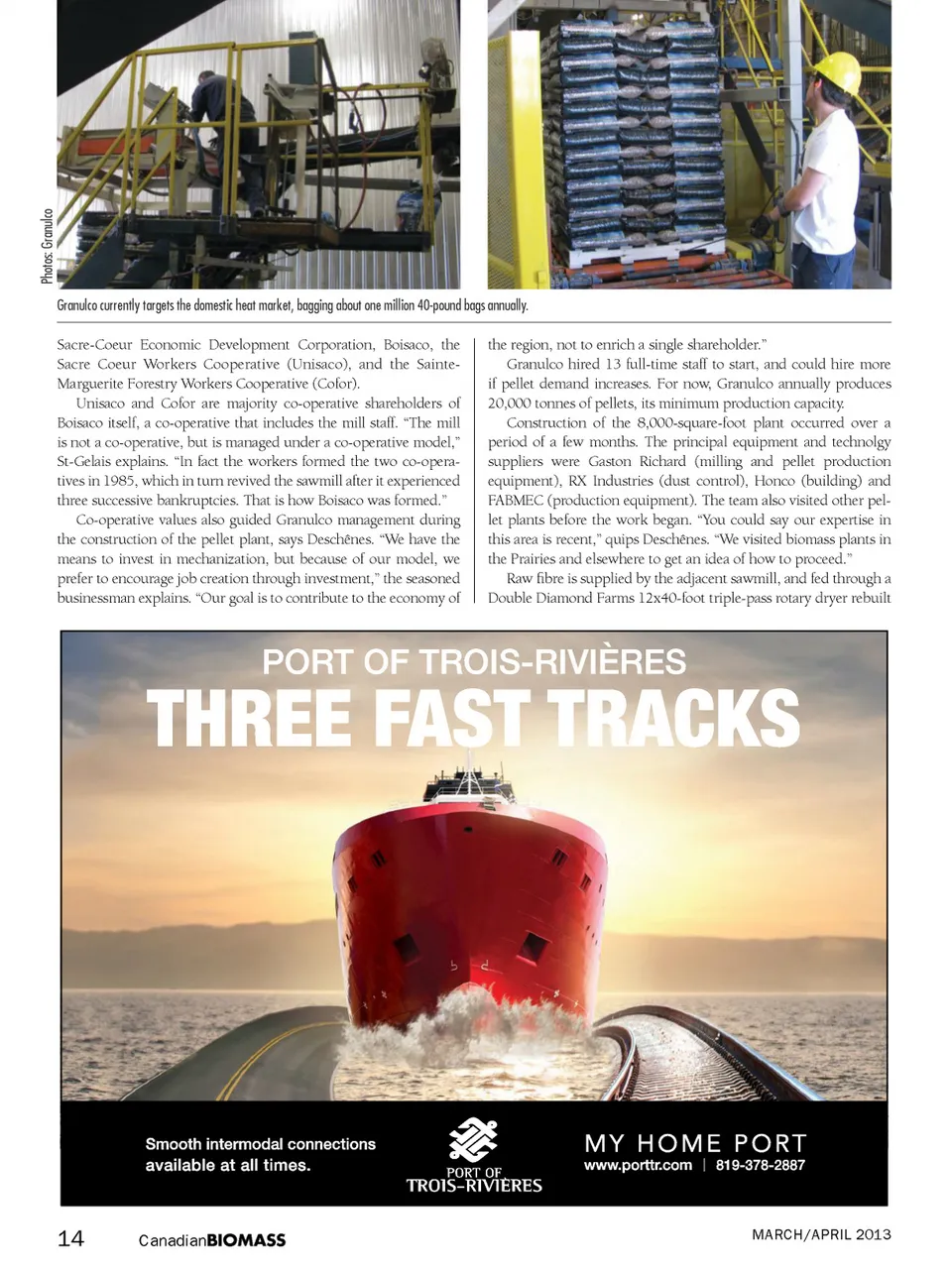
Photos: Granulco Granulco currently targets the domestic heat market, bagging about one million 40-pound bags annually. Sacre-Coeur Economic Development Corporation, Boisaco, the Sacre Coeur Workers Cooperative (Unisaco), and the Sainte-Marguerite Forestry Workers Cooperative (Cofor). Unisaco and Cofor are majority co-operative shareholders of Boisaco itself, a co-operative that includes the mill staff. “The mill is not a co-operative, but is managed under a co-operative model,” St-Gelais explains. “In fact the workers formed the two co-opera-tives in 1985, which in turn revived the sawmill after it experienced three successive bankruptcies. That is how Boisaco was formed.” Co-operative values also guided Granulco management during the construction of the pellet plant, says Deschênes. “We have the means to invest in mechanization, but because of our model, we prefer to encourage job creation through investment,” the seasoned businessman explains. “Our goal is to contribute to the economy of the region, not to enrich a single shareholder.” Granulco hired 13 full-time staff to start, and could hire more if pellet demand increases. For now, Granulco annually produces 20,000 tonnes of pellets, its minimum production capacity. Construction of the 8,000-square-foot plant occurred over a period of a few months. The principal equipment and technolgy suppliers were Gaston Richard (milling and pellet production equipment), RX Industries (dust control), Honco (building) and FABMEC (production equipment). The team also visited other pel-let plants before the work began. “You could say our expertise in this area is recent,” quips Deschênes. “We visited biomass plants in the Prairies and elsewhere to get an idea of how to proceed.” Raw fibre is supplied by the adjacent sawmill, and fed through a Double Diamond Farms 12x40-foot triple-pass rotary dryer rebuilt 14 Canadian BIOMASS MarCh/april 2013
Canadian Biomass March/April 2013: Page 14