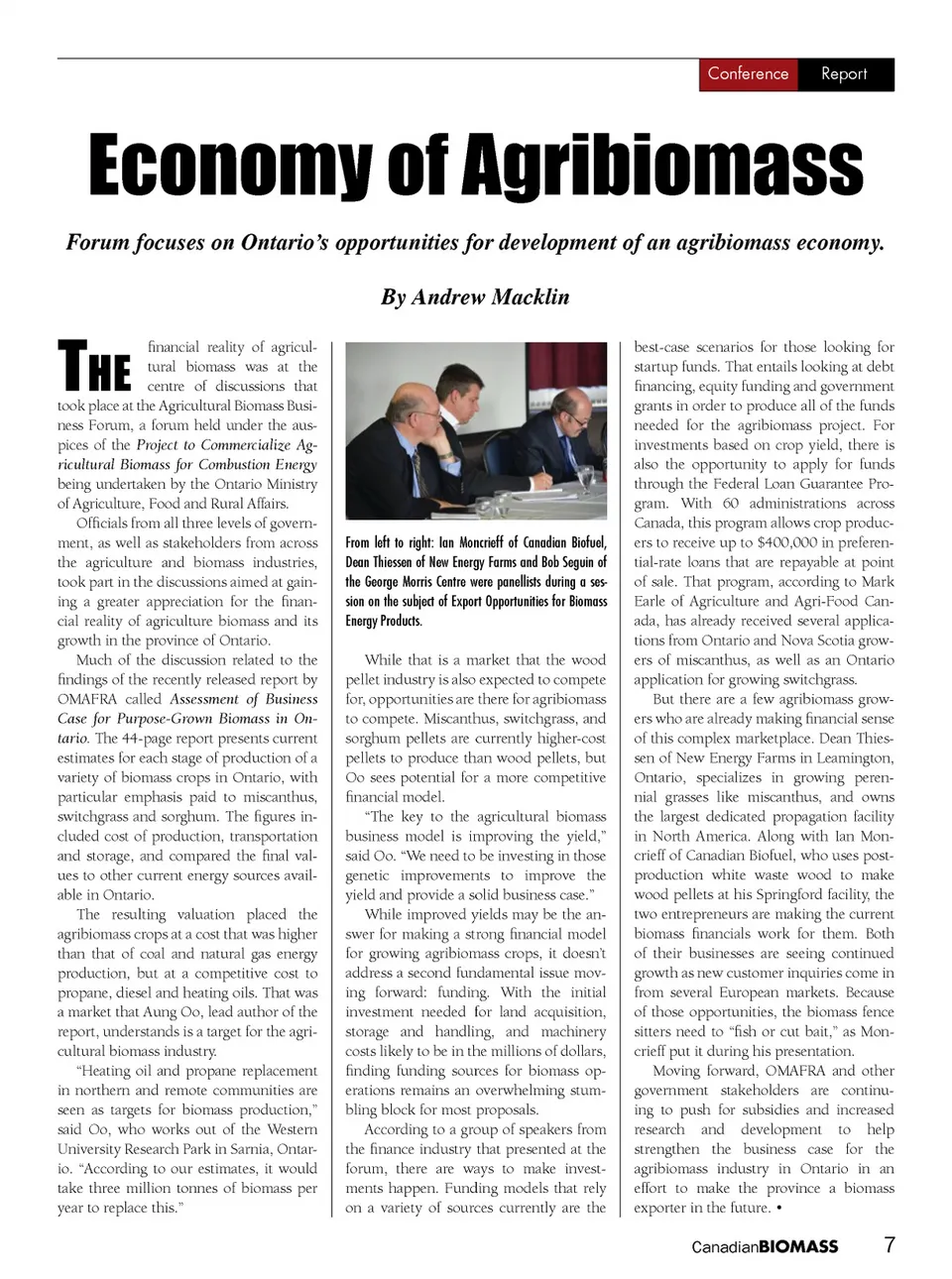
Conference Report Economy of Agribiomass Forum focuses on Ontario’s opportunities for development of an agribiomass economy. By Andrew Macklin financial reality of agricul-tural biomass was at the centre of discussions that took place at the Agricultural Biomass Busi-ness Forum, a forum held under the aus-pices of the Project to Commercialize Ag-ricultural Biomass for Combustion Energy being undertaken by the Ontario Ministry of Agriculture, Food and Rural Affairs. Officials from all three levels of govern-ment, as well as stakeholders from across the agriculture and biomass industries, took part in the discussions aimed at gain-ing a greater appreciation for the finan-cial reality of agriculture biomass and its growth in the province of Ontario. Much of the discussion related to the findings of the recently released report by OMAFRA called Assessment of Business Case for Purpose-Grown Biomass in On-tario. The 44-page report presents current estimates for each stage of production of a variety of biomass crops in Ontario, with particular emphasis paid to miscanthus, switchgrass and sorghum. The figures in-cluded cost of production, transportation and storage, and compared the final val-ues to other current energy sources avail-able in Ontario. The resulting valuation placed the agribiomass crops at a cost that was higher than that of coal and natural gas energy production, but at a competitive cost to propane, diesel and heating oils. That was a market that Aung Oo, lead author of the report, understands is a target for the agri-cultural biomass industry. “Heating oil and propane replacement in northern and remote communities are seen as targets for biomass production,” said Oo, who works out of the Western University Research Park in Sarnia, Ontar-io. “According to our estimates, it would take three million tonnes of biomass per year to replace this.” T he From left to right: Ian Moncrieff of Canadian Biofuel, Dean Thiessen of New Energy Farms and Bob Seguin of the George Morris Centre were panellists during a ses-sion on the subject of Export Opportunities for Biomass Energy Products. While that is a market that the wood pellet industry is also expected to compete for, opportunities are there for agribiomass to compete. Miscanthus, switchgrass, and sorghum pellets are currently higher-cost pellets to produce than wood pellets, but Oo sees potential for a more competitive financial model. “The key to the agricultural biomass business model is improving the yield,” said Oo. “We need to be investing in those genetic improvements to improve the yield and provide a solid business case.” While improved yields may be the an-swer for making a strong financial model for growing agribiomass crops, it doesn’t address a second fundamental issue mov-ing forward: funding. With the initial investment needed for land acquisition, storage and handling, and machinery costs likely to be in the millions of dollars, finding funding sources for biomass op-erations remains an overwhelming stum-bling block for most proposals. According to a group of speakers from the finance industry that presented at the forum, there are ways to make invest-ments happen. Funding models that rely on a variety of sources currently are the best-case scenarios for those looking for startup funds. That entails looking at debt financing, equity funding and government grants in order to produce all of the funds needed for the agribiomass project. For investments based on crop yield, there is also the opportunity to apply for funds through the Federal Loan Guarantee Pro-gram. With 60 administrations across Canada, this program allows crop produc-ers to receive up to $400,000 in preferen-tial-rate loans that are repayable at point of sale. That program, according to Mark Earle of Agriculture and Agri-Food Can-ada, has already received several applica-tions from Ontario and Nova Scotia grow-ers of miscanthus, as well as an Ontario application for growing switchgrass. But there are a few agribiomass grow-ers who are already making financial sense of this complex marketplace. Dean Thies-sen of New Energy Farms in Leamington, Ontario, specializes in growing peren-nial grasses like miscanthus, and owns the largest dedicated propagation facility in North America. Along with Ian Mon-crieff of Canadian Biofuel, who uses post-production white waste wood to make wood pellets at his Springford facility, the two entrepreneurs are making the current biomass financials work for them. Both of their businesses are seeing continued growth as new customer inquiries come in from several European markets. Because of those opportunities, the biomass fence sitters need to “fish or cut bait,” as Mon-crieff put it during his presentation. Moving forward, OMAFRA and other government stakeholders are continu-ing to push for subsidies and increased research and development to help strengthen the business case for the agribiomass industry in Ontario in an effort to make the province a biomass exporter in the future. • Canadian BIOMASS 7
Canadian Biomass January/February 2013: Page 7