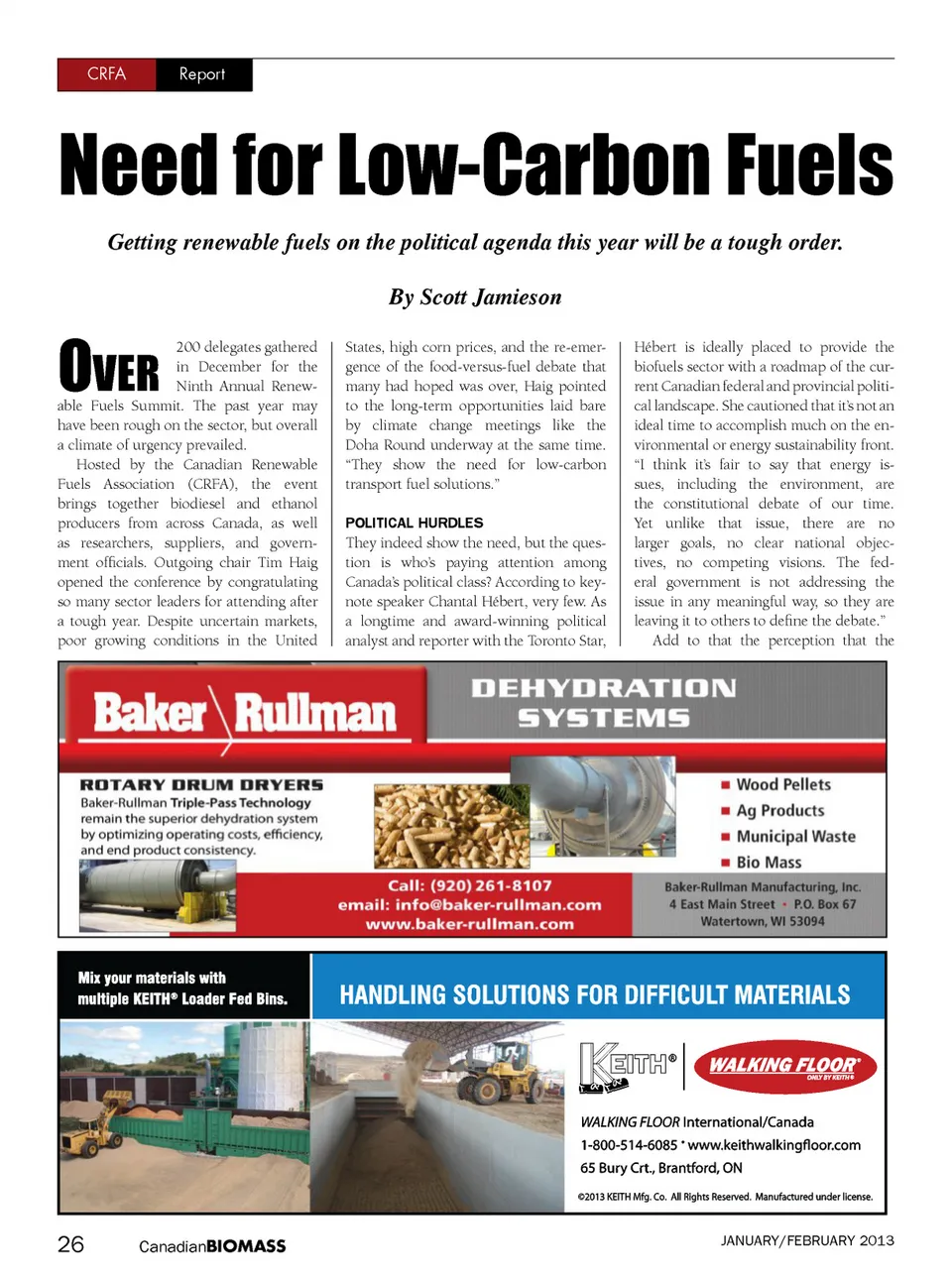
Harper government is seen as a simple agent of the oil sec-tor, and governments in Ontario and Que-bec that lack the clear mandate or fiscal flex-ibility to pursue ambi-tious energy reforms, and Hébert sees tough times ahead for interest groups trying to push renewable or alterna-tive energy solutions. “It will be tough to gain a voice in such Chantal Hébert opened up the 2012 summit. “I think it’s fair to say that energy issues, including a fractured political environment. The re-the environment, are the constitutional debate of newable fuel sector our time.” is not alone on that front, but it’s always wise to invest as much time with the oppo-sition parties as the government, and in the current times that’s even more the case,” she suggested. That political stalemate is all the more troubling given the message of luncheon keynote speaker Dr. Mark Jaccard of Si-mon Fraser University. He noted that the goal of limiting global temperature increases to 2°C or less is past; today we are looking more at limiting that increase to 4 or 6°C. Even still, that will re-quire a much more aggressive commitment to reduce fossil fuel use than is currently the case today. “If groups like this (CRFA) are waiting for high oil prices from scarcity of supply to drive the agenda of renewable fuels, it won’t happen. We need to reach peak emissions long before peak oil. Our problem is that with all the new supply options, there is too much fossil fuel supply, rather than not enough.” What that means from a policy and lobbying perspective is that the biofuels sector, among others, has to get a lot more aggres-sive in pushing its agenda, and in selling the need to the public. strength in unity Given that, a unified front would help. There appears to be work to do there as well. The paint was barely dry on the newly an-nounced Bio-Economy Network (BEN) at the summit when cracks started appearing in the alliance. Just minutes into the launch presentation by Catherine Cobden, executive vice-presi-dent of the Forest Products Association of Canada (FPAC), ten-sions over access to such large-scale funding packages as the NextGen Biofuels Fund came to the forefront of the discussion. The fund is directed to processes that primarily produce biofu-els, while the forest products sector may choose to follow pro-cesses that either do not have biofuels as a primary product, or do not make biofuels at all. If the assembled bioeconomy associations had a com-mon song sheet, it was all but lost mid way through question period. It’s fair to say that this was not the public launch the BEN organizers wanted. Next year’s summit will be held in Montreal. For more info visit www.greenfuels.org. • Pneumatic and mechanical boiler fuel feed systems by Jeffrery Rader, a brand of TerraSource ™ Global, combine the best of our storage, reclaim, conveying and feeding equipment. We work closely with our customers to ensure that our designs meet the storage, metering and feed rate requirements of the boiler, whether it’s feeding 100% biomass or co-firing biomass with coal. 1.800.615.9296 • www.terrasource.com TerraSource™ Global is a wholly-owned subsidiary of Hillenbrand, Inc. (NYSE: HI) ©2013 TerraSource™ Global. All Rights Reserved. Canadian BIOMASS 27
Canadian Biomass January/February 2013: Page 27