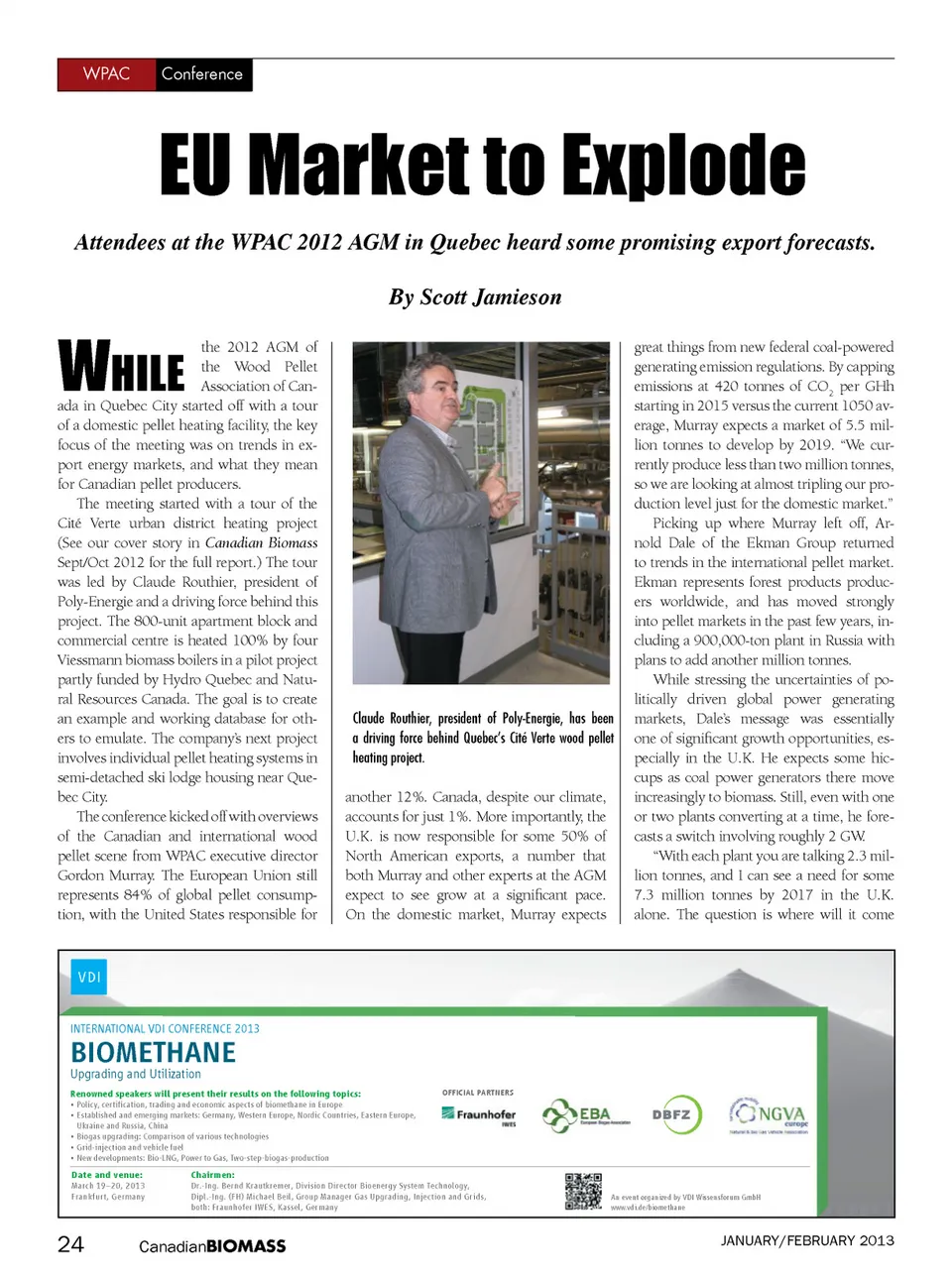
WPAC Conference EU Market to Explode Attendees at the WPAC 2012 AGM in Quebec heard some promising export forecasts. By Scott Jamieson the 2012 AGM of the Wood Pellet Association of Can-ada in Quebec City started off with a tour of a domestic pellet heating facility, the key focus of the meeting was on trends in ex-port energy markets, and what they mean for Canadian pellet producers. The meeting started with a tour of the Cité Verte urban district heating project (See our cover story in Canadian Biomass Sept/Oct 2012 for the full report.) The tour was led by Claude Routhier, president of Poly-Energie and a driving force behind this project. The 800-unit apartment block and commercial centre is heated 100% by four Viessmann biomass boilers in a pilot project partly funded by Hydro Quebec and Natu-ral Resources Canada. The goal is to create an example and working database for oth-ers to emulate. The company’s next project involves individual pellet heating systems in semi-detached ski lodge housing near Que-bec City. The conference kicked off with overviews of the Canadian and international wood pellet scene from WPAC executive director Gordon Murray. The European Union still represents 84% of global pellet consump-tion, with the United States responsible for W hile Claude Routhier, president of Poly-Energie, has been a driving force behind Quebec’s Cité Verte wood pellet heating project. another 12%. Canada, despite our climate, accounts for just 1%. More importantly, the U.K. is now responsible for some 50% of North American exports, a number that both Murray and other experts at the AGM expect to see grow at a significant pace. On the domestic market, Murray expects great things from new federal coal-powered generating emission regulations. By capping emissions at 420 tonnes of CO 2 per GHh starting in 2015 versus the current 1050 av-erage, Murray expects a market of 5.5 mil-lion tonnes to develop by 2019. “We cur-rently produce less than two million tonnes, so we are looking at almost tripling our pro-duction level just for the domestic market.” Picking up where Murray left off, Ar-nold Dale of the Ekman Group returned to trends in the international pellet market. Ekman represents forest products produc-ers worldwide, and has moved strongly into pellet markets in the past few years, in-cluding a 900,000-ton plant in Russia with plans to add another million tonnes. While stressing the uncertainties of po-litically driven global power generating markets, Dale’s message was essentially one of significant growth opportunities, es-pecially in the U.K. He expects some hic-cups as coal power generators there move increasingly to biomass. Still, even with one or two plants converting at a time, he fore-casts a switch involving roughly 2 GW. “With each plant you are talking 2.3 mil-lion tonnes, and I can see a need for some 7.3 million tonnes by 2017 in the U.K. alone. The question is where will it come INTERNATIONAL VDI CONFERENCE 2013 BIOMETHANE Upgrading and Utilization Renowned speakers will present their results on the following topics: • Policy, certification, trading and economic aspects of biomethane in Europe • Established and emerging markets: Germany, Western Europe, Nordic Countries, Eastern Europe, Ukraine and Russia, China • Biogas upgrading: Comparison of various technologies • Grid-injection and vehicle fuel • New developments: Bio-LNG, Power to Gas, Two-step-biogas-production Date and venue: March 19–20, 2013 Frankfurt, Germany OFFICIAL PARTNERS Chairmen: Dr.-Ing. Bernd Krautkremer, Division Director Bioenergy System Technology, Dipl.-Ing. (FH) Michael Beil, Group Manager Gas Upgrading, Injection and Grids, both: Fraunhofer IWES, Kassel, Germany An event organized by VDI Wissensforum GmbH www.vdi.de/biomethane 24 Canadian BIOMASS January/February 2013
Canadian Biomass January/February 2013: Page 24