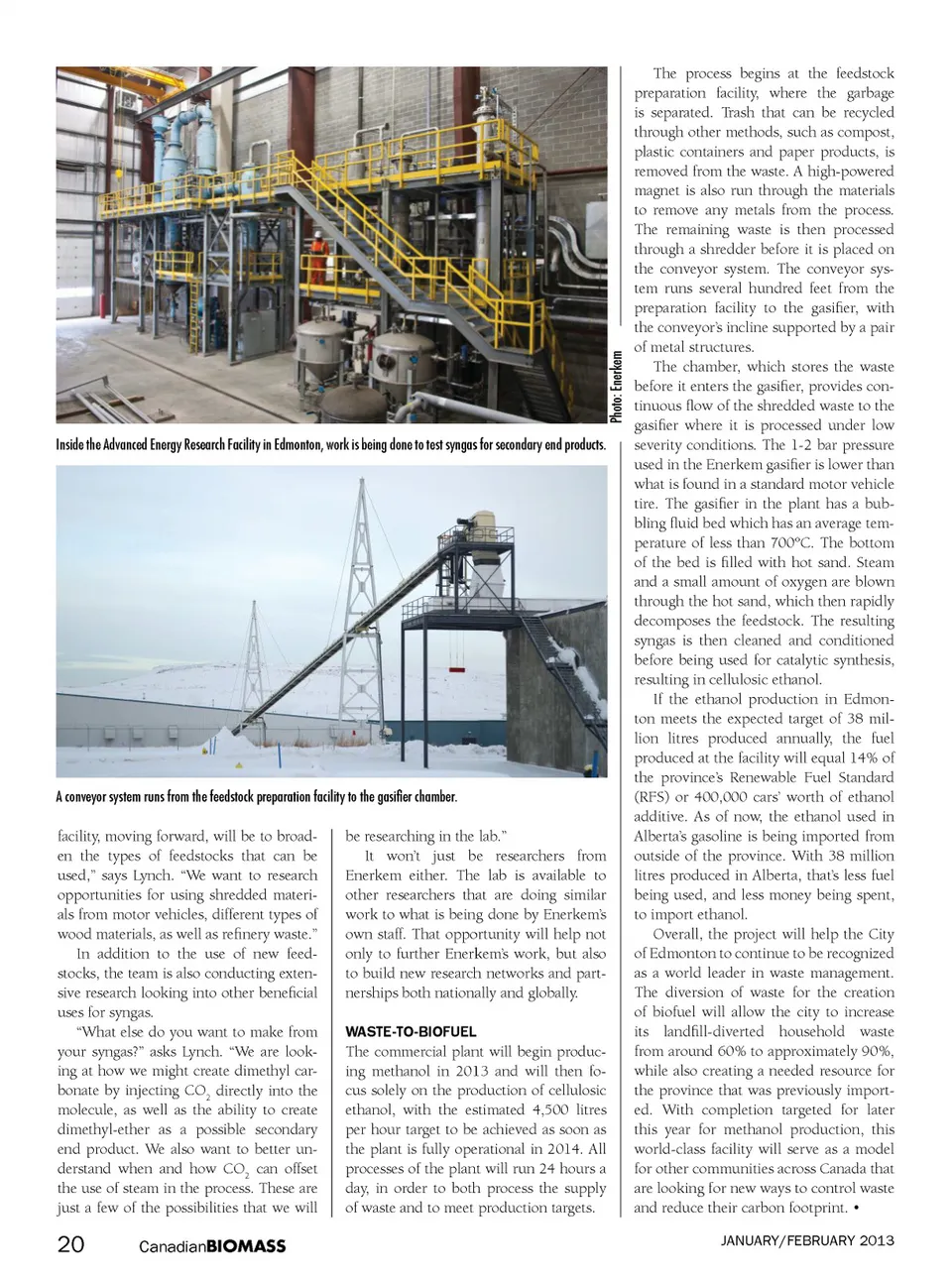
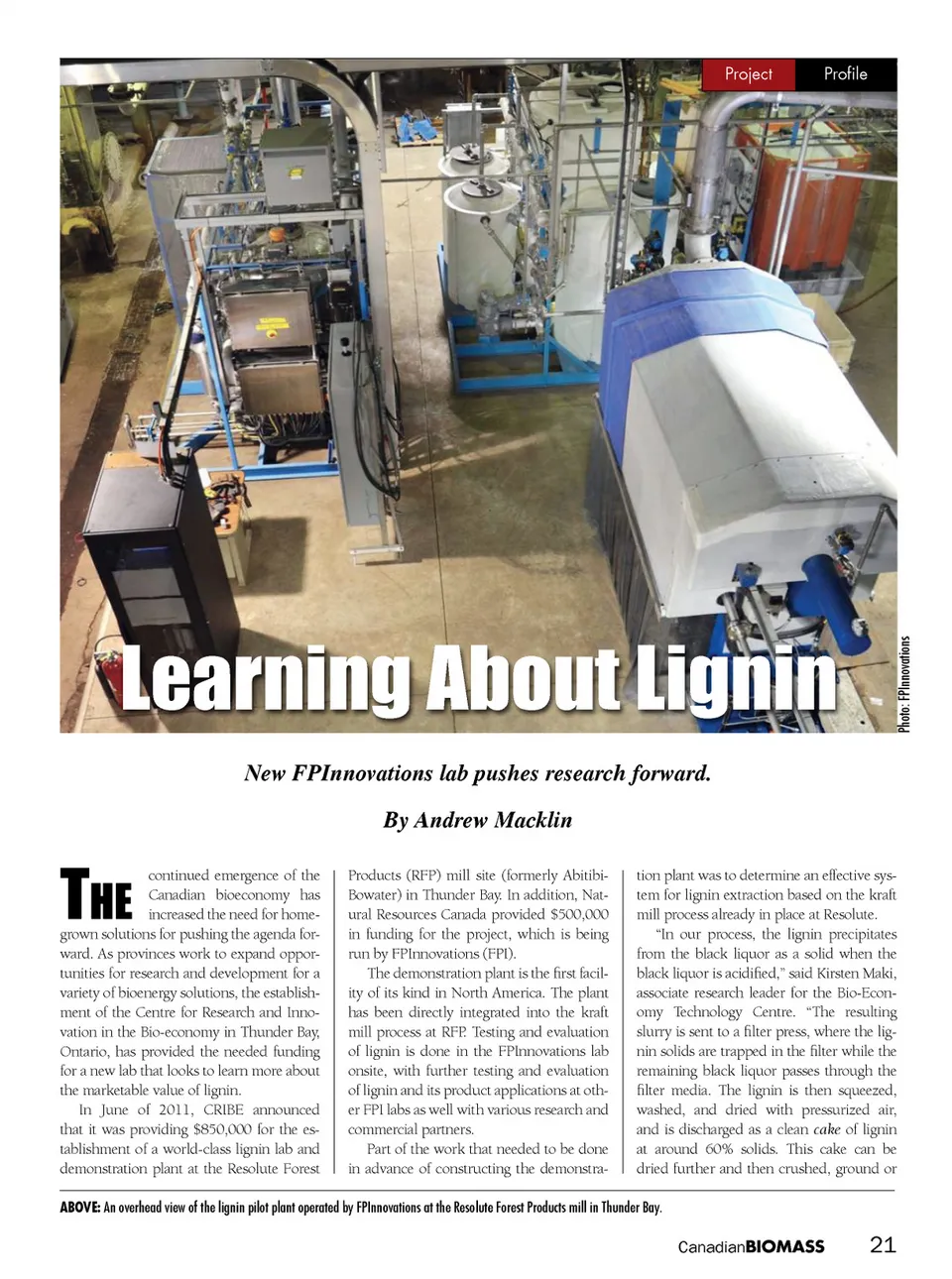
Inside the Advanced Energy Research Facility in Edmonton, work is being done to test syngas for secondary end products. A conveyor system runs from the feedstock preparation facility to the gasifier chamber. facility, moving forward, will be to broad-en the types of feedstocks that can be used,” says Lynch. “We want to research opportunities for using shredded materi-als from motor vehicles, different types of wood materials, as well as refinery waste.” In addition to the use of new feed-stocks, the team is also conducting exten-sive research looking into other beneficial uses for syngas. “What else do you want to make from your syngas?” asks Lynch. “We are look-ing at how we might create dimethyl car-bonate by injecting CO 2 directly into the molecule, as well as the ability to create dimethyl-ether as a possible secondary end product. We also want to better un-derstand when and how CO 2 can offset the use of steam in the process. These are just a few of the possibilities that we will be researching in the lab.” It won’t just be researchers from Enerkem either. The lab is available to other researchers that are doing similar work to what is being done by Enerkem’s own staff. That opportunity will help not only to further Enerkem’s work, but also to build new research networks and part-nerships both nationally and globally. waste-tO-biOfuel The commercial plant will begin produc-ing methanol in 2013 and will then fo-cus solely on the production of cellulosic ethanol, with the estimated 4,500 litres per hour target to be achieved as soon as the plant is fully operational in 2014. All processes of the plant will run 24 hours a day, in order to both process the supply of waste and to meet production targets. The process begins at the feedstock preparation facility, where the garbage is separated. Trash that can be recycled through other methods, such as compost, plastic containers and paper products, is removed from the waste. A high-powered magnet is also run through the materials to remove any metals from the process. The remaining waste is then processed through a shredder before it is placed on the conveyor system. The conveyor sys-tem runs several hundred feet from the preparation facility to the gasifier, with the conveyor’s incline supported by a pair of metal structures. The chamber, which stores the waste before it enters the gasifier, provides con-tinuous flow of the shredded waste to the gasifier where it is processed under low severity conditions. The 1-2 bar pressure used in the Enerkem gasifier is lower than what is found in a standard motor vehicle tire. The gasifier in the plant has a bub-bling fluid bed which has an average tem-perature of less than 700°C. The bottom of the bed is filled with hot sand. Steam and a small amount of oxygen are blown through the hot sand, which then rapidly decomposes the feedstock. The resulting syngas is then cleaned and conditioned before being used for catalytic synthesis, resulting in cellulosic ethanol. If the ethanol production in Edmon-ton meets the expected target of 38 mil-lion litres produced annually, the fuel produced at the facility will equal 14% of the province’s Renewable Fuel Standard (RFS) or 400,000 cars’ worth of ethanol additive. As of now, the ethanol used in Alberta’s gasoline is being imported from outside of the province. With 38 million litres produced in Alberta, that’s less fuel being used, and less money being spent, to import ethanol. Overall, the project will help the City of Edmonton to continue to be recognized as a world leader in waste management. The diversion of waste for the creation of biofuel will allow the city to increase its landfill-diverted household waste from around 60% to approximately 90%, while also creating a needed resource for the province that was previously import-ed. With completion targeted for later this year for methanol production, this world-class facility will serve as a model for other communities across Canada that are looking for new ways to control waste and reduce their carbon footprint. • January/February 2013 20 Canadian BIOMASS Photo: Enerkem
Canadian Biomass January/February 2013: Page 20