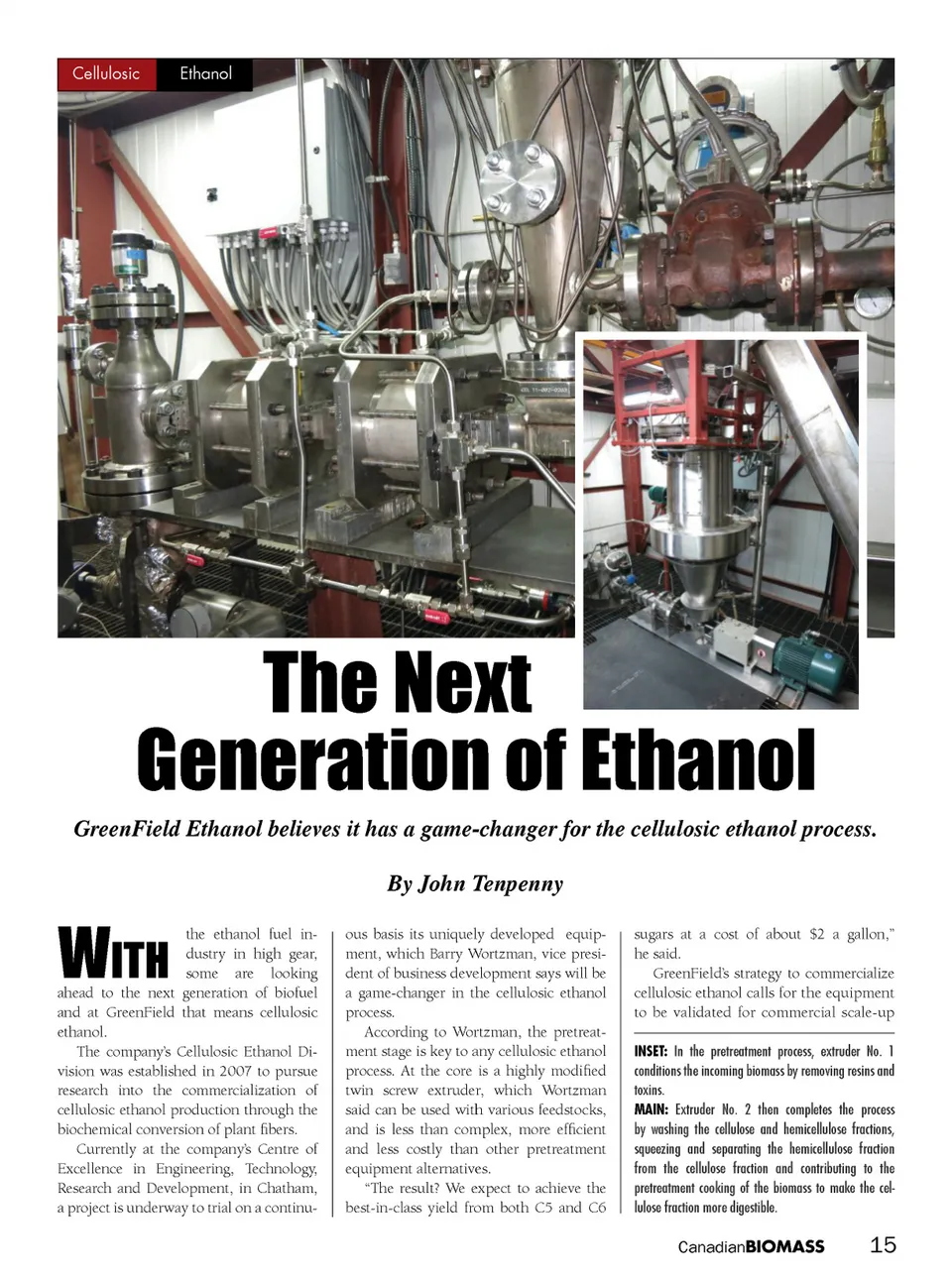
Cellulosic Ethanol GreenField Ethanol believes it has a game-changer for the cellulosic ethanol process. By John Tenpenny The Next Generation of Ethanol ous basis its uniquely developed equip-ment, which Barry Wortzman, vice presi-dent of business development says will be a game-changer in the cellulosic ethanol process. According to Wortzman, the pretreat-ment stage is key to any cellulosic ethanol process. At the core is a highly modified twin screw extruder, which Wortzman said can be used with various feedstocks, and is less than complex, more efficient and less costly than other pretreatment equipment alternatives. “The result? We expect to achieve the best-in-class yield from both C5 and C6 W iTh the ethanol fuel in-dustry in high gear, some are looking ahead to the next generation of biofuel and at GreenField that means cellulosic ethanol. The company’s Cellulosic Ethanol Di-vision was established in 2007 to pursue research into the commercialization of cellulosic ethanol production through the biochemical conversion of plant fibers. Currently at the company’s Centre of Excellence in Engineering, Technology, Research and Development, in Chatham, a project is underway to trial on a continu-sugars at a cost of about $2 a gallon,” he said. GreenField’s strategy to commercialize cellulosic ethanol calls for the equipment to be validated for commercial scale-up INSET: In the pretreatment process, extruder No. 1 conditions the incoming biomass by removing resins and toxins. MAIN: Extruder No. 2 then completes the process by washing the cellulose and hemicellulose fractions, squeezing and separating the hemicellulose fraction from the cellulose fraction and contributing to the pretreatment cooking of the biomass to make the cel-lulose fraction more digestible. Canadian BIOMASS 15
Canadian Biomass January/February 2013: Page 15