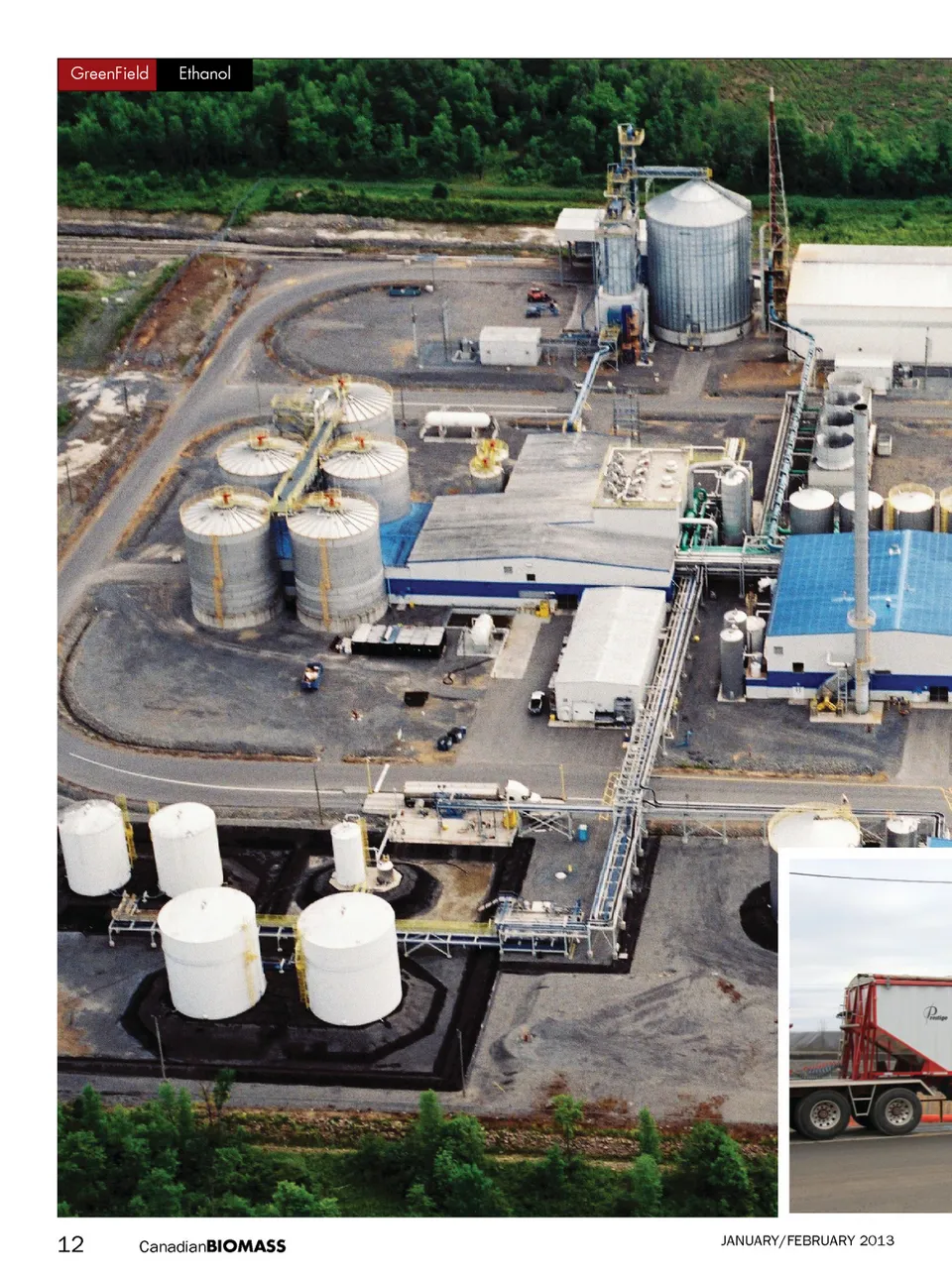
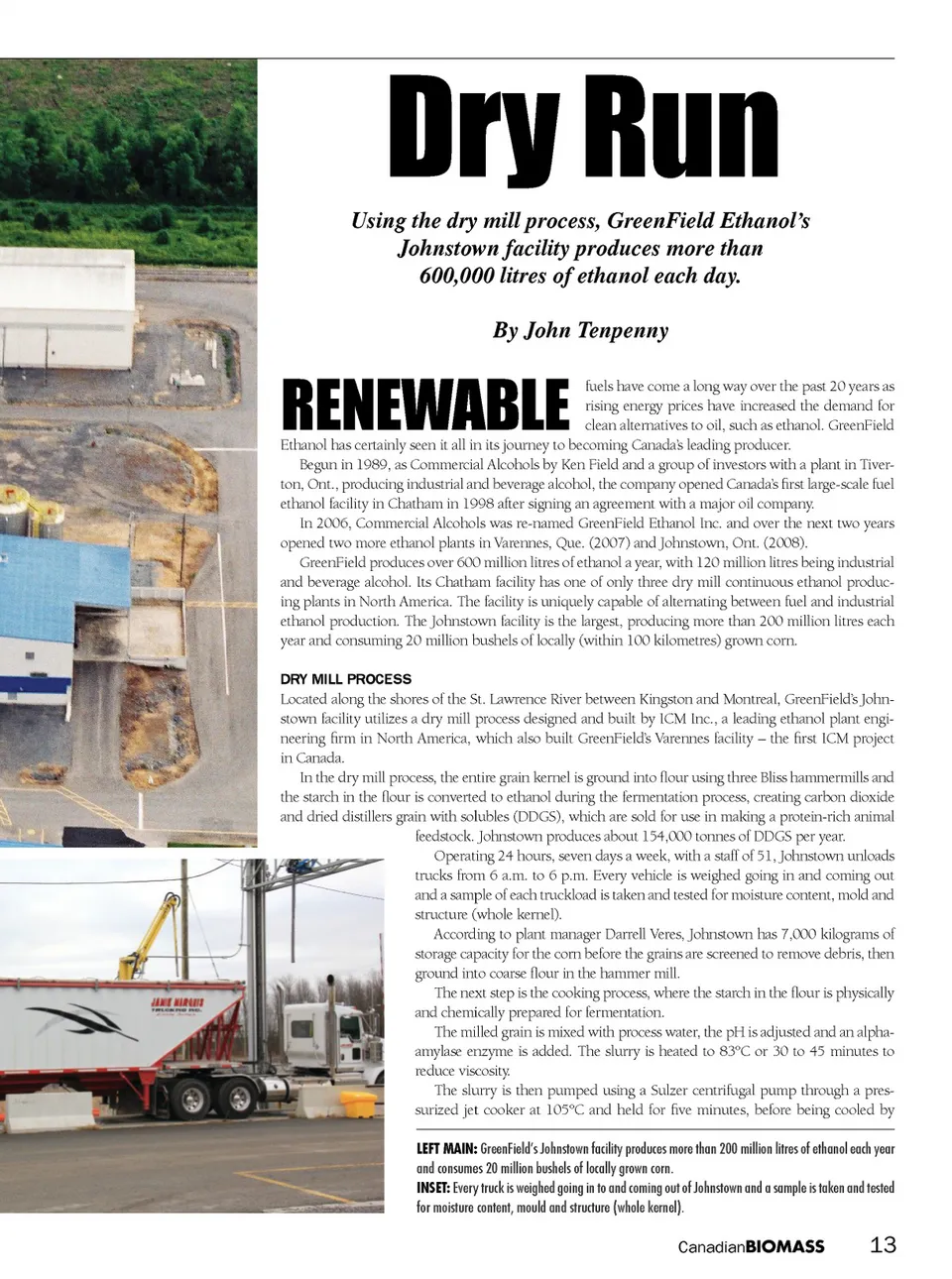
Using the dry mill process, GreenField Ethanol’s Johnstown facility produces more than 600,000 litres of ethanol each day. By John Tenpenny fuels have come a long way over the past 20 years as rising energy prices have increased the demand for clean alternatives to oil, such as ethanol. GreenField Ethanol has certainly seen it all in its journey to becoming Canada’s leading producer. Begun in 1989, as Commercial Alcohols by Ken Field and a group of investors with a plant in Tiver-ton, Ont., producing industrial and beverage alcohol, the company opened Canada’s first large-scale fuel ethanol facility in Chatham in 1998 after signing an agreement with a major oil company. In 2006, Commercial Alcohols was re-named GreenField Ethanol Inc. and over the next two years opened two more ethanol plants in Varennes, Que. (2007) and Johnstown, Ont. (2008). GreenField produces over 600 million litres of ethanol a year, with 120 million litres being industrial and beverage alcohol. Its Chatham facility has one of only three dry mill continuous ethanol produc-ing plants in North America. The facility is uniquely capable of alternating between fuel and industrial ethanol production. The Johnstown facility is the largest, producing more than 200 million litres each year and consuming 20 million bushels of locally (within 100 kilometres) grown corn. Dry mill prOcess Dry Run RENEWABLE Located along the shores of the St. Lawrence River between Kingston and Montreal, GreenField’s John-stown facility utilizes a dry mill process designed and built by ICM Inc., a leading ethanol plant engi-neering firm in North America, which also built GreenField’s Varennes facility – the first ICM project in Canada. In the dry mill process, the entire grain kernel is ground into flour using three Bliss hammermills and the starch in the flour is converted to ethanol during the fermentation process, creating carbon dioxide and dried distillers grain with solubles (DDGS), which are sold for use in making a protein-rich animal feedstock. Johnstown produces about 154,000 tonnes of DDGS per year. Operating 24 hours, seven days a week, with a staff of 51, Johnstown unloads trucks from 6 a.m. to 6 p.m. Every vehicle is weighed going in and coming out and a sample of each truckload is taken and tested for moisture content, mold and structure (whole kernel). According to plant manager Darrell Veres, Johnstown has 7,000 kilograms of storage capacity for the corn before the grains are screened to remove debris, then ground into coarse flour in the hammer mill. The next step is the cooking process, where the starch in the flour is physically and chemically prepared for fermentation. The milled grain is mixed with process water, the pH is adjusted and an alpha-amylase enzyme is added. The slurry is heated to 83°C or 30 to 45 minutes to reduce viscosity. The slurry is then pumped using a Sulzer centrifugal pump through a pres-surized jet cooker at 105°C and held for five minutes, before being cooled by LEFT MAIN: GreenField’s Johnstown facility produces more than 200 million litres of ethanol each year and consumes 20 million bushels of locally grown corn. INSET: Every truck is weighed going in to and coming out of Johnstown and a sample is taken and tested for moisture content, mould and structure (whole kernel). Canadian BIOMASS 13
Canadian Biomass January/February 2013: Page 13