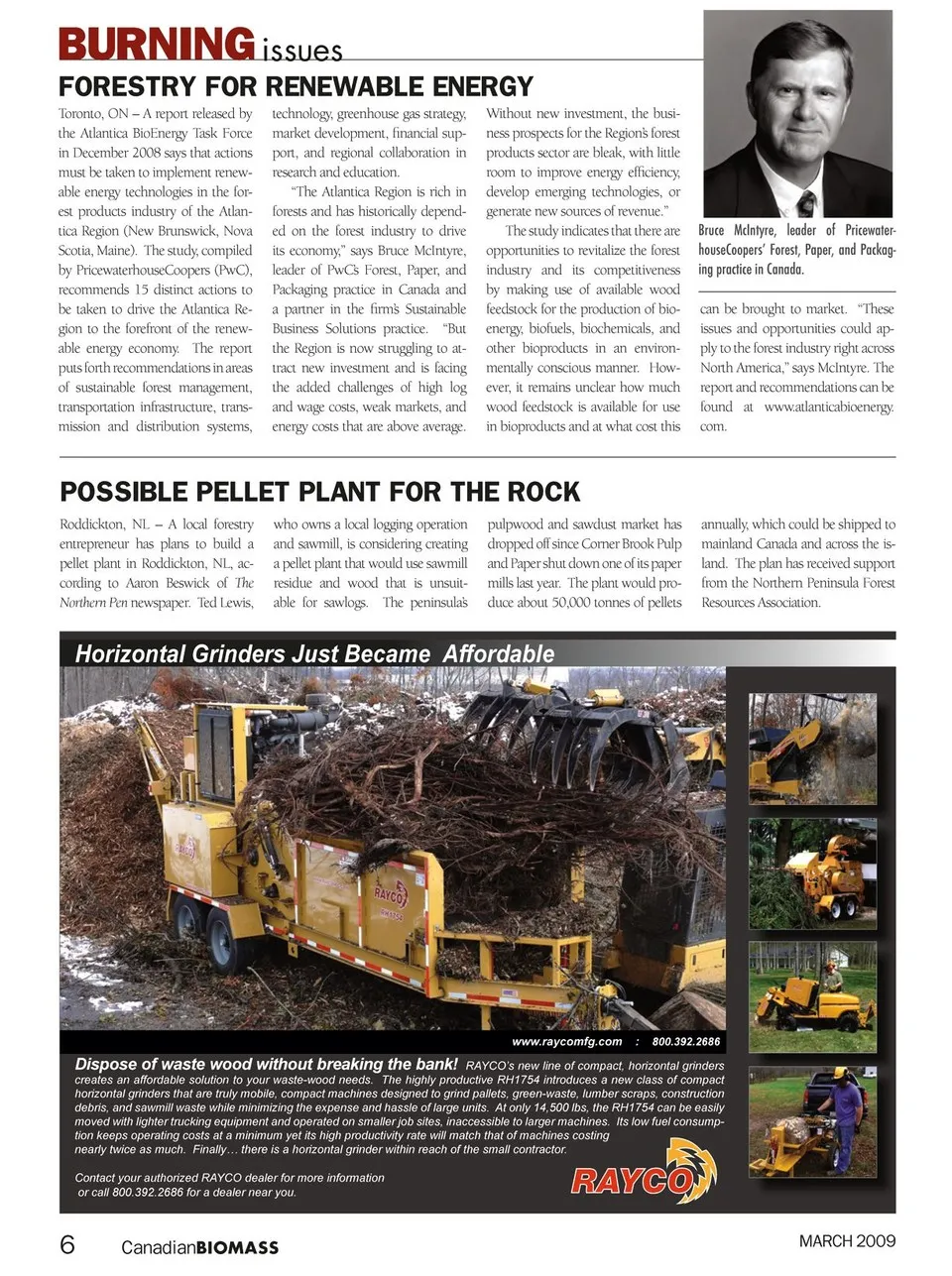
BURNINGissues Forestry For reNewable eNergy Toronto, ON – A report released by the Atlantica BioEnergy Task Force in December 2008 says that actions must be taken to implement renew- able energy technologies in the for- est products industry of the Atlan- tica Region (New Brunswick, Nova Scotia, Maine). The study, compiled by PricewaterhouseCoopers (PwC), recommends 15 distinct actions to be taken to drive the Atlantica Re- gion to the forefront of the renew- able energy economy. The report puts forth recommendations in areas of sustainable forest management, transportation infrastructure, trans- mission and distribution systems, technology, greenhouse gas strategy, market development, financial sup- port, and regional collaboration in research and education. “The Atlantica Region is rich in forests and has historically depend- ed on the forest industry to drive its economy,” says Bruce McIntyre, leader of PwC’s Forest, Paper, and Packaging practice in Canada and a partner in the firm’s Sustainable Business Solutions practice. “But the Region is now struggling to at- tract new investment and is facing the added challenges of high log and wage costs, weak markets, and energy costs that are above average. Without new investment, the busi- ness prospects for the Region’s forest products sector are bleak, with little room to improve energy efficiency, develop emerging technologies, or generate new sources of revenue.” The study indicates that there are opportunities to revitalize the forest industry and its competitiveness by making use of available wood feedstock for the production of bio- energy, biofuels, biochemicals, and other bioproducts in an environ- mentally conscious manner. How- ever, it remains unclear how much wood feedstock is available for use in bioproducts and at what cost this possible pellet plaNt For the rock Roddickton, NL – A local forestry entrepreneur has plans to build a pellet plant in Roddickton, NL, ac- cording to Aaron Beswick of The Northern Pen newspaper. Ted Lewis, who owns a local logging operation and sawmill, is considering creating a pellet plant that would use sawmill residue and wood that is unsuit- able for sawlogs. The peninsula’s pulpwood and sawdust market has dropped off since Corner Brook Pulp and Paper shut down one of its paper mills last year. The plant would pro- duce about 50,000 tonnes of pellets Horizontal Grinders Just Became Affordable annually, which could be shipped to mainland Canada and across the is- land. The plan has received support from the Northern Peninsula Forest Resources Association. Bruce McIntyre, leader of Pricewater- houseCoopers’ Forest, Paper, and Packag- ing practice in Canada. can be brought to market. “These issues and opportunities could ap- ply to the forest industry right across North America,” says McIntyre. The report and recommendations can be found at www.atlanticabioenergy. com. www.raycomfg.com : 800.392.2686 Dispose of waste wood without breaking the bank! RAYCO’s new line of compact, horizontal grinders creates an affordable solution to your waste-wood needs. The highly productive RH1754 introduces a new class of compact horizontal grinders that are truly mobile, compact machines designed to grind pallets, green-waste, lumber scraps, construction debris, and sawmill waste while minimizing the expense and hassle of large units. At only 14,500 lbs, the RH1754 can be easily moved with lighter trucking equipment and operated on smaller job sites, inaccessible to larger machines. Its low fuel consump- tion keeps operating costs at a minimum yet its high productivity rate will match that of machines costing nearly twice as much. Finally… there is a horizontal grinder within reach of the small contractor. Contact your authorized RAYCO dealer for more information or call 800.392.2686 for a dealer near you. 6 CanadianBIOMASS MARCH 2009
Canadian Biomass March 2009: Page 6