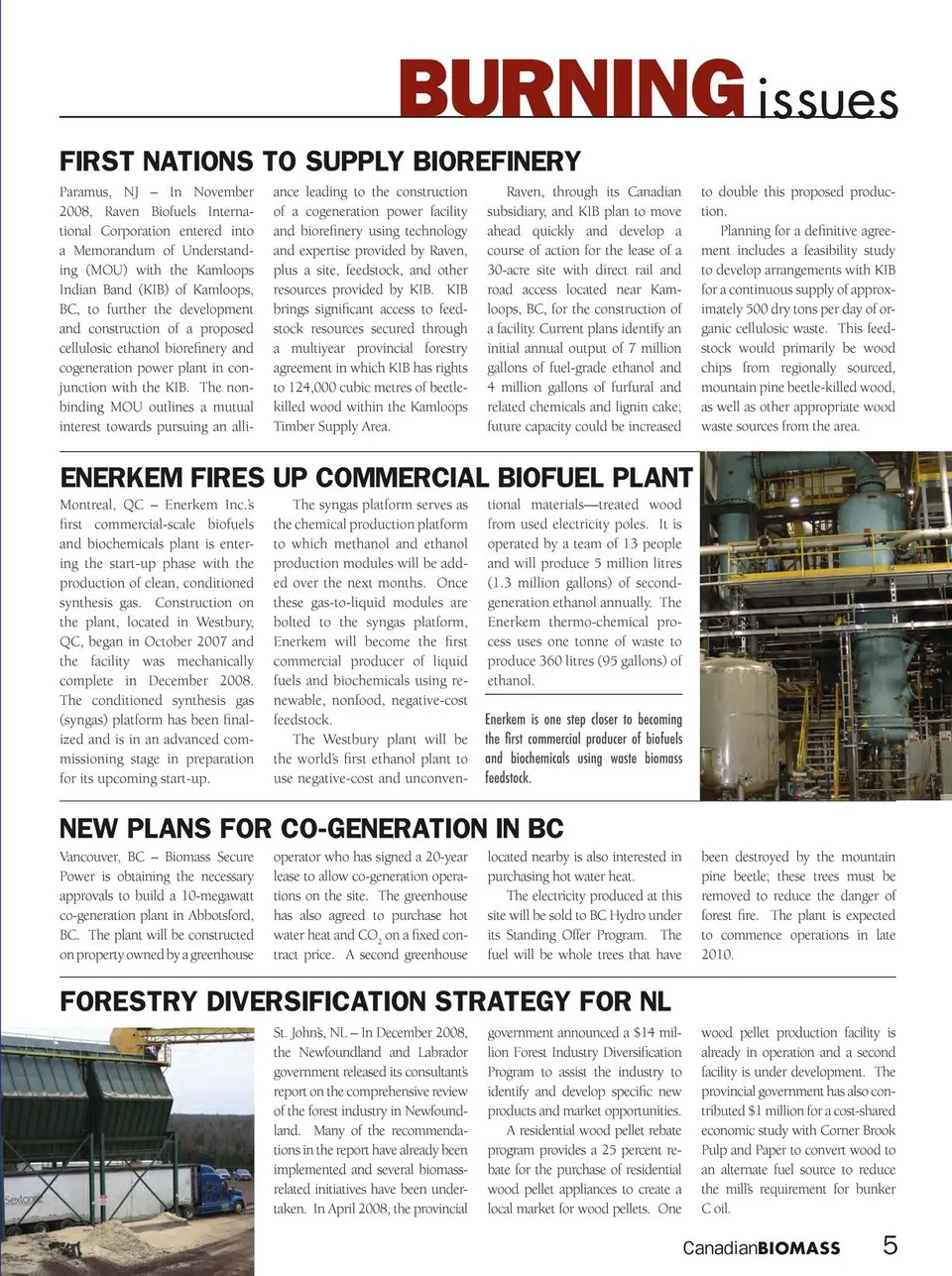
BURNINGissues First NatioNs to supply bioreFiNery Paramus, NJ – In November 2008, Raven Biofuels Interna- tional Corporation entered into a Memorandum of Understand- ing (MOU) with the Kamloops Indian Band (KIB) of Kamloops, BC, to further the development and construction of a proposed cellulosic ethanol biorefinery and cogeneration power plant in con- junction with the KIB. The non- binding MOU outlines a mutual interest towards pursuing an alli- ance leading to the construction of a cogeneration power facility and biorefinery using technology and expertise provided by Raven, plus a site, feedstock, and other resources provided by KIB. KIB brings significant access to feed- stock resources secured through a multiyear provincial forestry agreement in which KIB has rights to 124,000 cubic metres of beetle- killed wood within the Kamloops Timber Supply Area. Raven, through its Canadian subsidiary, and KIB plan to move ahead quickly and develop a course of action for the lease of a 30-acre site with direct rail and road access located near Kam- loops, BC, for the construction of a facility. Current plans identify an initial annual output of 7 million gallons of fuel-grade ethanol and 4 million gallons of furfural and related chemicals and lignin cake; future capacity could be increased eNerkem Fires up commercial bioFuel plaNt Montreal, QC – Enerkem Inc.’s first commercial-scale biofuels and biochemicals plant is enter- ing the start-up phase with the production of clean, conditioned synthesis gas. Construction on the plant, located in Westbury, QC, began in October 2007 and the facility was mechanically complete in December 2008. The conditioned synthesis gas (syngas) platform has been final- ized and is in an advanced com- missioning stage in preparation for its upcoming start-up. The syngas platform serves as the chemical production platform to which methanol and ethanol production modules will be add- ed over the next months. Once these gas-to-liquid modules are bolted to the syngas platform, Enerkem will become the first commercial producer of liquid fuels and biochemicals using re- newable, nonfood, negative-cost feedstock. The Westbury plant will be the world’s first ethanol plant to use negative-cost and unconven- tional materials—treated wood from used electricity poles. It is operated by a team of 13 people and will produce 5 million litres (1.3 million gallons) of second- generation ethanol annually. The Enerkem thermo-chemical pro- cess uses one tonne of waste to produce 360 litres (95 gallons) of ethanol. Enerkem is one step closer to becoming the first commercial producer of biofuels and biochemicals using waste biomass feedstock. New plaNs For co-geNeratioN iN bc Vancouver, BC – Biomass Secure Power is obtaining the necessary approvals to build a 10-megawatt co-generation plant in Abbotsford, BC. The plant will be constructed on property owned by a greenhouse operator who has signed a 20-year lease to allow co-generation opera- tions on the site. The greenhouse has also agreed to purchase hot water heat and CO2 on a fixed con- tract price. A second greenhouse located nearby is also interested in purchasing hot water heat. The electricity produced at this site will be sold to BC Hydro under its Standing Offer Program. The fuel will be whole trees that have Forestry diversiFicatioN strategy For Nl St. John’s, NL – In December 2008, the Newfoundland and Labrador government released its consultant’s report on the comprehensive review of the forest industry in Newfound- land. Many of the recommenda- tions in the report have already been implemented and several biomass- related initiatives have been under- taken. In April 2008, the provincial government announced a $14 mil- lion Forest Industry Diversification Program to assist the industry to identify and develop specific new products and market opportunities. A residential wood pellet rebate program provides a 25 percent re- bate for the purchase of residential wood pellet appliances to create a localmarket for wood pellets. One wood pellet production facility is already in operation and a second facility is under development. The provincial government has also con- tributed $1 million for a cost-shared economic study with Corner Brook Pulp and Paper to convert wood to an alternate fuel source to reduce the mill’s requirement for bunker C oil. CanadianBIOMASS 5 been destroyed by the mountain pine beetle; these trees must be removed to reduce the danger of forest fire. The plant is expected to commence operations in late 2010. to double this proposed produc- tion. Planning for a definitive agree- ment includes a feasibility study to develop arrangements with KIB for a continuous supply of approx- imately 500 dry tons per day of or- ganic cellulosic waste. This feed- stock would primarily be wood chips from regionally sourced, mountain pine beetle-killed wood, as well as other appropriate wood waste sources from the area.
Canadian Biomass March 2009: Page 5