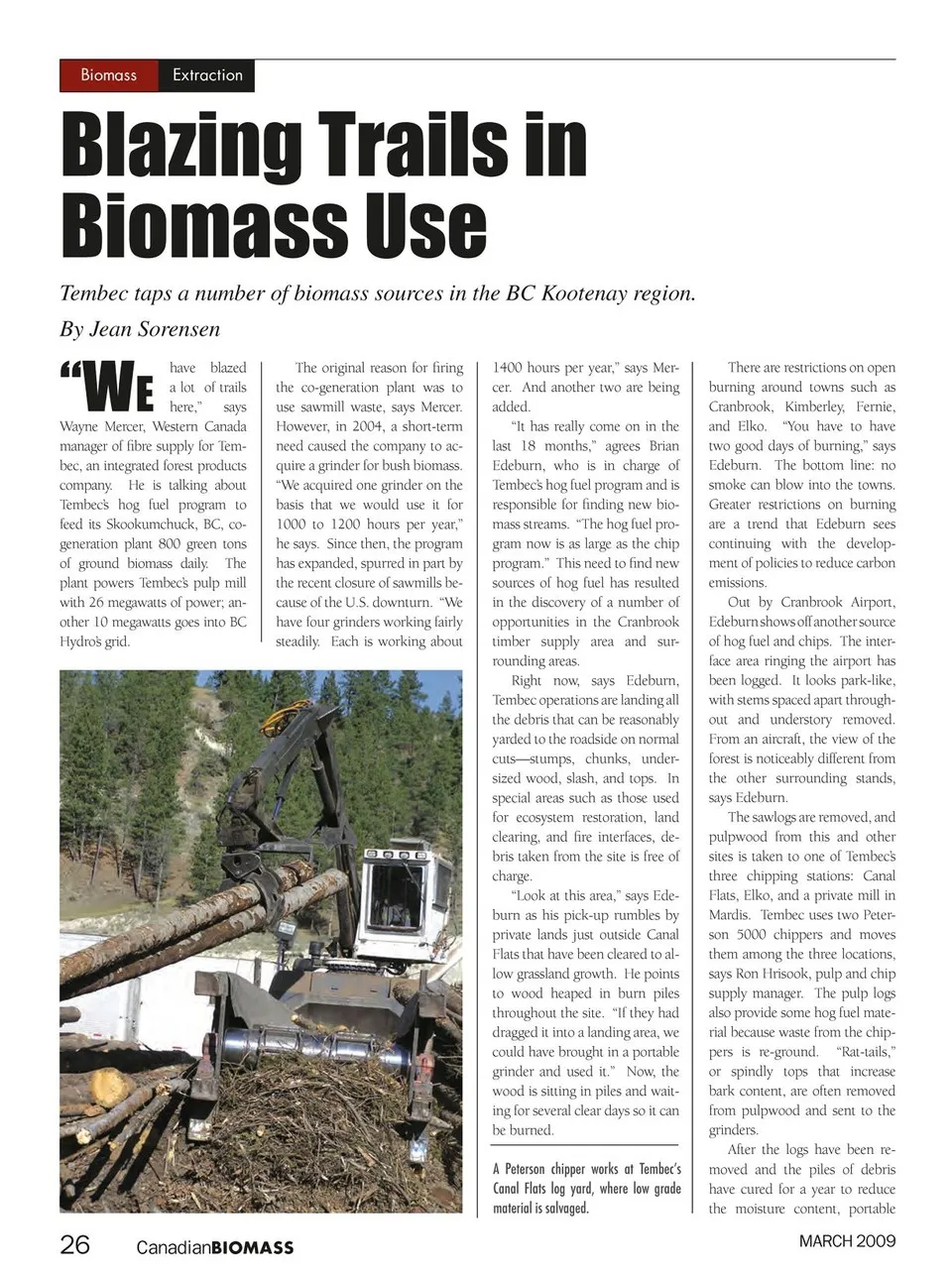
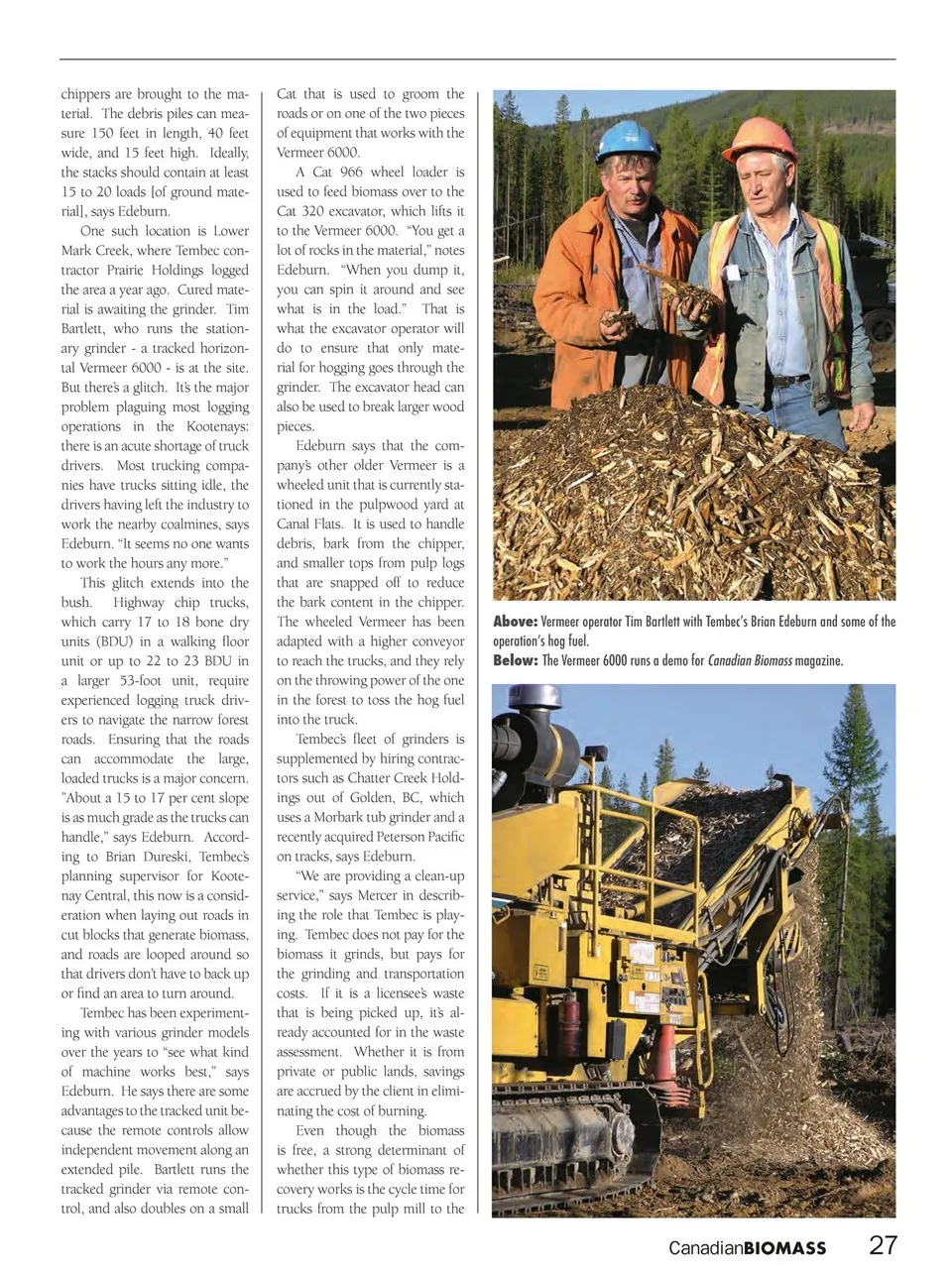
chippers are brought to the ma- terial. The debris piles can mea- sure 150 feet in length, 40 feet wide, and 15 feet high. Ideally, the stacks should contain at least 15 to 20 loads [of ground mate- rial], says Edeburn. One such location is Lower Mark Creek, where Tembec con- tractor Prairie Holdings logged the area a year ago. Cured mate- rial is awaiting the grinder. Tim Bartlett, who runs the station- ary grinder - a tracked horizon- tal Vermeer 6000 - is at the site. But there’s a glitch. It’s the major problem plaguing most logging operations in the Kootenays: there is an acute shortage of truck drivers. Most trucking compa- nies have trucks sitting idle, the drivers having left the industry to work the nearby coalmines, says Edeburn. “It seems no one wants to work the hours any more.” This glitch extends into the bush. Highway chip trucks, which carry 17 to 18 bone dry units (BDU) in a walking floor unit or up to 22 to 23 BDU in a larger 53-foot unit, require experienced logging truck driv- ers to navigate the narrow forest roads. Ensuring that the roads can accommodate the large, loaded trucks is a major concern. ”About a 15 to 17 per cent slope is as much grade as the trucks can handle,” says Edeburn. Accord- ing to Brian Dureski, Tembec’s planning supervisor for Koote- nay Central, this now is a consid- eration when laying out roads in cut blocks that generate biomass, and roads are looped around so that drivers don’t have to back up or find an area to turn around. Tembec has been experiment- ing with various grinder models over the years to “see what kind of machine works best,” says Edeburn. He says there are some advantages to the tracked unit be- cause the remote controls allow independent movement along an extended pile. Bartlett runs the tracked grinder via remote con- trol, and also doubles on a small Cat that is used to groom the roads or on one of the two pieces of equipment that works with the Vermeer 6000. A Cat 966 wheel loader is used to feed biomass over to the Cat 320 excavator, which lifts it to the Vermeer 6000. “You get a lot of rocks in the material,” notes Edeburn. “When you dump it, you can spin it around and see what is in the load.” That is what the excavator operator will do to ensure that only mate- rial for hogging goes through the grinder. The excavator head can also be used to break larger wood pieces. Edeburn says that the com- pany’s other older Vermeer is a wheeled unit that is currently sta- tioned in the pulpwood yard at Canal Flats. It is used to handle debris, bark from the chipper, and smaller tops from pulp logs that are snapped off to reduce the bark content in the chipper. The wheeled Vermeer has been adapted with a higher conveyor to reach the trucks, and they rely on the throwing power of the one in the forest to toss the hog fuel into the truck. Tembec’s fleet of grinders is supplemented by hiring contrac- tors such as Chatter Creek Hold- ings out of Golden, BC, which uses a Morbark tub grinder and a recently acquired Peterson Pacific on tracks, says Edeburn. “We are providing a clean-up service,” says Mercer in describ- ing the role that Tembec is play- ing. Tembec does not pay for the biomass it grinds, but pays for the grinding and transportation costs. If it is a licensee’s waste that is being picked up, it’s al- ready accounted for in the waste assessment. Whether it is from private or public lands, savings are accrued by the client in elimi- nating the cost of burning. Even though the biomass is free, a strong determinant of whether this type of biomass re- covery works is the cycle time for trucks from the pulp mill to the CanadianBIOMASS 27 Above: Vermeer operator Tim Bartlett with Tembec’s Brian Edeburn and some of the operation’s hog fuel. Below: The Vermeer 6000 runs a demo for Canadian Biomassmagazine.
Canadian Biomass March 2009: Page 27