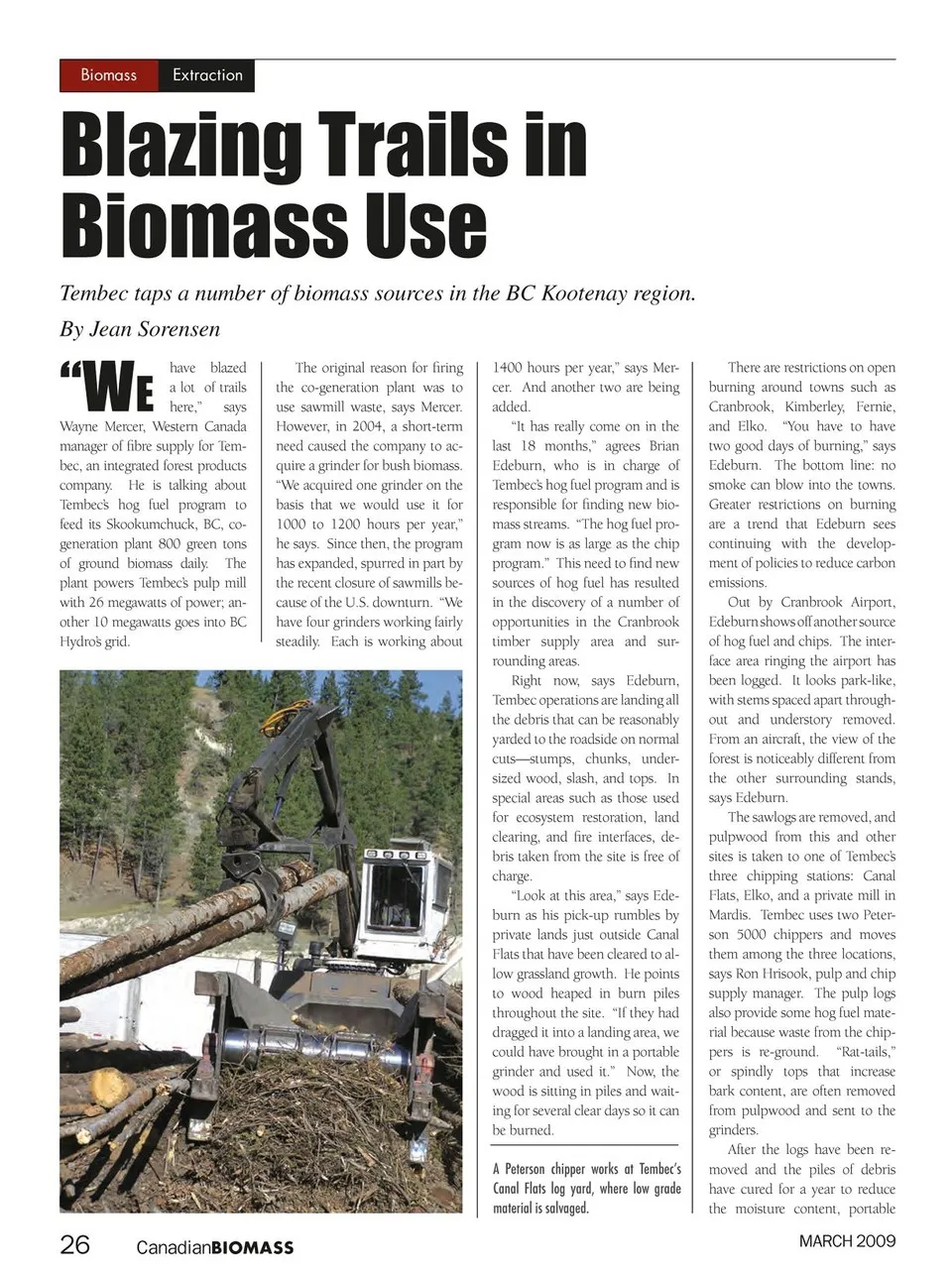
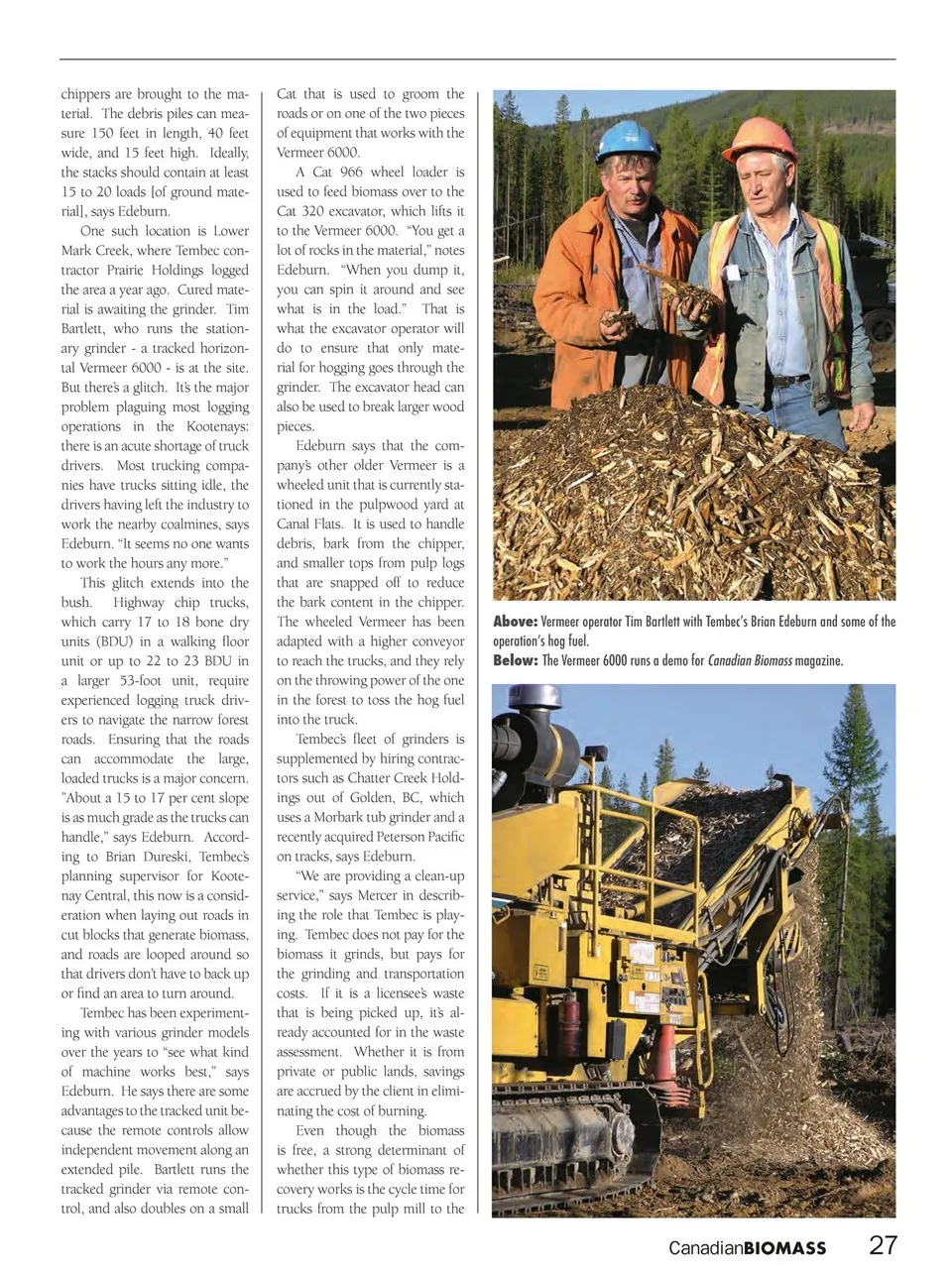
Biomass Extraction Blazing Trails in Biomass Use Tembec taps a number of biomass sources in the BC Kootenay region. By Jean Sorensen “We have blazed a lot of trails here,” says Wayne Mercer, Western Canada manager of fibre supply for Tem- bec, an integrated forest products company. He is talking about Tembec’s hog fuel program to feed its Skookumchuck, BC, co- generation plant 800 green tons of ground biomass daily. The plant powers Tembec’s pulp mill with 26 megawatts of power; an- other 10 megawatts goes into BC Hydro’s grid. The original reason for firing the co-generation plant was to use sawmill waste, says Mercer. However, in 2004, a short-term need caused the company to ac- quire a grinder for bush biomass. “We acquired one grinder on the basis that we would use it for 1000 to 1200 hours per year,” he says. Since then, the program has expanded, spurred in part by the recent closure of sawmills be- cause of the U.S. downturn. “We have four grinders working fairly steadily. Each is working about 1400 hours per year,” says Mer- cer. And another two are being added. “It has really come on in the last 18 months,” agrees Brian Edeburn, who is in charge of Tembec’s hog fuel program and is responsible for finding new bio- mass streams. “The hog fuel pro- gram now is as large as the chip program.” This need to find new sources of hog fuel has resulted in the discovery of a number of opportunities in the Cranbrook timber supply area and sur- rounding areas. Right now, says Edeburn, Tembec operations are landing all the debris that can be reasonably yarded to the roadside on normal cuts—stumps, chunks, under- sized wood, slash, and tops. In special areas such as those used for ecosystem restoration, land clearing, and fire interfaces, de- bris taken from the site is free of charge. “Look at this area,” says Ede- burn as his pick-up rumbles by private lands just outside Canal Flats that have been cleared to al- low grassland growth. He points to wood heaped in burn piles throughout the site. “If they had dragged it into a landing area, we could have brought in a portable grinder and used it.” Now, the wood is sitting in piles and wait- ing for several clear days so it can be burned. A Peterson chipper works at Tembec’s Canal Flats log yard, where low grade material is salvaged. 26 CanadianBIOMASS There are restrictions on open burning around towns such as Cranbrook, Kimberley, Fernie, and Elko. “You have to have two good days of burning,” says Edeburn. The bottom line: no smoke can blow into the towns. Greater restrictions on burning are a trend that Edeburn sees continuing with the develop- ment of policies to reduce carbon emissions. Out by Cranbrook Airport, Edeburn shows off another source of hog fuel and chips. The inter- face area ringing the airport has been logged. It looks park-like, with stems spaced apart through- out and understory removed. From an aircraft, the view of the forest is noticeably different from the other surrounding stands, says Edeburn. The sawlogs are removed, and pulpwood from this and other sites is taken to one of Tembec’s three chipping stations: Canal Flats, Elko, and a private mill in Mardis. Tembec uses two Peter- son 5000 chippers and moves them among the three locations, says Ron Hrisook, pulp and chip supply manager. The pulp logs also provide some hog fuel mate- rial because waste from the chip- pers is re-ground. “Rat-tails,” or spindly tops that increase bark content, are often removed from pulpwood and sent to the grinders. After the logs have been re- moved and the piles of debris have cured for a year to reduce the moisture content, portable MARCH 2009
Canadian Biomass March 2009: Page 26