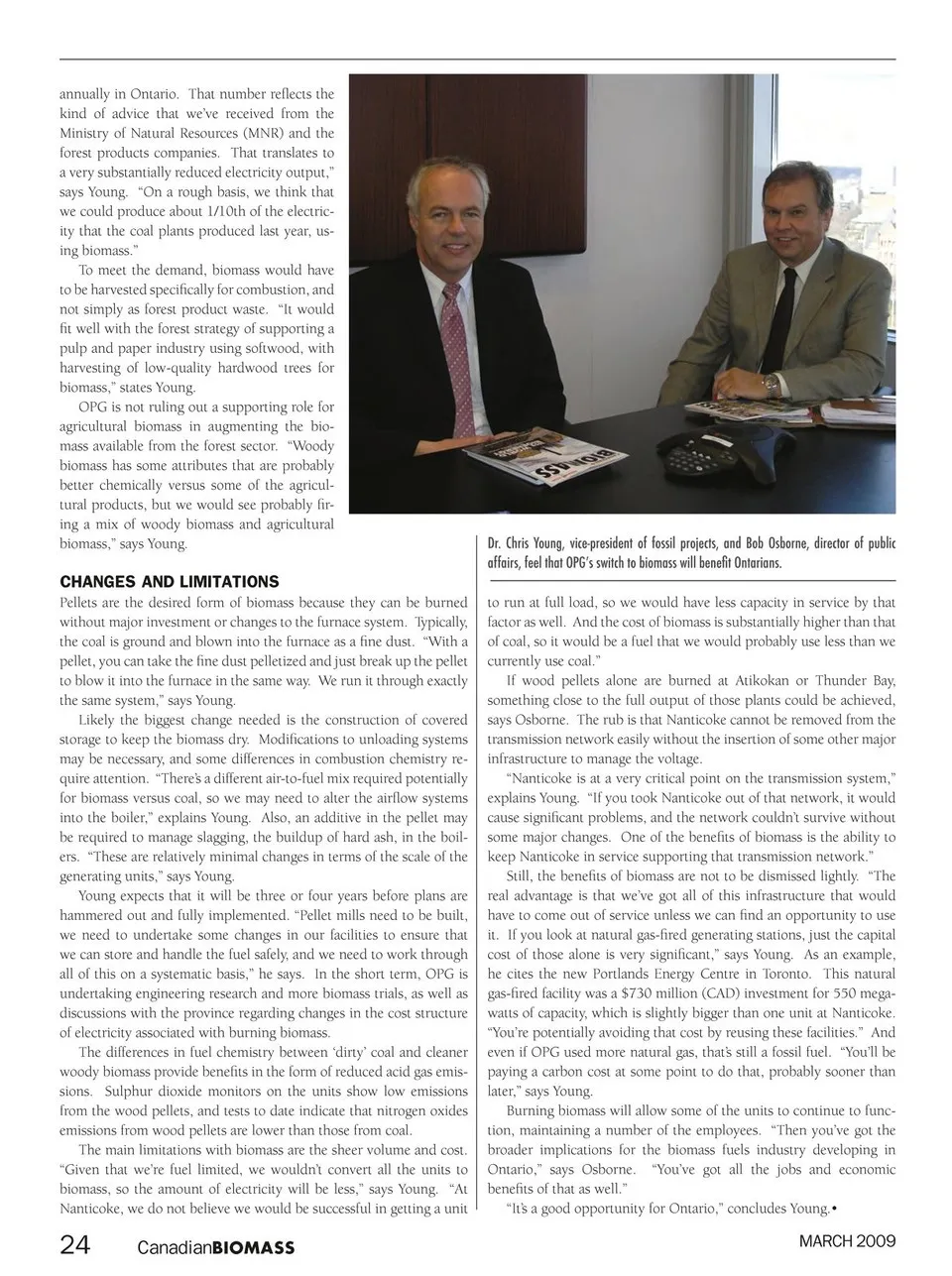
annually in Ontario. That number reflects the kind of advice that we’ve received from the Ministry of Natural Resources (MNR) and the forest products companies. That translates to a very substantially reduced electricity output,” says Young. “On a rough basis, we think that we could produce about 1/10th of the electric- ity that the coal plants produced last year, us- ing biomass.” To meet the demand, biomass would have to be harvested specifically for combustion, and not simply as forest product waste. “It would fit well with the forest strategy of supporting a pulp and paper industry using softwood, with harvesting of low-quality hardwood trees for biomass,” states Young. OPG is not ruling out a supporting role for agricultural biomass in augmenting the bio- mass available from the forest sector. “Woody biomass has some attributes that are probably better chemically versus some of the agricul- tural products, but we would see probably fir- ing a mix of woody biomass and agricultural biomass,” says Young. chaNges aNd limitatioNs Pellets are the desired form of biomass because they can be burned without major investment or changes to the furnace system. Typically, the coal is ground and blown into the furnace as a fine dust. “With a pellet, you can take the fine dust pelletized and just break up the pellet to blow it into the furnace in the same way. We run it through exactly the same system,” says Young. Likely the biggest change needed is the construction of covered storage to keep the biomass dry. Modifications to unloading systems may be necessary, and some differences in combustion chemistry re- quire attention. “There’s a different air-to-fuel mix required potentially for biomass versus coal, so we may need to alter the airflow systems into the boiler,” explains Young. Also, an additive in the pellet may be required to manage slagging, the buildup of hard ash, in the boil- ers. “These are relatively minimal changes in terms of the scale of the generating units,” says Young. Young expects that it will be three or four years before plans are hammered out and fully implemented. “Pellet mills need to be built, we need to undertake some changes in our facilities to ensure that we can store and handle the fuel safely, and we need to work through all of this on a systematic basis,” he says. In the short term, OPG is undertaking engineering research and more biomass trials, as well as discussions with the province regarding changes in the cost structure of electricity associated with burning biomass. The differences in fuel chemistry between ‘dirty’ coal and cleaner woody biomass provide benefits in the form of reduced acid gas emis- sions. Sulphur dioxide monitors on the units show low emissions from the wood pellets, and tests to date indicate that nitrogen oxides emissions from wood pellets are lower than those from coal. The main limitations with biomass are the sheer volume and cost. “Given that we’re fuel limited, we wouldn’t convert all the units to biomass, so the amount of electricity will be less,” says Young. “At Nanticoke, we do not believe we would be successful in getting a unit 24 CanadianBIOMASS Dr. Chris Young, vice-president of fossil projects, and Bob Osborne, director of public affairs, feel that OPG’s switch to biomass will benefit Ontarians. to run at full load, so we would have less capacity in service by that factor as well. And the cost of biomass is substantially higher than that of coal, so it would be a fuel that we would probably use less than we currently use coal.” If wood pellets alone are burned at Atikokan or Thunder Bay, something close to the full output of those plants could be achieved, says Osborne. The rub is that Nanticoke cannot be removed from the transmission network easily without the insertion of some other major infrastructure to manage the voltage. “Nanticoke is at a very critical point on the transmission system,” explains Young. “If you took Nanticoke out of that network, it would cause significant problems, and the network couldn’t survive without some major changes. One of the benefits of biomass is the ability to keep Nanticoke in service supporting that transmission network.” Still, the benefits of biomass are not to be dismissed lightly. “The real advantage is that we’ve got all of this infrastructure that would have to come out of service unless we can find an opportunity to use it. If you look at natural gas-fired generating stations, just the capital cost of those alone is very significant,” says Young. As an example, he cites the new Portlands Energy Centre in Toronto. This natural gas-fired facility was a $730 million (CAD) investment for 550 mega- watts of capacity, which is slightly bigger than one unit at Nanticoke. “You’re potentially avoiding that cost by reusing these facilities.” And even if OPG used more natural gas, that’s still a fossil fuel. “You’ll be paying a carbon cost at some point to do that, probably sooner than later,” says Young. Burning biomass will allow some of the units to continue to func- tion, maintaining a number of the employees. “Then you’ve got the broader implications for the biomass fuels industry developing in Ontario,” says Osborne. “You’ve got all the jobs and economic benefits of that as well.” “It’s a good opportunity for Ontario,” concludes Young.• MARCH 2009
Canadian Biomass March 2009: Page 24