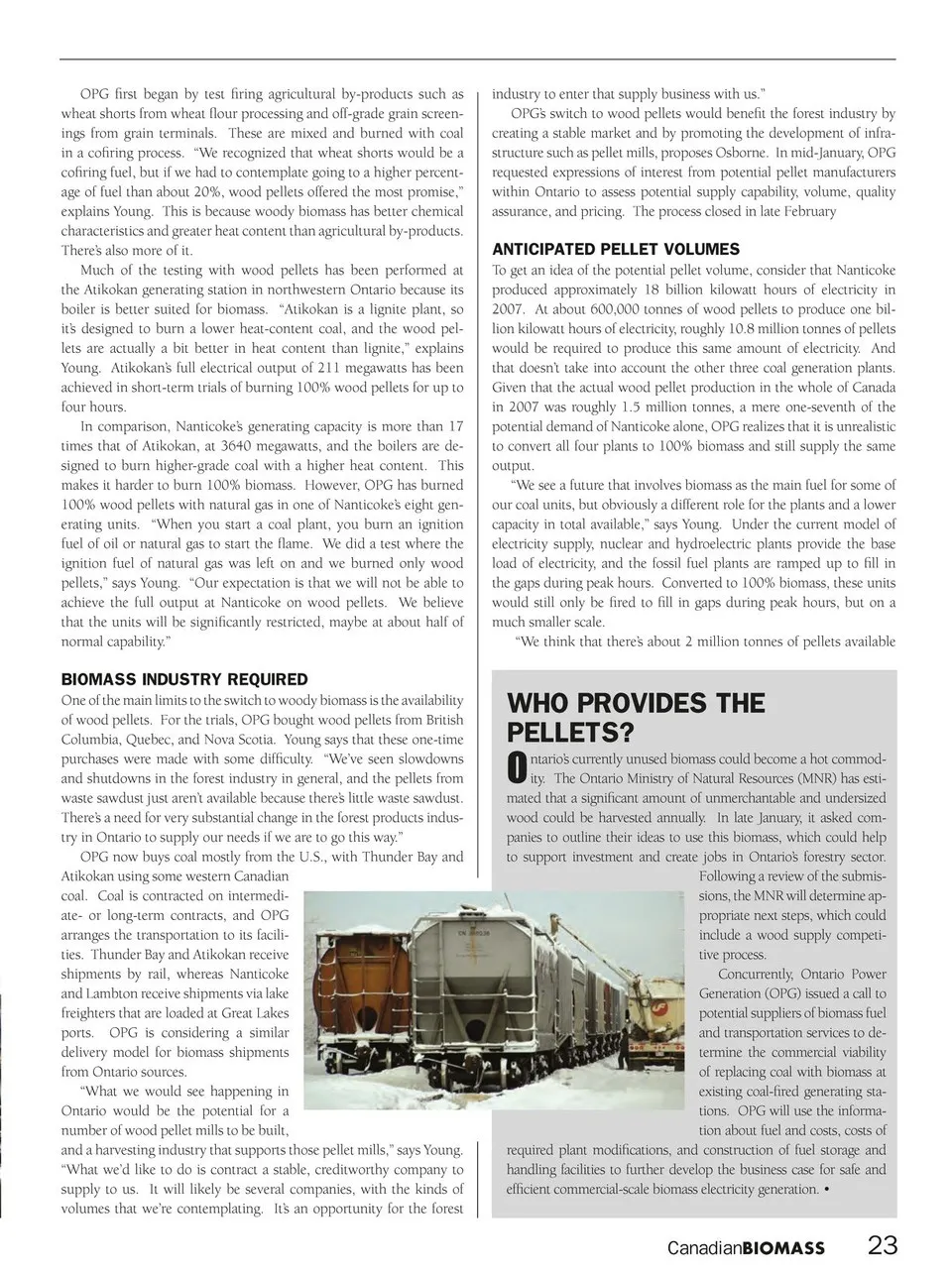
OPG first began by test firing agricultural by-products such as wheat shorts from wheat flour processing and off-grade grain screen- ings from grain terminals. These are mixed and burned with coal in a cofiring process. “We recognized that wheat shorts would be a cofiring fuel, but if we had to contemplate going to a higher percent- age of fuel than about 20%, wood pellets offered the most promise,” explains Young. This is because woody biomass has better chemical characteristics and greater heat content than agricultural by-products. There’s also more of it. Much of the testing with wood pellets has been performed at the Atikokan generating station in northwestern Ontario because its boiler is better suited for biomass. “Atikokan is a lignite plant, so it’s designed to burn a lower heat-content coal, and the wood pel- lets are actually a bit better in heat content than lignite,” explains Young. Atikokan’s full electrical output of 211 megawatts has been achieved in short-term trials of burning 100% wood pellets for up to four hours. In comparison, Nanticoke’s generating capacity is more than 17 times that of Atikokan, at 3640 megawatts, and the boilers are de- signed to burn higher-grade coal with a higher heat content. This makes it harder to burn 100% biomass. However, OPG has burned 100% wood pellets with natural gas in one of Nanticoke’s eight gen- erating units. “When you start a coal plant, you burn an ignition fuel of oil or natural gas to start the flame. We did a test where the ignition fuel of natural gas was left on and we burned only wood pellets,” says Young. “Our expectation is that we will not be able to achieve the full output at Nanticoke on wood pellets. We believe that the units will be significantly restricted, maybe at about half of normal capability.” biomass iNdustry required One of the main limits to the switch to woody biomass is the availability of wood pellets. For the trials, OPG bought wood pellets from British Columbia, Quebec, and Nova Scotia. Young says that these one-time purchases were made with some difficulty. “We’ve seen slowdowns and shutdowns in the forest industry in general, and the pellets from waste sawdust just aren’t available because there’s little waste sawdust. There’s a need for very substantial change in the forest products indus- try in Ontario to supply our needs if we are to go this way.” OPG now buys coal mostly from the U.S., with Thunder Bay and Atikokan using some western Canadian coal. Coal is contracted on intermedi- ate- or long-term contracts, and OPG arranges the transportation to its facili- ties. Thunder Bay and Atikokan receive shipments by rail, whereas Nanticoke and Lambton receive shipments via lake freighters that are loaded at Great Lakes ports. OPG is considering a similar delivery model for biomass shipments from Ontario sources. “What we would see happening in Ontario would be the potential for a number of wood pellet mills to be built, and a harvesting industry that supports those pellet mills,” says Young. “What we’d like to do is contract a stable, creditworthy company to supply to us. It will likely be several companies, with the kinds of volumes that we’re contemplating. It’s an opportunity for the forest industry to enter that supply business with us.” OPG’s switch to wood pellets would benefit the forest industry by creating a stable market and by promoting the development of infra- structure such as pellet mills, proposes Osborne. In mid-January, OPG requested expressions of interest from potential pellet manufacturers within Ontario to assess potential supply capability, volume, quality assurance, and pricing. The process closed in late February aNticipated pellet volumes To get an idea of the potential pellet volume, consider that Nanticoke produced approximately 18 billion kilowatt hours of electricity in 2007. At about 600,000 tonnes of wood pellets to produce one bil- lion kilowatt hours of electricity, roughly 10.8 million tonnes of pellets would be required to produce this same amount of electricity. And that doesn’t take into account the other three coal generation plants. Given that the actual wood pellet production in the whole of Canada in 2007 was roughly 1.5 million tonnes, a mere one-seventh of the potential demand of Nanticoke alone, OPG realizes that it is unrealistic to convert all four plants to 100% biomass and still supply the same output. “We see a future that involves biomass as the main fuel for some of our coal units, but obviously a different role for the plants and a lower capacity in total available,” says Young. Under the current model of electricity supply, nuclear and hydroelectric plants provide the base load of electricity, and the fossil fuel plants are ramped up to fill in the gaps during peak hours. Converted to 100% biomass, these units would still only be fired to fill in gaps during peak hours, but on a much smaller scale. “We think that there’s about 2 million tonnes of pellets available who provides the pellets? O ntario’s currently unused biomass could become a hot commod- ity. The Ontario Ministry of Natural Resources (MNR) has esti- mated that a significant amount of unmerchantable and undersized wood could be harvested annually. In late January, it asked com- panies to outline their ideas to use this biomass, which could help to support investment and create jobs in Ontario’s forestry sector. Following a review of the submis- sions, the MNR will determine ap- propriate next steps, which could include a wood supply competi- tive process. Concurrently, Ontario Power Generation (OPG) issued a call to potential suppliers of biomass fuel and transportation services to de- termine the commercial viability of replacing coal with biomass at existing coal-fired generating sta- tions. OPG will use the informa- tion about fuel and costs, costs of required plant modifications, and construction of fuel storage and handling facilities to further develop the business case for safe and efficient commercial-scale biomass electricity generation. • CanadianBIOMASS 23
Canadian Biomass March 2009: Page 23