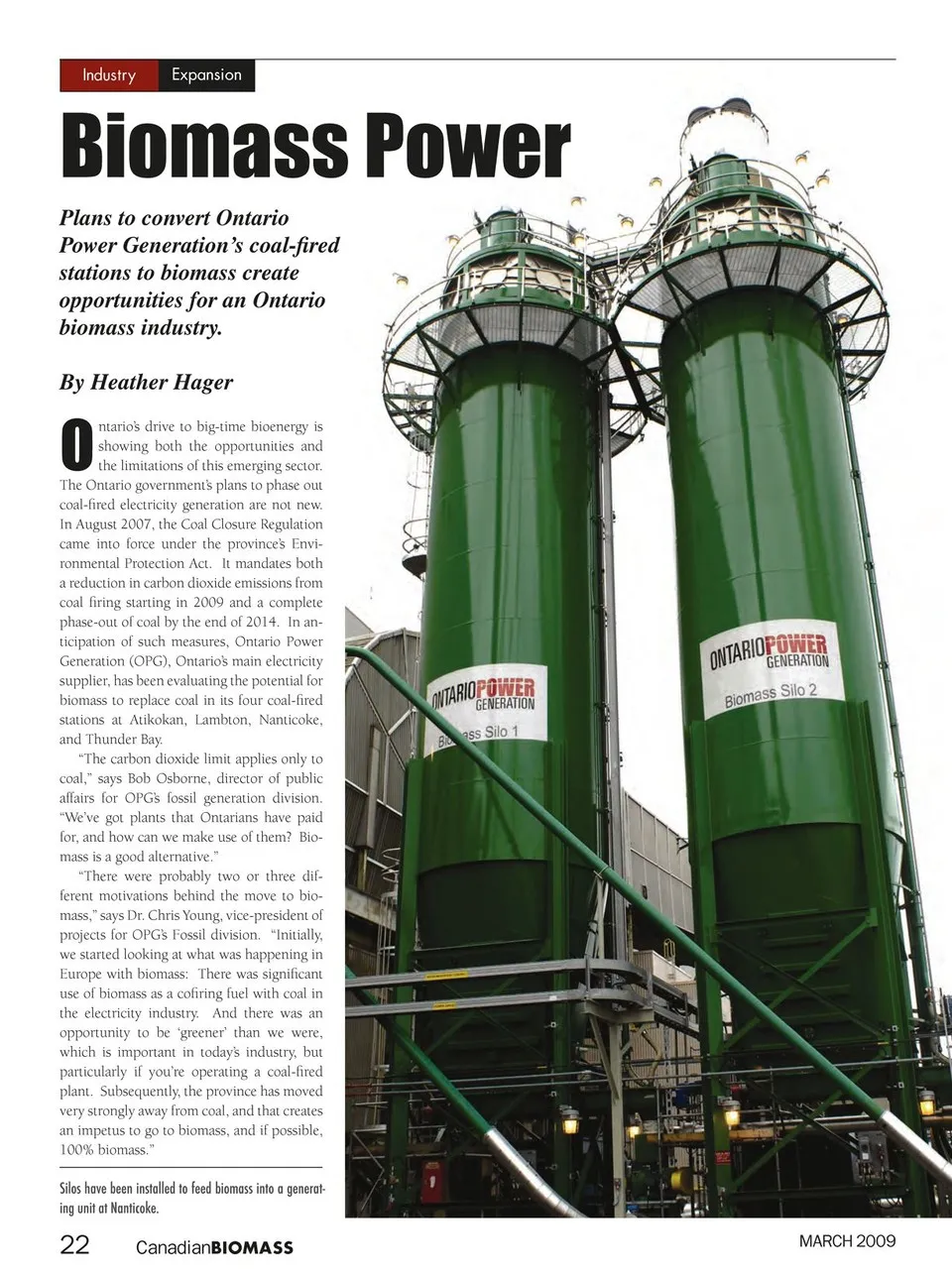
Industry Expansion Biomass Power Plans to convert Ontario Power Generation’s coal-fired stations to biomass create opportunities for an Ontario biomass industry. By Heather Hager The Ontario government’s plans to phase out coal-fired electricity generation are not new. In August 2007, the Coal Closure Regulation came into force under the province’s Envi- ronmental Protection Act. It mandates both a reduction in carbon dioxide emissions from coal firing starting in 2009 and a complete phase-out of coal by the end of 2014. In an- ticipation of such measures, Ontario Power Generation (OPG), Ontario’s main electricity supplier, has been evaluating the potential for biomass to replace coal in its four coal-fired stations at Atikokan, Lambton, Nanticoke, and Thunder Bay. “The carbon dioxide limit applies only to O coal,” says Bob Osborne, director of public affairs for OPG’s fossil generation division. “We’ve got plants that Ontarians have paid for, and how can we make use of them? Bio- mass is a good alternative.” “There were probably two or three dif- ferent motivations behind the move to bio- mass,” says Dr. Chris Young, vice-president of projects for OPG’s Fossil division. “Initially, we started looking at what was happening in Europe with biomass: There was significant use of biomass as a cofiring fuel with coal in the electricity industry. And there was an opportunity to be ‘greener’ than we were, which is important in today’s industry, but particularly if you’re operating a coal-fired plant. Subsequently, the province has moved very strongly away from coal, and that creates an impetus to go to biomass, and if possible, 100% biomass.” Silos have been installed to feed biomass into a generat- ing unit at Nanticoke. 22 CanadianBIOMASS MARCH 2009 ntario’s drive to big-time bioenergy is showing both the opportunities and the limitations of this emerging sector.
Canadian Biomass March 2009: Page 22