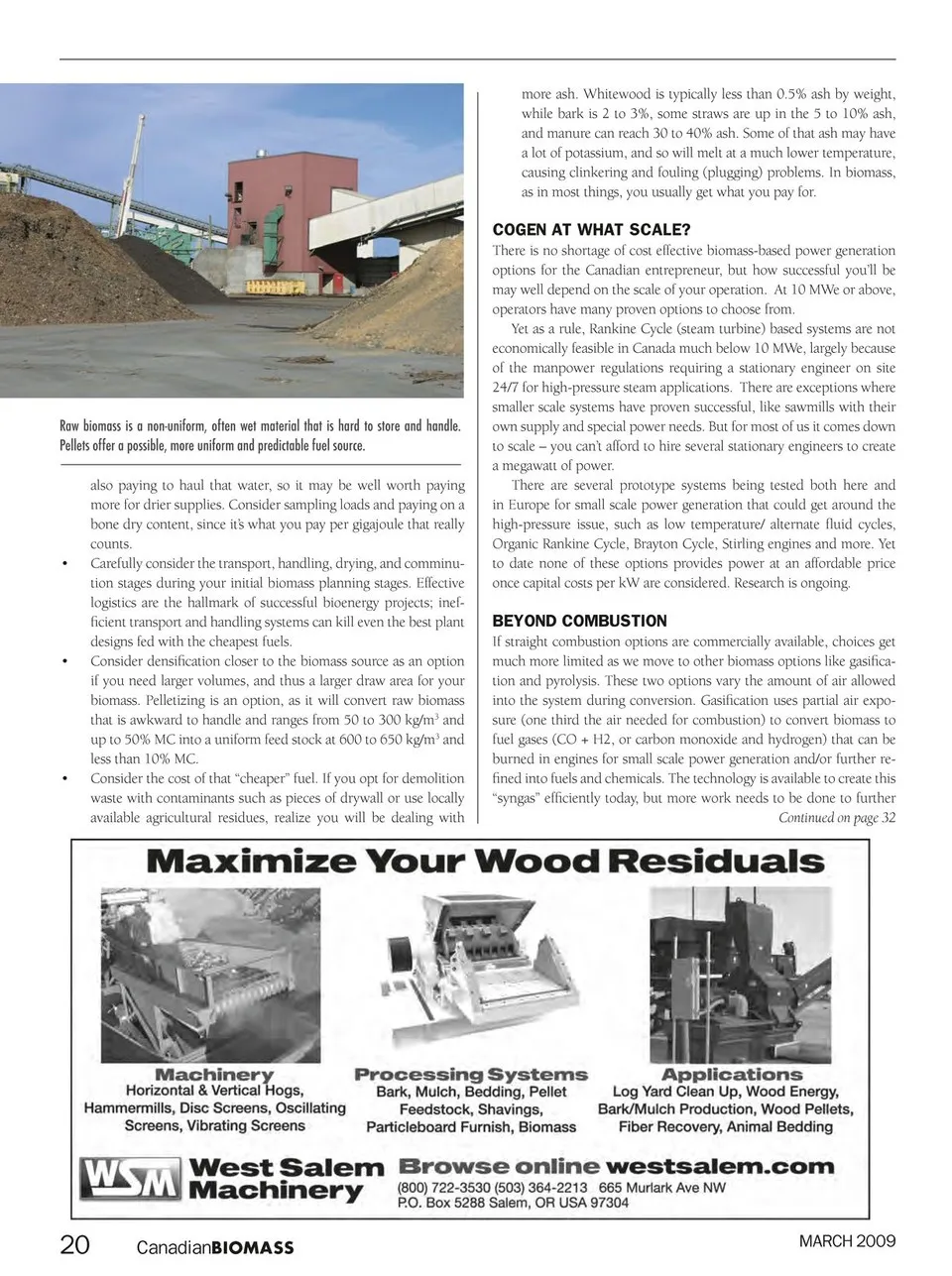
more ash. Whitewood is typically less than 0.5% ash by weight, while bark is 2 to 3%, some straws are up in the 5 to 10% ash, and manure can reach 30 to 40% ash. Some of that ash may have a lot of potassium, and so will melt at a much lower temperature, causing clinkering and fouling (plugging) problems. In biomass, as in most things, you usually get what you pay for. cogeN at what scale? There is no shortage of cost effective biomass-based power generation options for the Canadian entrepreneur, but how successful you’ll be may well depend on the scale of your operation. At 10 MWe or above, operators have many proven options to choose from. Yet as a rule, Rankine Cycle (steam turbine) based systems are not Raw biomass is a non-uniform, often wet material that is hard to store and handle. Pellets offer a possible, more uniform and predictable fuel source. also paying to haul that water, so it may be well worth paying more for drier supplies. Consider sampling loads and paying on a bone dry content, since it’s what you pay per gigajoule that really counts. • Carefully consider the transport, handling, drying, and comminu- tion stages during your initial biomass planning stages. Effective logistics are the hallmark of successful bioenergy projects; inef- ficient transport and handling systems can kill even the best plant designs fed with the cheapest fuels. • Consider densification closer to the biomass source as an option if you need larger volumes, and thus a larger draw area for your biomass. Pelletizing is an option, as it will convert raw biomass that is awkward to handle and ranges from 50 to 300 kg/m3 up to 50% MC into a uniform feed stock at 600 to 650 kg/m3 and and less than 10% MC. • Consider the cost of that “cheaper” fuel. If you opt for demolition waste with contaminants such as pieces of drywall or use locally available agricultural residues, realize you will be dealing with economically feasible in Canada much below 10 MWe, largely because of the manpower regulations requiring a stationary engineer on site 24/7 for high-pressure steam applications. There are exceptions where smaller scale systems have proven successful, like sawmills with their own supply and special power needs. But for most of us it comes down to scale – you can’t afford to hire several stationary engineers to create a megawatt of power. There are several prototype systems being tested both here and in Europe for small scale power generation that could get around the high-pressure issue, such as low temperature/ alternate fluid cycles, Organic Rankine Cycle, Brayton Cycle, Stirling engines and more. Yet to date none of these options provides power at an affordable price once capital costs per kW are considered. Research is ongoing. beyoNd combustioN If straight combustion options are commercially available, choices get much more limited as we move to other biomass options like gasifica- tion and pyrolysis. These two options vary the amount of air allowed into the system during conversion. Gasification uses partial air expo- sure (one third the air needed for combustion) to convert biomass to fuel gases (CO + H2, or carbon monoxide and hydrogen) that can be burned in engines for small scale power generation and/or further re- fined into fuels and chemicals. The technology is available to create this “syngas” efficiently today, but more work needs to be done to further Continued on page 32 20 CanadianBIOMASS MARCH 2009
Canadian Biomass March 2009: Page 20