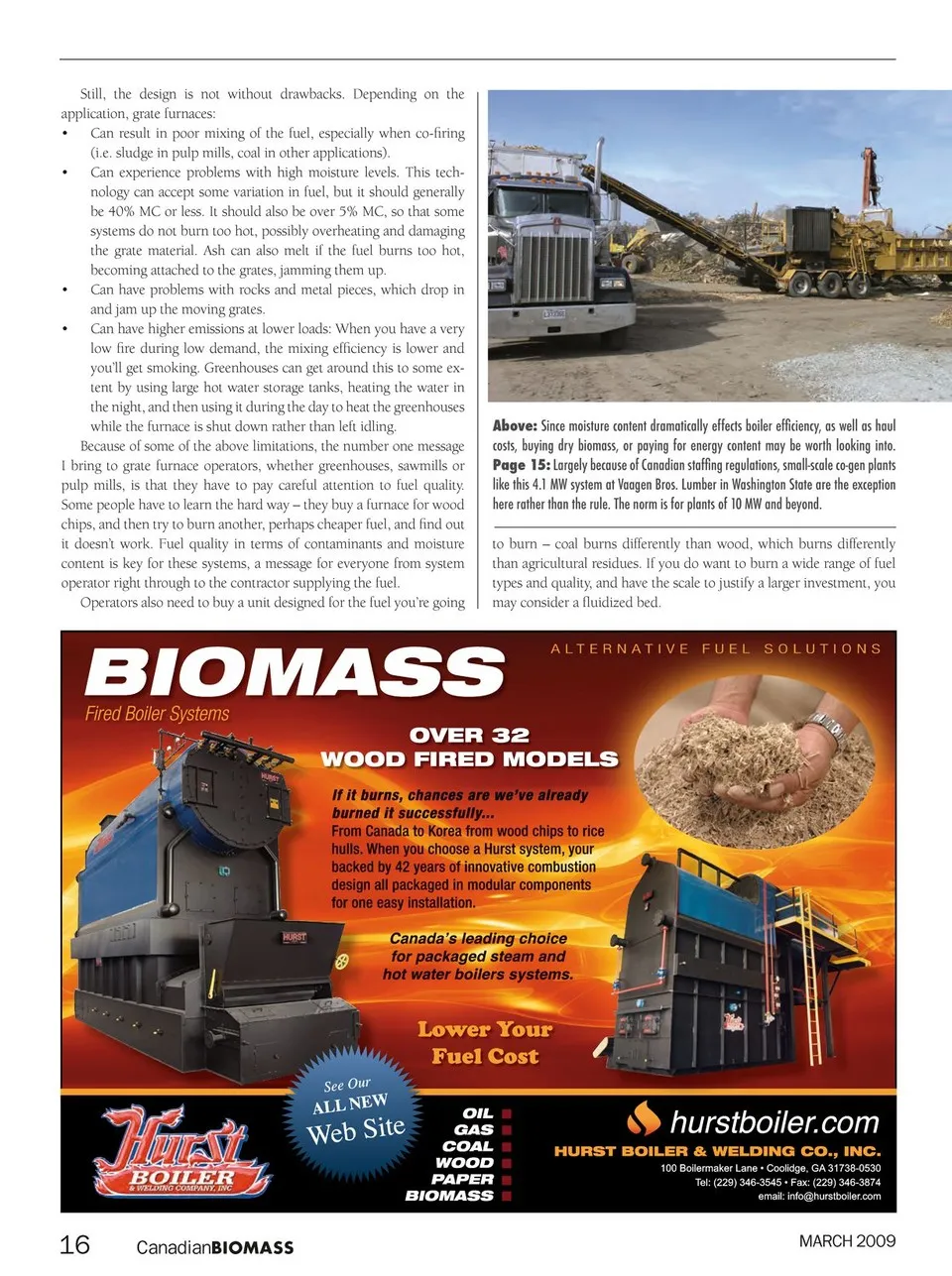
Still, the design is not without drawbacks. Depending on the application, grate furnaces: • Can result in poor mixing of the fuel, especially when co-firing (i.e. sludge in pulp mills, coal in other applications). • Can experience problems with high moisture levels. This tech- nology can accept some variation in fuel, but it should generally be 40% MC or less. It should also be over 5% MC, so that some systems do not burn too hot, possibly overheating and damaging the grate material. Ash can also melt if the fuel burns too hot, becoming attached to the grates, jamming them up. • Can have problems with rocks and metal pieces, which drop in and jam up the moving grates. • Can have higher emissions at lower loads: When you have a very low fire during low demand, the mixing efficiency is lower and you’ll get smoking. Greenhouses can get around this to some ex- tent by using large hot water storage tanks, heating the water in the night, and then using it during the day to heat the greenhouses while the furnace is shut down rather than left idling. Because of some of the above limitations, the number one message I bring to grate furnace operators, whether greenhouses, sawmills or pulp mills, is that they have to pay careful attention to fuel quality. Some people have to learn the hard way – they buy a furnace for wood chips, and then try to burn another, perhaps cheaper fuel, and find out it doesn’t work. Fuel quality in terms of contaminants and moisture content is key for these systems, a message for everyone from system operator right through to the contractor supplying the fuel. Operators also need to buy a unit designed for the fuel you’re going Above: Since moisture content dramatically effects boiler efficiency, as well as haul costs, buying dry biomass, or paying for energy content may be worth looking into. Page 15: Largely because of Canadian staffing regulations, small-scale co-gen plants like this 4.1 MW system at Vaagen Bros. Lumber in Washington State are the exception here rather than the rule. The norm is for plants of 10 MW and beyond. to burn – coal burns differently than wood, which burns differently than agricultural residues. If you do want to burn a wide range of fuel types and quality, and have the scale to justify a larger investment, you may consider a fluidized bed. 16 CanadianBIOMASS MARCH 2009
Canadian Biomass March 2009: Page 16