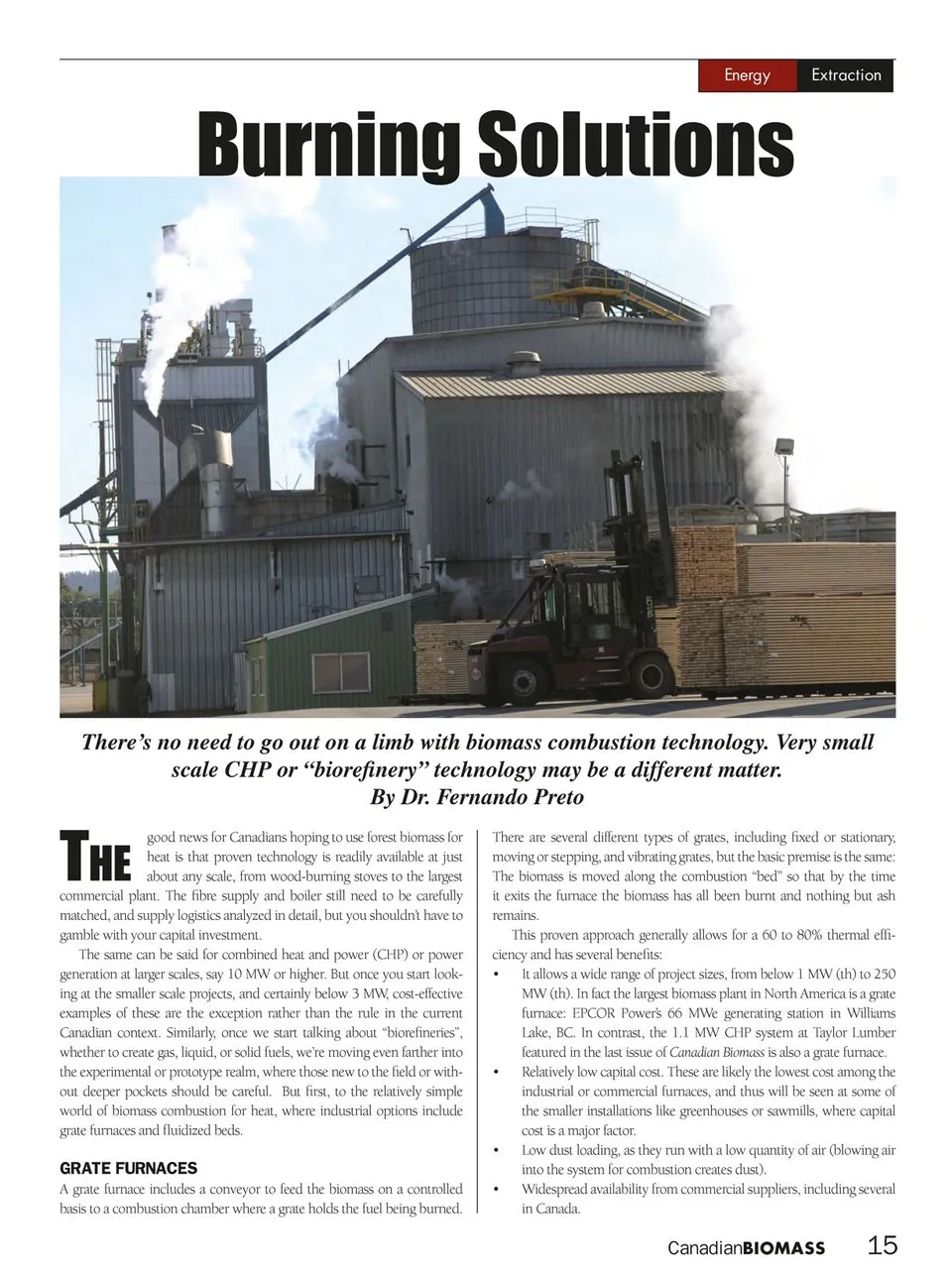
Energy Burning Solutions Extraction There’s no need to go out on a limb with biomass combustion technology. Very small scale CHP or “biorefinery” technology may be a different matter. By Dr. Fernando Preto the good news for Canadians hoping to use forest biomass for heat is that proven technology is readily available at just about any scale, from wood-burning stoves to the largest commercial plant. The fibre supply and boiler still need to be carefully matched, and supply logistics analyzed in detail, but you shouldn’t have to gamble with your capital investment. The same can be said for combined heat and power (CHP) or power generation at larger scales, say 10 MW or higher. But once you start look- ing at the smaller scale projects, and certainly below 3 MW, cost-effective examples of these are the exception rather than the rule in the current Canadian context. Similarly, once we start talking about “biorefineries”, whether to create gas, liquid, or solid fuels, we’re moving even farther into the experimental or prototype realm, where those new to the field or with- out deeper pockets should be careful. But first, to the relatively simple world of biomass combustion for heat, where industrial options include grate furnaces and fluidized beds. grate FurNaces A grate furnace includes a conveyor to feed the biomass on a controlled basis to a combustion chamber where a grate holds the fuel being burned. There are several different types of grates, including fixed or stationary, moving or stepping, and vibrating grates, but the basic premise is the same: The biomass is moved along the combustion “bed” so that by the time it exits the furnace the biomass has all been burnt and nothing but ash remains. This proven approach generally allows for a 60 to 80% thermal effi- ciency and has several benefits: • It allows a wide range of project sizes, from below 1 MW (th) to 250 MW (th). In fact the largest biomass plant in North America is a grate furnace: EPCOR Power’s 66 MWe generating station in Williams Lake, BC. In contrast, the 1.1 MW CHP system at Taylor Lumber featured in the last issue of Canadian Biomass is also a grate furnace. • Relatively low capital cost. These are likely the lowest cost among the industrial or commercial furnaces, and thus will be seen at some of the smaller installations like greenhouses or sawmills, where capital cost is a major factor. • Low dust loading, as they run with a low quantity of air (blowing air into the system for combustion creates dust). • Widespread availability from commercial suppliers, including several in Canada. CanadianBIOMASS 15
Canadian Biomass March 2009: Page 15