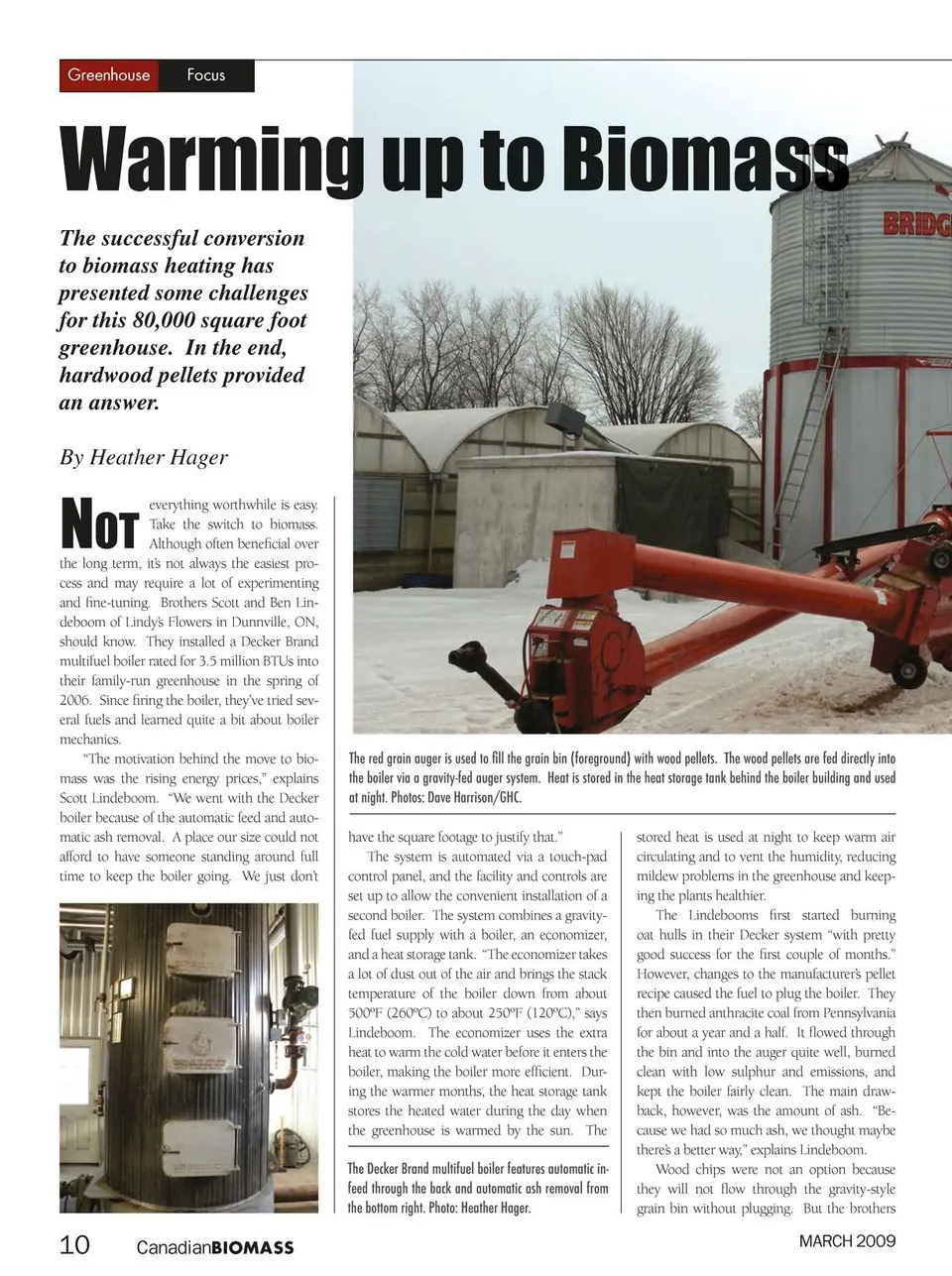
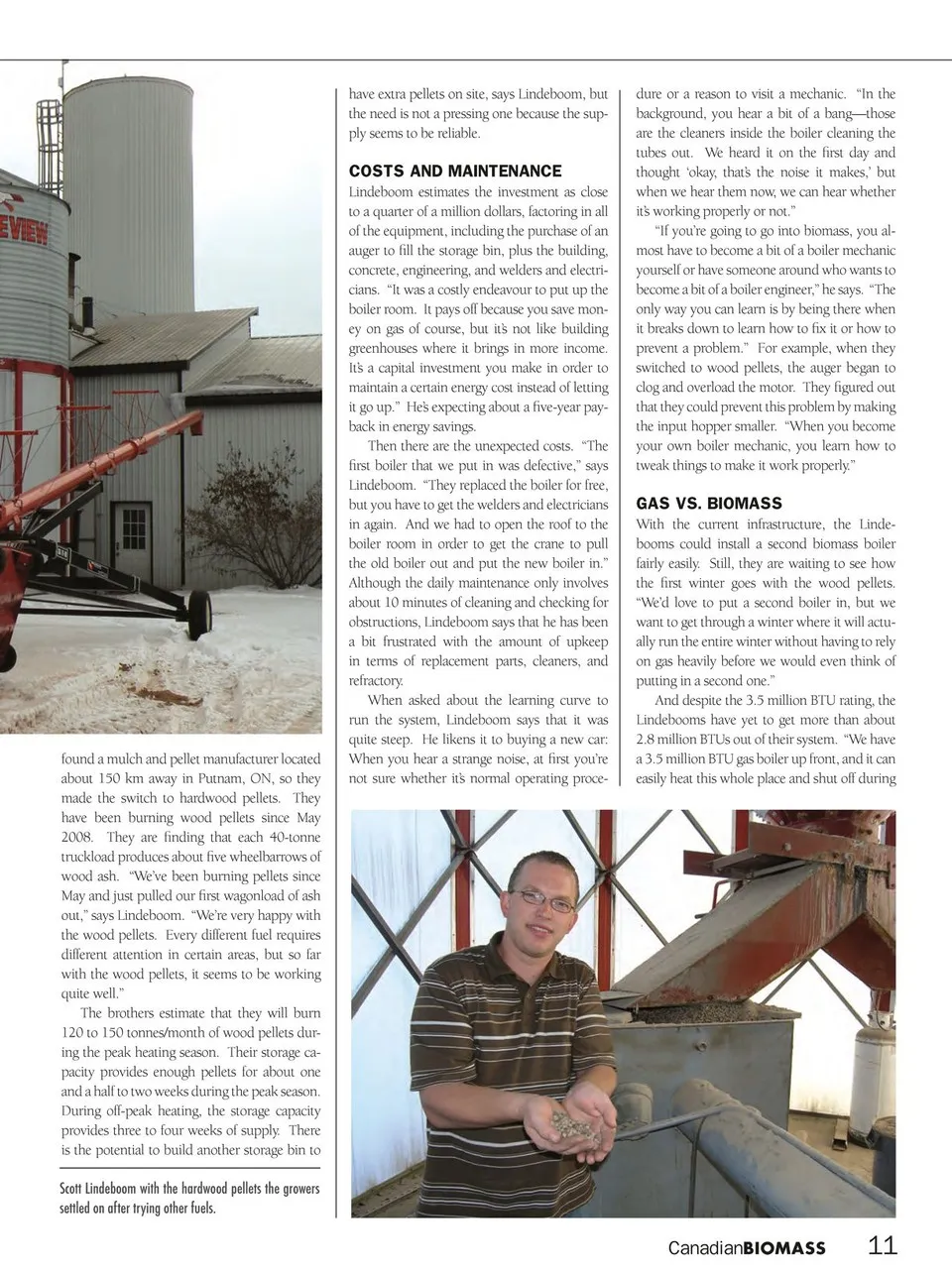
have extra pellets on site, says Lindeboom, but the need is not a pressing one because the sup- ply seems to be reliable. costs aNd maiNteNaNce Lindeboom estimates the investment as close to a quarter of a million dollars, factoring in all of the equipment, including the purchase of an auger to fill the storage bin, plus the building, concrete, engineering, and welders and electri- cians. “It was a costly endeavour to put up the boiler room. It pays off because you save mon- ey on gas of course, but it’s not like building greenhouses where it brings in more income. It’s a capital investment you make in order to maintain a certain energy cost instead of letting it go up.” He’s expecting about a five-year pay- back in energy savings. Then there are the unexpected costs. “The first boiler that we put in was defective,” says Lindeboom. “They replaced the boiler for free, but you have to get the welders and electricians in again. And we had to open the roof to the boiler room in order to get the crane to pull the old boiler out and put the new boiler in.” Although the daily maintenance only involves about 10 minutes of cleaning and checking for obstructions, Lindeboom says that he has been a bit frustrated with the amount of upkeep in terms of replacement parts, cleaners, and refractory. When asked about the learning curve to found a mulch and pellet manufacturer located about 150 km away in Putnam, ON, so they made the switch to hardwood pellets. They have been burning wood pellets since May 2008. They are finding that each 40-tonne truckload produces about five wheelbarrows of wood ash. “We’ve been burning pellets since May and just pulled our first wagonload of ash out,” says Lindeboom. “We’re very happy with the wood pellets. Every different fuel requires different attention in certain areas, but so far with the wood pellets, it seems to be working quite well.” The brothers estimate that they will burn 120 to 150 tonnes/month of wood pellets dur- ing the peak heating season. Their storage ca- pacity provides enough pellets for about one and a half to two weeks during the peak season. During off-peak heating, the storage capacity provides three to four weeks of supply. There is the potential to build another storage bin to Scott Lindeboom with the hardwood pellets the growers settled on after trying other fuels. CanadianBIOMASS 11 run the system, Lindeboom says that it was quite steep. He likens it to buying a new car: When you hear a strange noise, at first you’re not sure whether it’s normal operating proce- dure or a reason to visit a mechanic. “In the background, you hear a bit of a bang—those are the cleaners inside the boiler cleaning the tubes out. We heard it on the first day and thought ‘okay, that’s the noise it makes,’ but when we hear them now, we can hear whether it’s working properly or not.” “If you’re going to go into biomass, you al- most have to become a bit of a boiler mechanic yourself or have someone around who wants to become a bit of a boiler engineer,” he says. “The only way you can learn is by being there when it breaks down to learn how to fix it or how to prevent a problem.” For example, when they switched to wood pellets, the auger began to clog and overload the motor. They figured out that they could prevent this problem by making the input hopper smaller. “When you become your own boiler mechanic, you learn how to tweak things to make it work properly.” gas vs. biomass With the current infrastructure, the Linde- booms could install a second biomass boiler fairly easily. Still, they are waiting to see how the first winter goes with the wood pellets. “We’d love to put a second boiler in, but we want to get through a winter where it will actu- ally run the entire winter without having to rely on gas heavily before we would even think of putting in a second one.” And despite the 3.5 million BTU rating, the Lindebooms have yet to get more than about 2.8 million BTUs out of their system. “We have a 3.5 million BTU gas boiler up front, and it can easily heat this whole place and shut off during
Canadian Biomass March 2009: Page 11