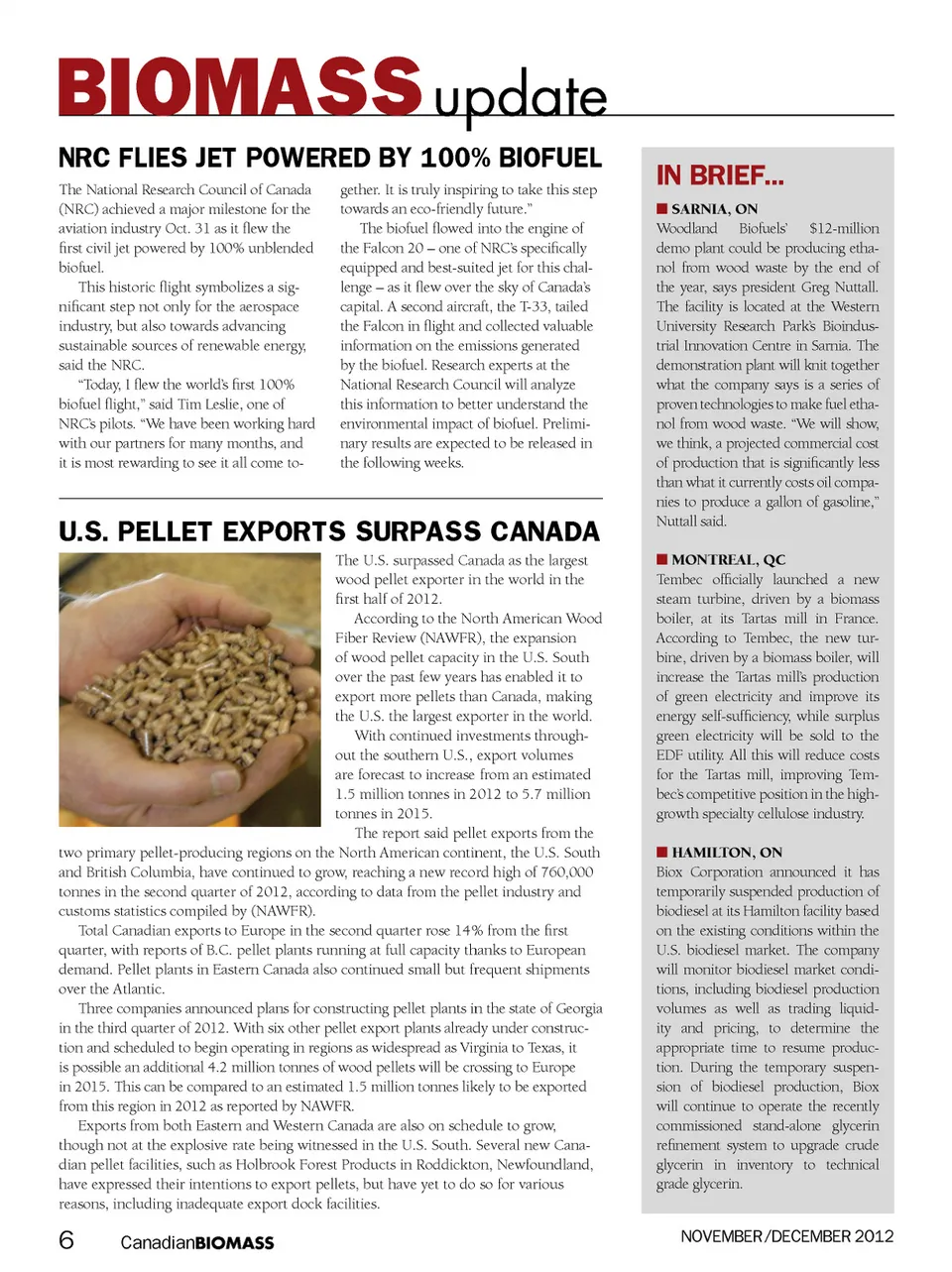
BIOMASS update NRC FLIES JET POWERED BY 100% BIOFUEL The National Research Council of Canada (NRC) achieved a major milestone for the aviation industry Oct. 31 as it flew the first civil jet powered by 100% unblended biofuel. This historic flight symbolizes a sig-nificant step not only for the aerospace industry, but also towards advancing sustainable sources of renewable energy, said the NRC. “Today, I flew the world’s first 100% biofuel flight,” said Tim Leslie, one of NRC’s pilots. “We have been working hard with our partners for many months, and it is most rewarding to see it all come to-gether. It is truly inspiring to take this step towards an eco-friendly future.” The biofuel flowed into the engine of the Falcon 20 – one of NRC’s specifically equipped and best-suited jet for this chal-lenge – as it flew over the sky of Canada’s capital. A second aircraft, the T-33, tailed the Falcon in flight and collected valuable information on the emissions generated by the biofuel. Research experts at the National Research Council will analyze this information to better understand the environmental impact of biofuel. Prelimi-nary results are expected to be released in the following weeks. IN BRIEF... n SARNIA, ON Woodland Biofuels’ $12-million demo plant could be producing etha-nol from wood waste by the end of the year, says president Greg Nuttall. The facility is located at the Western University Research Park’s Bioindus-trial Innovation Centre in Sarnia. The demonstration plant will knit together what the company says is a series of proven technologies to make fuel etha-nol from wood waste. “We will show, we think, a projected commercial cost of production that is significantly less than what it currently costs oil compa-nies to produce a gallon of gasoline,” Nuttall said. n MONTREAL, QC Tembec officially launched a new steam turbine, driven by a biomass boiler, at its Tartas mill in France. According to Tembec, the new tur-bine, driven by a biomass boiler, will increase the Tartas mill’s production of green electricity and improve its energy self-sufficiency, while surplus green electricity will be sold to the EDF utility. All this will reduce costs for the Tartas mill, improving Tem-bec’s competitive position in the high-growth specialty cellulose industry. n HAMILTON, ON Biox Corporation announced it has temporarily suspended production of biodiesel at its Hamilton facility based on the existing conditions within the U.S. biodiesel market. The company will monitor biodiesel market condi-tions, including biodiesel production volumes as well as trading liquid-ity and pricing, to determine the appropriate time to resume produc-tion. During the temporary suspen-sion of biodiesel production, Biox will continue to operate the recently commissioned stand-alone glycerin refinement system to upgrade crude glycerin in inventory to technical grade glycerin. NOVEMBER/DECEMBER 2012 U.S. PELLET EXPORTS SURPASS CANADA The U.S. surpassed Canada as the largest wood pellet exporter in the world in the first half of 2012. According to the North American Wood Fiber Review (NAWFR), the expansion of wood pellet capacity in the U.S. South over the past few years has enabled it to export more pellets than Canada, making the U.S. the largest exporter in the world. With continued investments through-out the southern U.S., export volumes are forecast to increase from an estimated 1.5 million tonnes in 2012 to 5.7 million tonnes in 2015. The report said pellet exports from the two primary pellet-producing regions on the North American continent, the U.S. South and British Columbia, have continued to grow, reaching a new record high of 760,000 tonnes in the second quarter of 2012, according to data from the pellet industry and customs statistics compiled by (NAWFR). Total Canadian exports to Europe in the second quarter rose 14% from the first quarter, with reports of B.C. pellet plants running at full capacity thanks to European demand. Pellet plants in Eastern Canada also continued small but frequent shipments over the Atlantic. Three companies announced plans for constructing pellet plants in the state of Georgia in the third quarter of 2012. With six other pellet export plants already under construc-tion and scheduled to begin operating in regions as widespread as Virginia to Texas, it is possible an additional 4.2 million tonnes of wood pellets will be crossing to Europe in 2015. This can be compared to an estimated 1.5 million tonnes likely to be exported from this region in 2012 as reported by NAWFR. Exports from both Eastern and Western Canada are also on schedule to grow, though not at the explosive rate being witnessed in the U.S. South. Several new Cana-dian pellet facilities, such as Holbrook Forest Products in Roddickton, Newfoundland, have expressed their intentions to export pellets, but have yet to do so for various reasons, including inadequate export dock facilities. 6 Canadian BIOMASS
Canadian Biomass November/December 2012: Page 6