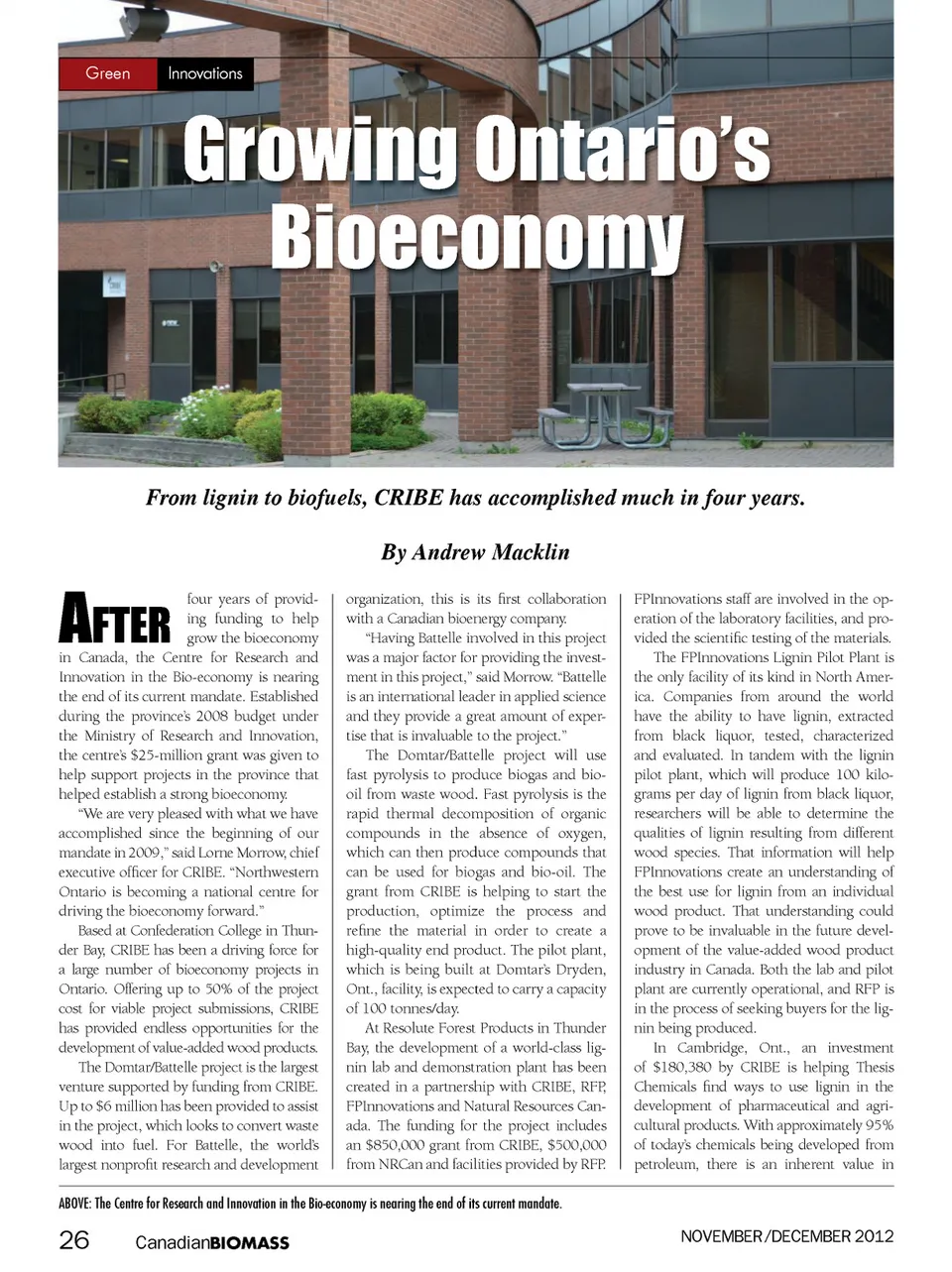
Green Innovations Growing Ontario’s Bioeconomy From lignin to biofuels, CRIBE has accomplished much in four years. By Andrew Macklin A fter four years of provid-ing funding to help grow the bioeconomy in Canada, the Centre for Research and Innovation in the Bio-economy is nearing the end of its current mandate. Established during the province’s 2008 budget under the Ministry of Research and Innovation, the centre’s $25-million grant was given to help support projects in the province that helped establish a strong bioeconomy. “We are very pleased with what we have accomplished since the beginning of our mandate in 2009,” said Lorne Morrow, chief executive officer for CRIBE. “Northwestern Ontario is becoming a national centre for driving the bioeconomy forward.” Based at Confederation College in Thun-der Bay, CRIBE has been a driving force for a large number of bioeconomy projects in Ontario. Offering up to 50% of the project cost for viable project submissions, CRIBE has provided endless opportunities for the development of value-added wood products. The Domtar/Battelle project is the largest venture supported by funding from CRIBE. Up to $6 million has been provided to assist in the project, which looks to convert waste wood into fuel. For Battelle, the world’s largest nonprofit research and development organization, this is its first collaboration with a Canadian bioenergy company. “Having Battelle involved in this project was a major factor for providing the invest-ment in this project,” said Morrow. “Battelle is an international leader in applied science and they provide a great amount of exper-tise that is invaluable to the project.” The Domtar/Battelle project will use fast pyrolysis to produce biogas and bio-oil from waste wood. Fast pyrolysis is the rapid thermal decomposition of organic compounds in the absence of oxygen, which can then produce compounds that can be used for biogas and bio-oil. The grant from CRIBE is helping to start the production, optimize the process and refine the material in order to create a high-quality end product. The pilot plant, which is being built at Domtar’s Dryden, Ont., facility, is expected to carry a capacity of 100 tonnes/day. At Resolute Forest Products in Thunder Bay, the development of a world-class lig-nin lab and demonstration plant has been created in a partnership with CRIBE, RFP , FPInnovations and Natural Resources Can-ada. The funding for the project includes an $850,000 grant from CRIBE, $500,000 from NRCan and facilities provided by RFP . FPInnovations staff are involved in the op-eration of the laboratory facilities, and pro-vided the scientific testing of the materials. The FPInnovations Lignin Pilot Plant is the only facility of its kind in North Amer-ica. Companies from around the world have the ability to have lignin, extracted from black liquor, tested, characterized and evaluated. In tandem with the lignin pilot plant, which will produce 100 kilo-grams per day of lignin from black liquor, researchers will be able to determine the qualities of lignin resulting from different wood species. That information will help FPInnovations create an understanding of the best use for lignin from an individual wood product. That understanding could prove to be invaluable in the future devel-opment of the value-added wood product industry in Canada. Both the lab and pilot plant are currently operational, and RFP is in the process of seeking buyers for the lig-nin being produced. In Cambridge, Ont., an investment of $180,380 by CRIBE is helping Thesis Chemicals find ways to use lignin in the development of pharmaceutical and agri-cultural products. With approximately 95% of today’s chemicals being developed from petroleum, there is an inherent value in ABOVE : The Centre for Research and Innovation in the Bio-economy is nearing the end of its current mandate. 26 Canadian BIOMASS NOVEMBER/DECEMBER 2012
Canadian Biomass November/December 2012: Page 26