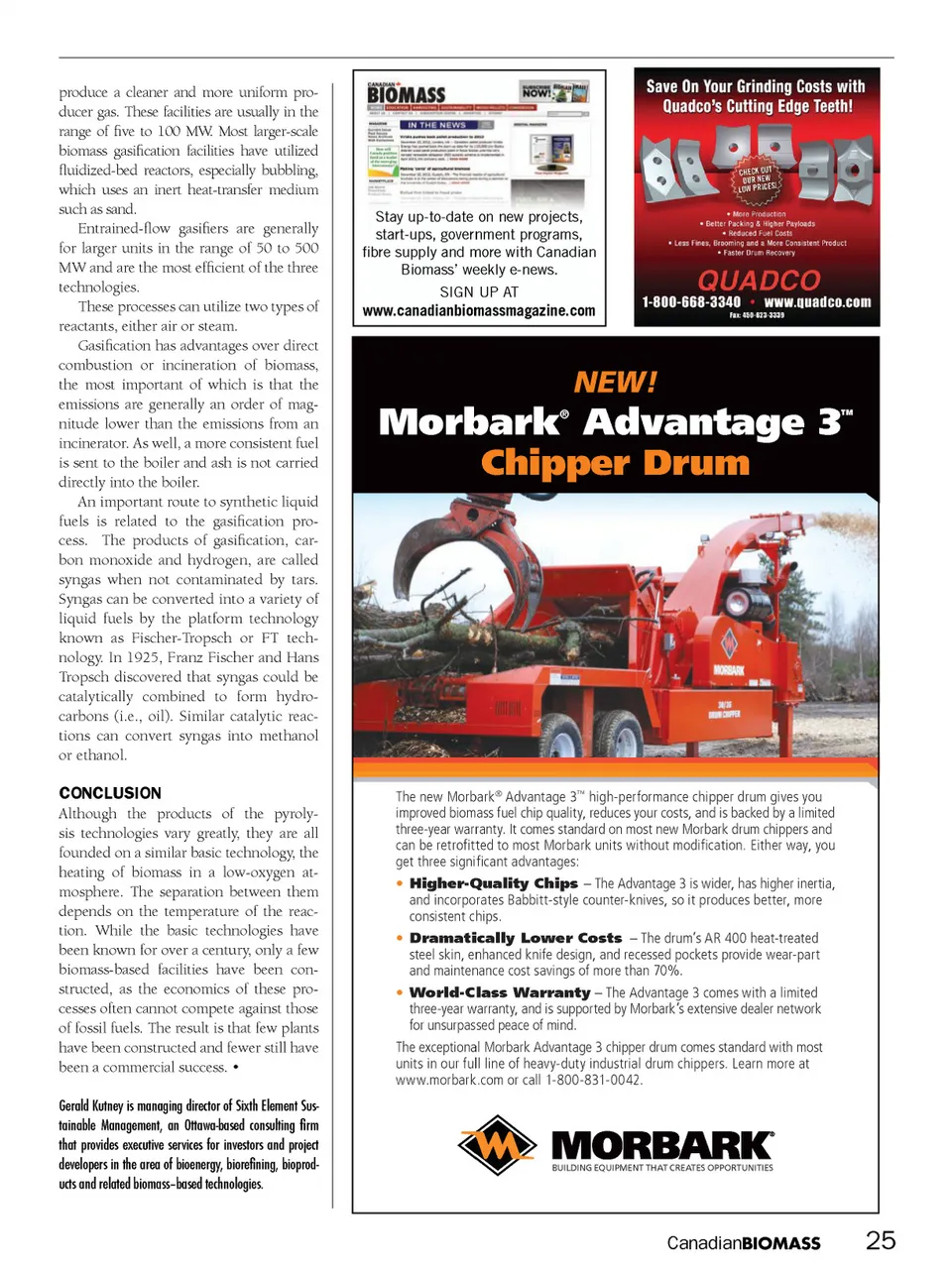
produce a cleaner and more uniform pro-ducer gas. These facilities are usually in the range of five to 100 MW . Most larger-scale biomass gasification facilities have utilized fluidized-bed reactors, especially bubbling, which uses an inert heat-transfer medium such as sand. Entrained-flow gasifiers are generally for larger units in the range of 50 to 500 MW and are the most efficient of the three technologies. These processes can utilize two types of reactants, either air or steam. Gasification has advantages over direct combustion or incineration of biomass, the most important of which is that the emissions are generally an order of mag-nitude lower than the emissions from an incinerator. As well, a more consistent fuel is sent to the boiler and ash is not carried directly into the boiler. An important route to synthetic liquid fuels is related to the gasification pro-cess. The products of gasification, car-bon monoxide and hydrogen, are called syngas when not contaminated by tars. Syngas can be converted into a variety of liquid fuels by the platform technology known as Fischer-Tropsch or FT tech-nology. In 1925, Franz Fischer and Hans Tropsch discovered that syngas could be catalytically combined to form hydro-carbons (i.e., oil). Similar catalytic reac-tions can convert syngas into methanol or ethanol. CONCLUSION Stay up-to-date on new projects, start-ups, government programs, fibre supply and more with Canadian Biomass’ weekly e-news. SIGN UP AT www.canadianbiomassmagazine.com Morbark Advantage 3 Chipper Drum ® ™ NEW! Although the products of the pyroly-sis technologies vary greatly, they are all founded on a similar basic technology, the heating of biomass in a low-oxygen at-mosphere. The separation between them depends on the temperature of the reac-tion. While the basic technologies have been known for over a century, only a few biomass-based facilities have been con-structed, as the economics of these pro-cesses often cannot compete against those of fossil fuels. The result is that few plants have been constructed and fewer still have been a commercial success. • Gerald Kutney is managing director of Sixth Element Sus-tainable Management, an Ottawa-based consulting firm that provides executive services for investors and project developers in the area of bioenergy, biorefining, bioprod -ucts and related biomass–based technologies. The new Morbark ® Advantage 3 ™ high-performance chipper drum gives you improved biomass fuel chip quality, reduces your costs, and is backed by a limited three-year warranty. It comes standard on most new Morbark drum chippers and can be retrofitted to most Morbark units without modification. Either way, you get three significant advantages: • Higher-Quality Chips – The Advantage 3 is wider, has higher inertia, and incorporates Babbitt-style counter-knives, so it produces better, more consistent chips. • Dramatically Lower Costs – The drum’s AR 400 heat-treated steel skin, enhanced knife design, and recessed pockets provide wear-part and maintenance cost savings of more than 70%. • World-Class Warranty – The Advantage 3 comes with a limited three-year warranty, and is supported by Morbark’s extensive dealer network for unsurpassed peace of mind. The exceptional Morbark Advantage 3 chipper drum comes standard with most units in our full line of heavy-duty industrial drum chippers. Learn more at www.morbark.com or call 1-800-831-0042. Building EquipmEnt that CrEatEs OppOrtunitiEs Canadian BIOMASS 25
Canadian Biomass November/December 2012: Page 25