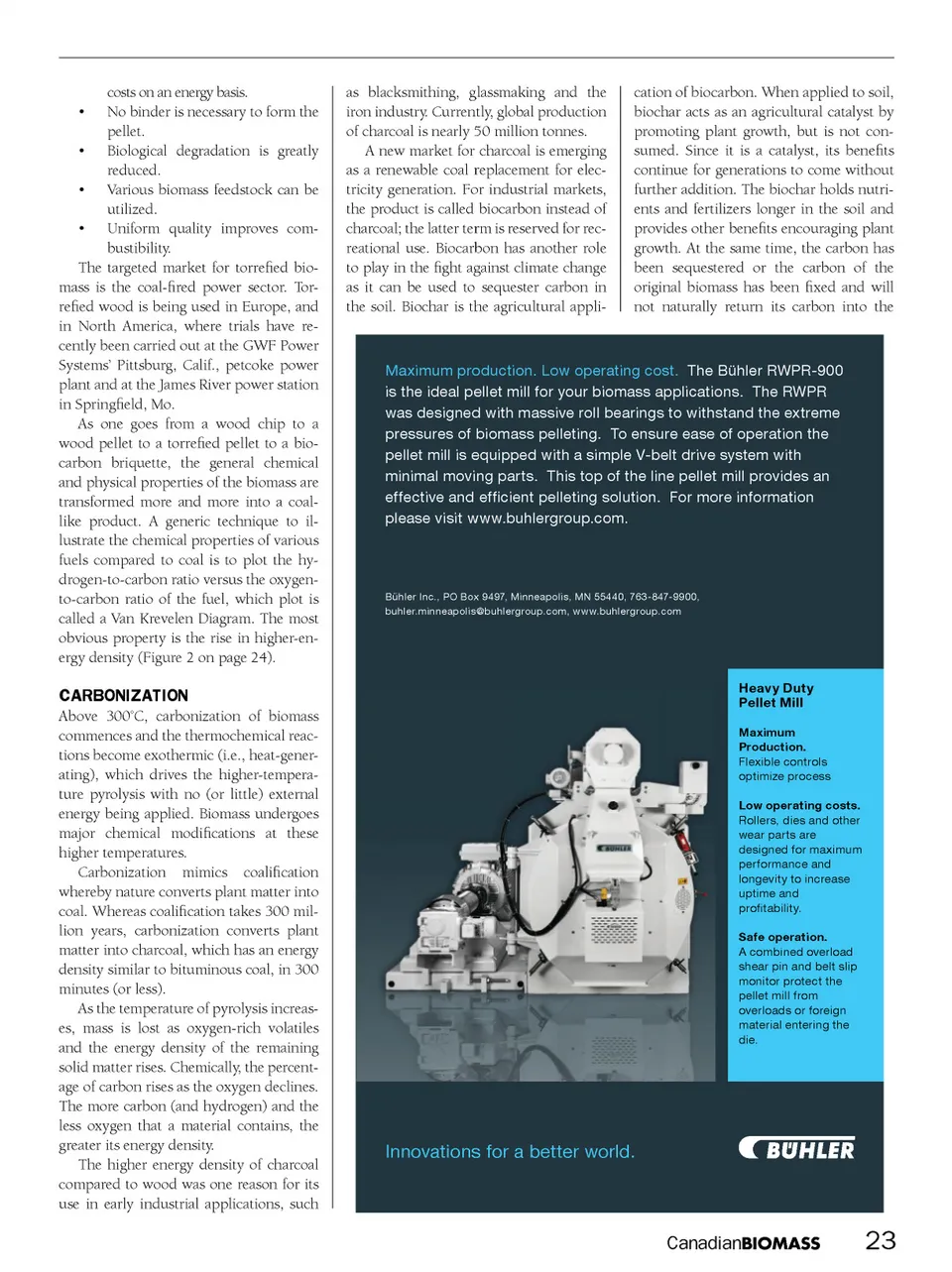
costs on an energy basis. No binder is necessary to form the pellet. • Biological degradation is greatly reduced. • Various biomass feedstock can be utilized. • Uniform quality improves com-bustibility. The targeted market for torrefied bio-mass is the coal-fired power sector. Tor-refied wood is being used in Europe, and in North America, where trials have re-cently been carried out at the GWF Power Systems’ Pittsburg, Calif., petcoke power plant and at the James River power station in Springfield, Mo. As one goes from a wood chip to a wood pellet to a torrefied pellet to a bio-carbon briquette, the general chemical and physical properties of the biomass are transformed more and more into a coal-like product. A generic technique to il-lustrate the chemical properties of various fuels compared to coal is to plot the hy-drogen-to-carbon ratio versus the oxygen-to-carbon ratio of the fuel, which plot is called a Van Krevelen Diagram. The most obvious property is the rise in higher-en-ergy density (Figure 2 on page 24). • CARBONIZATION as blacksmithing, glassmaking and the iron industry. Currently, global production of charcoal is nearly 50 million tonnes. A new market for charcoal is emerging as a renewable coal replacement for elec-tricity generation. For industrial markets, the product is called biocarbon instead of charcoal; the latter term is reserved for rec-reational use. Biocarbon has another role to play in the fight against climate change as it can be used to sequester carbon in the soil. Biochar is the agricultural appli-cation of biocarbon. When applied to soil, biochar acts as an agricultural catalyst by promoting plant growth, but is not con-sumed. Since it is a catalyst, its benefits continue for generations to come without further addition. The biochar holds nutri-ents and fertilizers longer in the soil and provides other benefits encouraging plant growth. At the same time, the carbon has been sequestered or the carbon of the original biomass has been fixed and will not naturally return its carbon into the Maximum production. Low operating cost. The Bühler RWPR-900 is the ideal pellet mill for your biomass applications. The RWPR was designed with massive roll bearings to withstand the extreme pressures of biomass pelleting. To ensure ease of operation the pellet mill is equipped with a simple V-belt drive system with minimal moving parts. This top of the line pellet mill provides an effective and effi cient pelleting solution. For more information please visit www.buhlergroup.com. Bühler Inc., PO Box 9497, Minneapolis, MN 55440, 763-847-9900, [email protected], www.buhlergroup.com Above 300˚C, carbonization of biomass commences and the thermochemical reac-tions become exothermic (i.e., heat-gener-ating), which drives the higher-tempera-ture pyrolysis with no (or little) external energy being applied. Biomass undergoes major chemical modifications at these higher temperatures. Carbonization mimics coalification whereby nature converts plant matter into coal. Whereas coalification takes 300 mil-lion years, carbonization converts plant matter into charcoal, which has an energy density similar to bituminous coal, in 300 minutes (or less). As the temperature of pyrolysis increas-es, mass is lost as oxygen-rich volatiles and the energy density of the remaining solid matter rises. Chemically, the percent-age of carbon rises as the oxygen declines. The more carbon (and hydrogen) and the less oxygen that a material contains, the greater its energy density. The higher energy density of charcoal compared to wood was one reason for its use in early industrial applications, such Heavy Duty Pellet Mill Maximum Production. Flexible controls optimize process Low operating costs. Rollers, dies and other wear parts are designed for maximum performance and longevity to increase uptime and profi tability. Safe operation. A combined overload shear pin and belt slip monitor protect the pellet mill from overloads or foreign material entering the die. Innovations for a better world. RWPR_2012.indd 1 Canadian BIOMASS 11/6/2012 8:27:20 AM 23
Canadian Biomass November/December 2012: Page 23