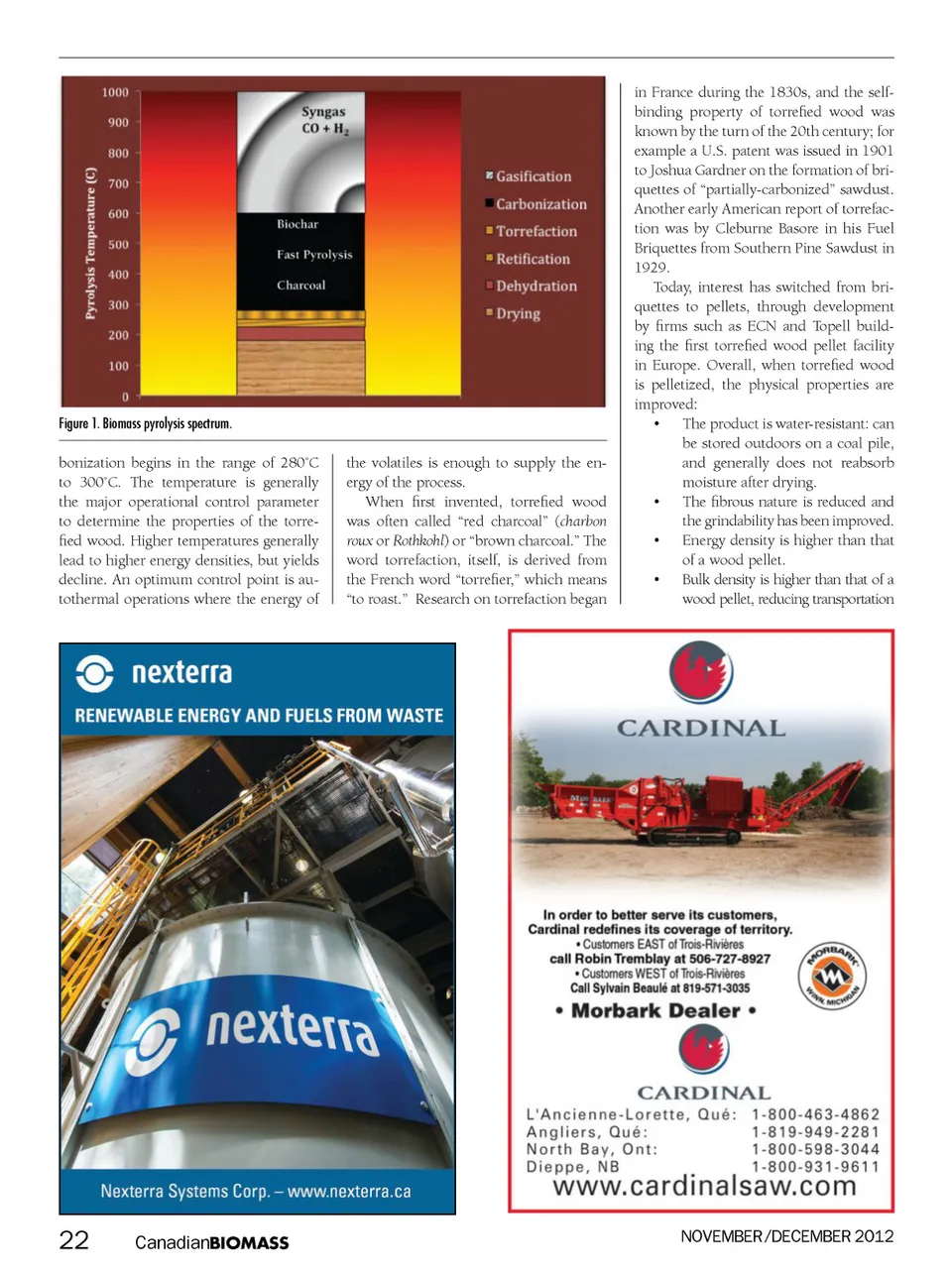
Figure 1. Biomass pyrolysis spectrum. bonization begins in the range of 280˚C to 300˚C. The temperature is generally the major operational control parameter to determine the properties of the torre-fied wood. Higher temperatures generally lead to higher energy densities, but yields decline. An optimum control point is au-tothermal operations where the energy of the volatiles is enough to supply the en-ergy of the process. When first invented, torrefied wood was often called “red charcoal” ( charbon roux or Rothkohl ) or “brown charcoal.” The word torrefaction, itself, is derived from the French word “torrefier,” which means “to roast.” Research on torrefaction began in France during the 1830s, and the self-binding property of torrefied wood was known by the turn of the 20th century; for example a U.S. patent was issued in 1901 to Joshua Gardner on the formation of bri-quettes of “partially-carbonized” sawdust. Another early American report of torrefac-tion was by Cleburne Basore in his Fuel Briquettes from Southern Pine Sawdust in 1929. Today, interest has switched from bri-quettes to pellets, through development by firms such as ECN and Topell build-ing the first torrefied wood pellet facility in Europe. Overall, when torrefied wood is pelletized, the physical properties are improved: • The product is water-resistant: can be stored outdoors on a coal pile, and generally does not reabsorb moisture after drying. • The fibrous nature is reduced and the grindability has been improved. • Energy density is higher than that of a wood pellet. • Bulk density is higher than that of a wood pellet, reducing transportation 22 Canadian BIOMASS NOVEMBER/DECEMBER 2012
Canadian Biomass November/December 2012: Page 22