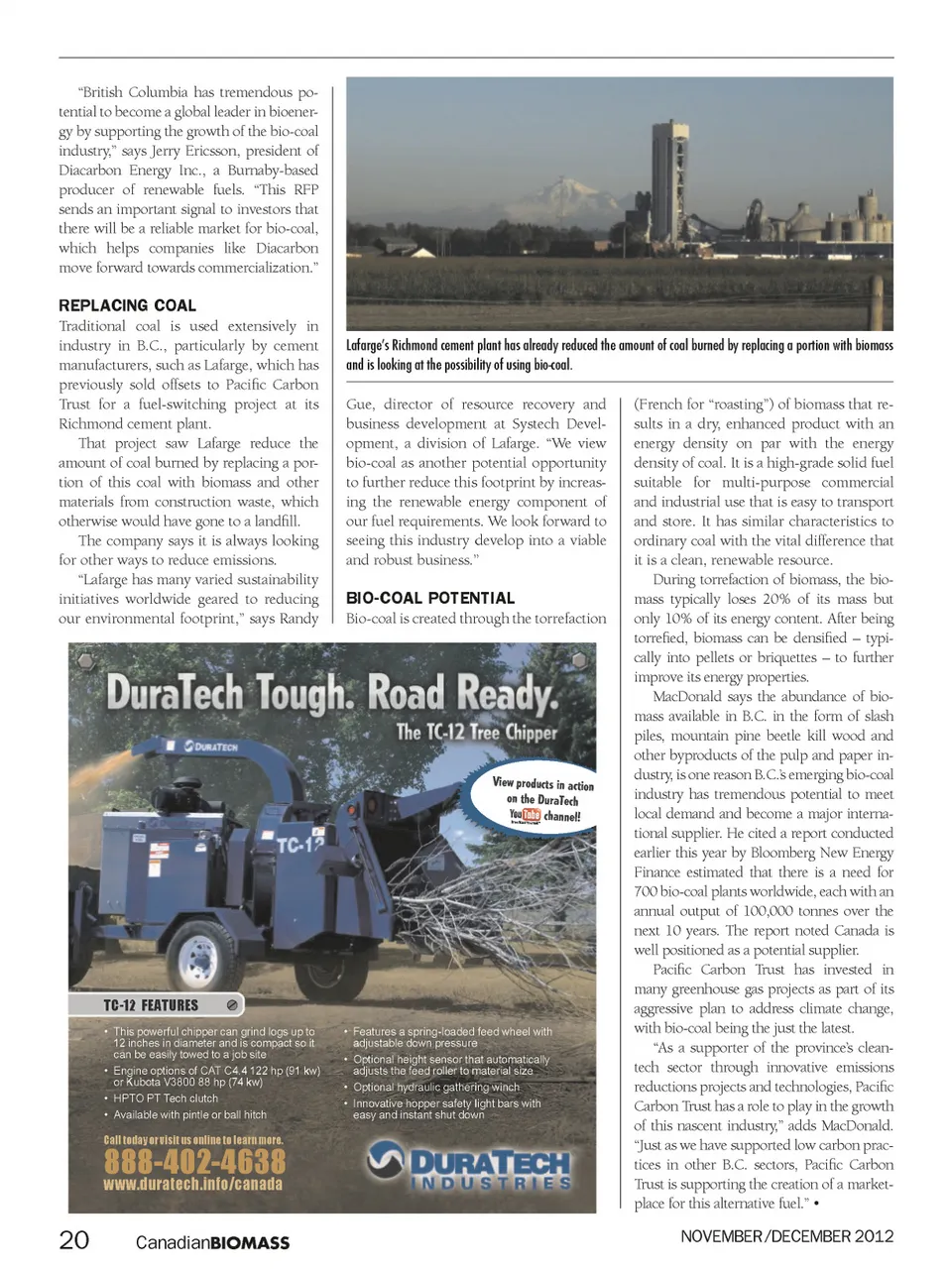
“British Columbia has tremendous po-tential to become a global leader in bioener-gy by supporting the growth of the bio-coal industry,” says Jerry Ericsson, president of Diacarbon Energy Inc., a Burnaby-based producer of renewable fuels. “This RFP sends an important signal to investors that there will be a reliable market for bio-coal, which helps companies like Diacarbon move forward towards commercialization.” REPLACING COAL Traditional coal is used extensively in industry in B.C., particularly by cement manufacturers, such as Lafarge, which has previously sold offsets to Pacific Carbon Trust for a fuel-switching project at its Richmond cement plant. That project saw Lafarge reduce the amount of coal burned by replacing a por-tion of this coal with biomass and other materials from construction waste, which otherwise would have gone to a landfill. The company says it is always looking for other ways to reduce emissions. “Lafarge has many varied sustainability initiatives worldwide geared to reducing our environmental footprint,” says Randy Lafarge’s Richmond cement plant has already reduced the amount of coal burned by replacing a portion with biomass and is looking at the possibility of using bio-coal. Gue, director of resource recovery and business development at Systech Devel-opment, a division of Lafarge. “We view bio-coal as another potential opportunity to further reduce this footprint by increas-ing the renewable energy component of our fuel requirements. We look forward to seeing this industry develop into a viable and robust business.” BIO-COAL POTENTIAL Bio-coal is created through the torrefaction View products in action on the DuraTech channel! TC-12 FEATURES • This powerful chipper can grind logs up to 12 inches in diameter and is compact so it can be easily towed to a job site • Engine options of CAT C4.4 122 hp (91 kw) or Kubota V3800 88 hp (74 kw) • HPTO PT Tech clutch • Available with pintle or ball hitch Call today or visit us online to learn more. • Features a spring-loaded feed wheel with adjustable down pressure • Optional height sensor that automatically adjusts the feed roller to material size • Optional hydraulic gathering winch • Innovative hopper safety light bars with easy and instant shut down 888-402-4638 www.duratech.info/canada (French for “roasting”) of biomass that re-sults in a dry, enhanced product with an energy density on par with the energy density of coal. It is a high-grade solid fuel suitable for multi-purpose commercial and industrial use that is easy to transport and store. It has similar characteristics to ordinary coal with the vital difference that it is a clean, renewable resource. During torrefaction of biomass, the bio-mass typically loses 20% of its mass but only 10% of its energy content. After being torrefied, biomass can be densified – typi-cally into pellets or briquettes – to further improve its energy properties. MacDonald says the abundance of bio-mass available in B.C. in the form of slash piles, mountain pine beetle kill wood and other byproducts of the pulp and paper in-dustry, is one reason B.C.’s emerging bio-coal industry has tremendous potential to meet local demand and become a major interna-tional supplier. He cited a report conducted earlier this year by Bloomberg New Energy Finance estimated that there is a need for 700 bio-coal plants worldwide, each with an annual output of 100,000 tonnes over the next 10 years. The report noted Canada is well positioned as a potential supplier. Pacific Carbon Trust has invested in many greenhouse gas projects as part of its aggressive plan to address climate change, with bio-coal being the just the latest. “As a supporter of the province’s clean-tech sector through innovative emissions reductions projects and technologies, Pacific Carbon Trust has a role to play in the growth of this nascent industry,” adds MacDonald. “Just as we have supported low carbon prac-tices in other B.C. sectors, Pacific Carbon Trust is supporting the creation of a market-place for this alternative fuel.” • NOVEMBER/DECEMBER 2012 20 Canadian BIOMASS
Canadian Biomass November/December 2012: Page 20