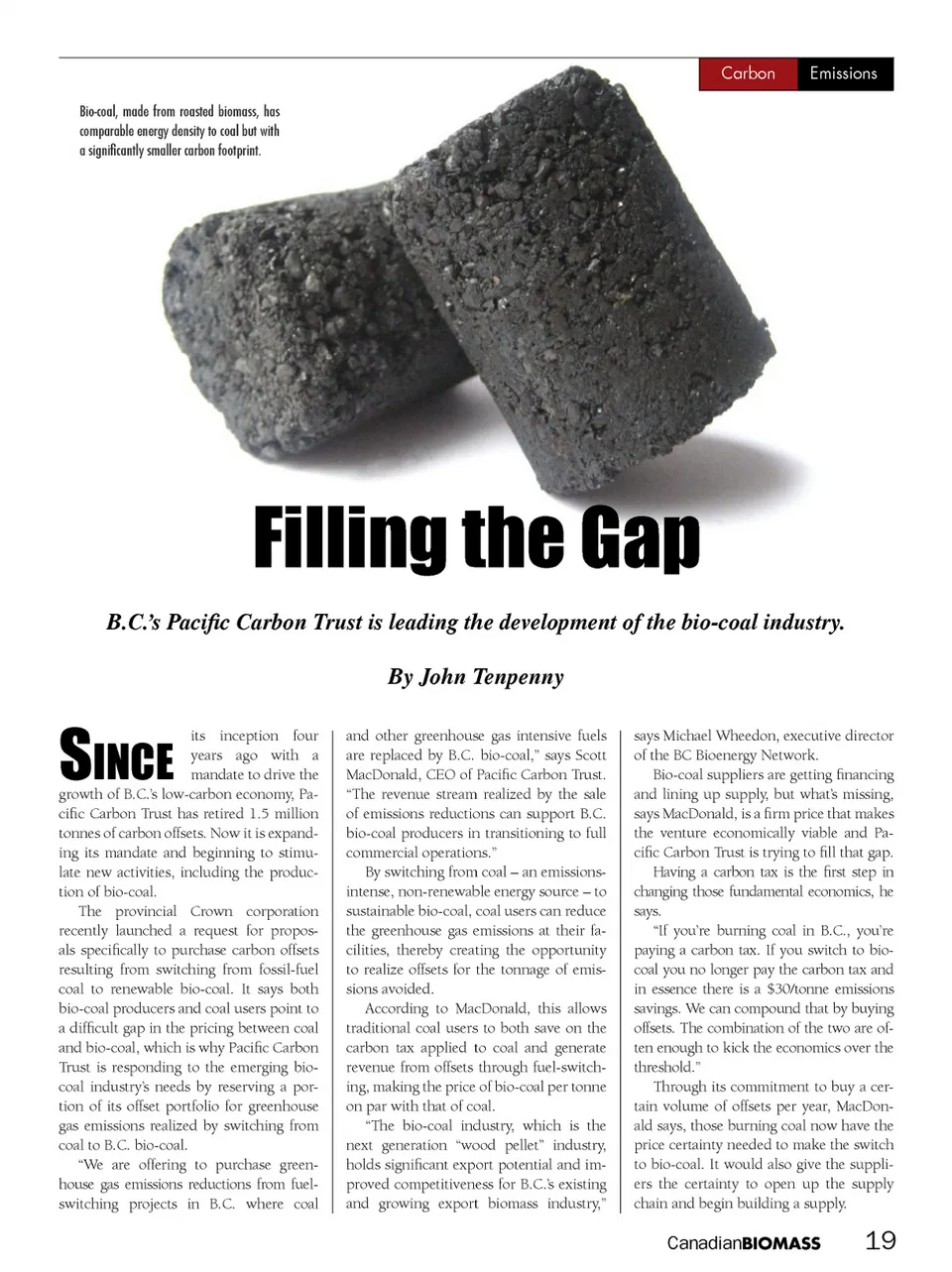
Carbon Bio-coal, made from roasted biomass, has comparable energy density to coal but with a significantly smaller carbon footprint. Emissions Filling the Gap B.C.’s Pacific Carbon Trust is leading the development of the bio-coal industry. By John Tenpenny its inception four years ago with a mandate to drive the growth of B.C.’s low-carbon economy, Pa-cific Carbon Trust has retired 1.5 million tonnes of carbon offsets. Now it is expand-ing its mandate and beginning to stimu-late new activities, including the produc-tion of bio-coal. The provincial Crown corporation recently launched a request for propos-als specifically to purchase carbon offsets resulting from switching from fossil-fuel coal to renewable bio-coal. It says both bio-coal producers and coal users point to a difficult gap in the pricing between coal and bio-coal, which is why Pacific Carbon Trust is responding to the emerging bio-coal industry’s needs by reserving a por-tion of its offset portfolio for greenhouse gas emissions realized by switching from coal to B.C. bio-coal. “We are offering to purchase green-house gas emissions reductions from fuel-switching projects in B.C. where coal S ince and other greenhouse gas intensive fuels are replaced by B.C. bio-coal,” says Scott MacDonald, CEO of Pacific Carbon Trust. “The revenue stream realized by the sale of emissions reductions can support B.C. bio-coal producers in transitioning to full commercial operations.” By switching from coal – an emissions-intense, non-renewable energy source – to sustainable bio-coal, coal users can reduce the greenhouse gas emissions at their fa-cilities, thereby creating the opportunity to realize offsets for the tonnage of emis-sions avoided. According to MacDonald, this allows traditional coal users to both save on the carbon tax applied to coal and generate revenue from offsets through fuel-switch-ing, making the price of bio-coal per tonne on par with that of coal. “The bio-coal industry, which is the next generation “wood pellet” industry, holds significant export potential and im-proved competitiveness for B.C.’s existing and growing export biomass industry,” says Michael Wheedon, executive director of the BC Bioenergy Network. Bio-coal suppliers are getting financing and lining up supply, but what’s missing, says MacDonald, is a firm price that makes the venture economically viable and Pa-cific Carbon Trust is trying to fill that gap. Having a carbon tax is the first step in changing those fundamental economics, he says. “If you’re burning coal in B.C., you’re paying a carbon tax. If you switch to bio-coal you no longer pay the carbon tax and in essence there is a $30/tonne emissions savings. We can compound that by buying offsets. The combination of the two are of-ten enough to kick the economics over the threshold.” Through its commitment to buy a cer-tain volume of offsets per year, MacDon-ald says, those burning coal now have the price certainty needed to make the switch to bio-coal. It would also give the suppli-ers the certainty to open up the supply chain and begin building a supply. Canadian BIOMASS 19
Canadian Biomass November/December 2012: Page 19