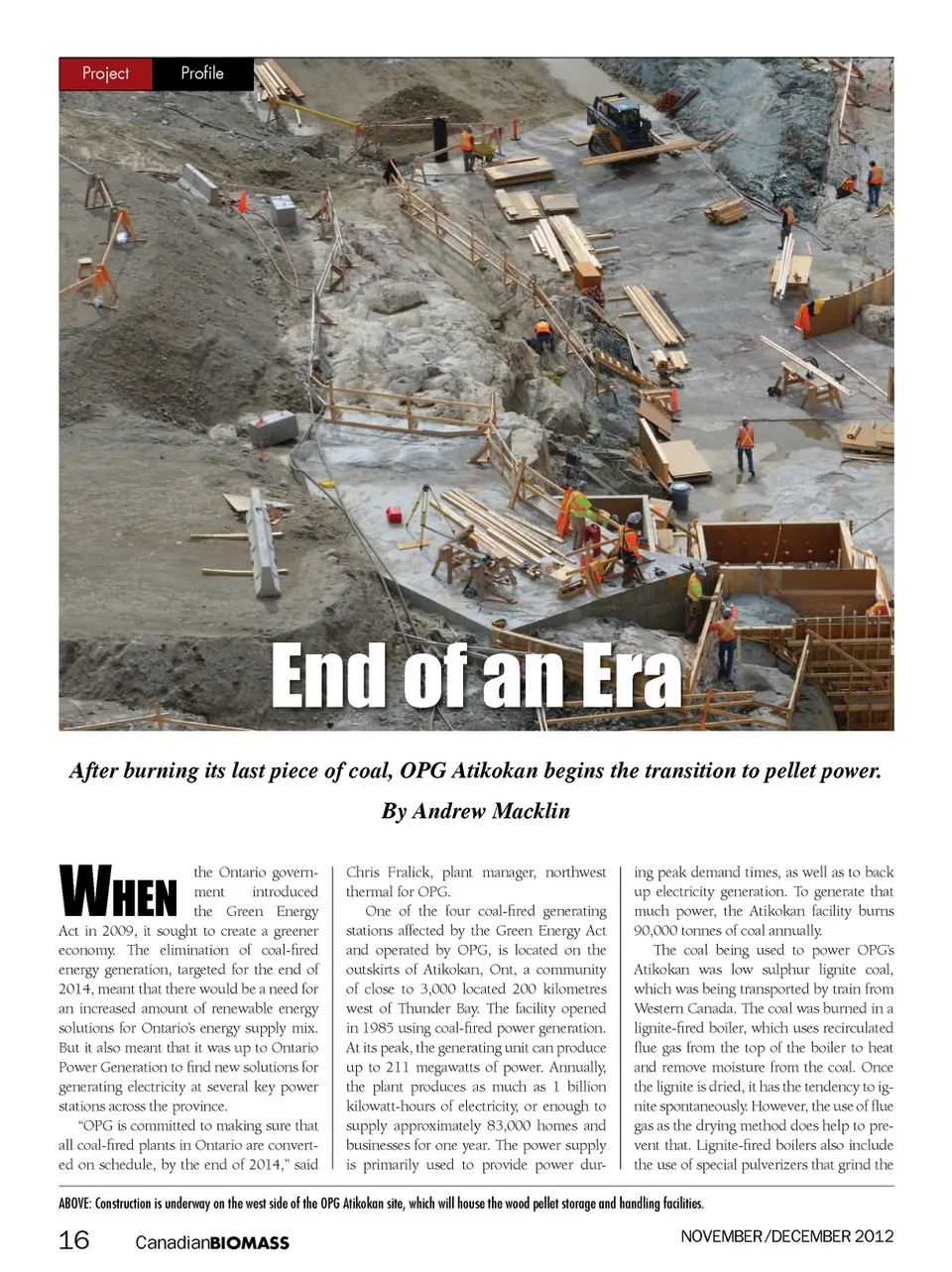
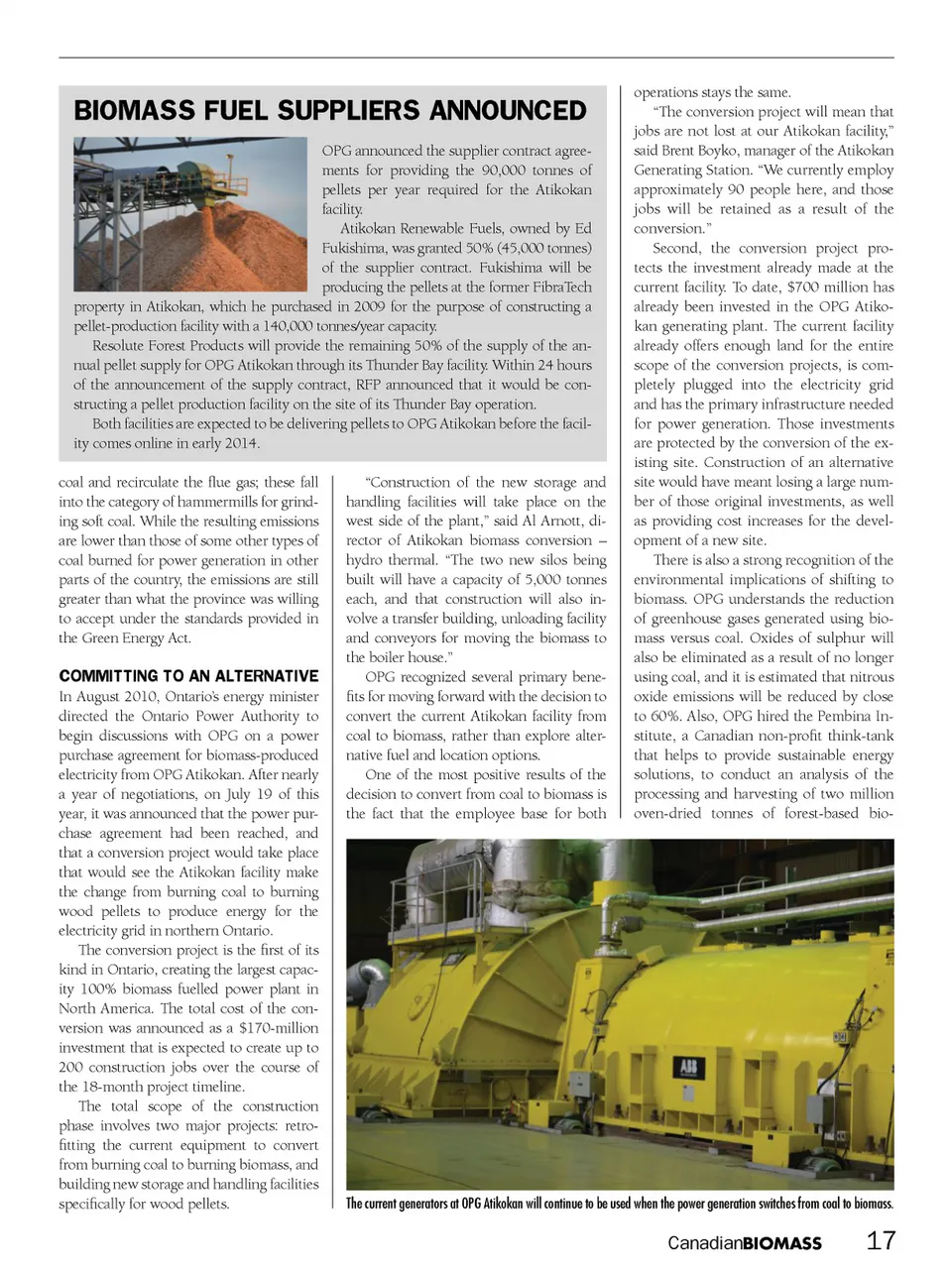
BIOMASS FUEL SUPPLIERS ANNOUNCED OPG announced the supplier contract agree-ments for providing the 90,000 tonnes of pellets per year required for the Atikokan facility. Atikokan Renewable Fuels, owned by Ed Fukishima, was granted 50% (45,000 tonnes) of the supplier contract. Fukishima will be producing the pellets at the former FibraTech property in Atikokan, which he purchased in 2009 for the purpose of constructing a pellet-production facility with a 140,000 tonnes/year capacity. Resolute Forest Products will provide the remaining 50% of the supply of the an-nual pellet supply for OPG Atikokan through its Thunder Bay facility. Within 24 hours of the announcement of the supply contract, RFP announced that it would be con-structing a pellet production facility on the site of its Thunder Bay operation. Both facilities are expected to be delivering pellets to OPG Atikokan before the facil-ity comes online in early 2014. coal and recirculate the flue gas; these fall into the category of hammermills for grind-ing soft coal. While the resulting emissions are lower than those of some other types of coal burned for power generation in other parts of the country, the emissions are still greater than what the province was willing to accept under the standards provided in the Green Energy Act. COMMITTING TO AN ALTERNATIVE In August 2010, Ontario’s energy minister directed the Ontario Power Authority to begin discussions with OPG on a power purchase agreement for biomass-produced electricity from OPG Atikokan. After nearly a year of negotiations, on July 19 of this year, it was announced that the power pur-chase agreement had been reached, and that a conversion project would take place that would see the Atikokan facility make the change from burning coal to burning wood pellets to produce energy for the electricity grid in northern Ontario. The conversion project is the first of its kind in Ontario, creating the largest capac-ity 100% biomass fuelled power plant in North America. The total cost of the con-version was announced as a $170-million investment that is expected to create up to 200 construction jobs over the course of the 18-month project timeline. The total scope of the construction phase involves two major projects: retro-fitting the current equipment to convert from burning coal to burning biomass, and building new storage and handling facilities specifically for wood pellets. “Construction of the new storage and handling facilities will take place on the west side of the plant,” said Al Arnott, di-rector of Atikokan biomass conversion – hydro thermal. “The two new silos being built will have a capacity of 5,000 tonnes each, and that construction will also in-volve a transfer building, unloading facility and conveyors for moving the biomass to the boiler house.” OPG recognized several primary bene-fits for moving forward with the decision to convert the current Atikokan facility from coal to biomass, rather than explore alter-native fuel and location options. One of the most positive results of the decision to convert from coal to biomass is the fact that the employee base for both operations stays the same. “The conversion project will mean that jobs are not lost at our Atikokan facility,” said Brent Boyko, manager of the Atikokan Generating Station. “We currently employ approximately 90 people here, and those jobs will be retained as a result of the conversion.” Second, the conversion project pro-tects the investment already made at the current facility. To date, $700 million has already been invested in the OPG Atiko-kan generating plant. The current facility already offers enough land for the entire scope of the conversion projects, is com-pletely plugged into the electricity grid and has the primary infrastructure needed for power generation. Those investments are protected by the conversion of the ex-isting site. Construction of an alternative site would have meant losing a large num-ber of those original investments, as well as providing cost increases for the devel-opment of a new site. There is also a strong recognition of the environmental implications of shifting to biomass. OPG understands the reduction of greenhouse gases generated using bio-mass versus coal. Oxides of sulphur will also be eliminated as a result of no longer using coal, and it is estimated that nitrous oxide emissions will be reduced by close to 60%. Also, OPG hired the Pembina In-stitute, a Canadian non-profit think-tank that helps to provide sustainable energy solutions, to conduct an analysis of the processing and harvesting of two million oven-dried tonnes of forest-based bio-The current generators at OPG Atikokan will continue to be used when the power generation switches from coal to biomass. Canadian BIOMASS 17
Canadian Biomass November/December 2012: Page 17