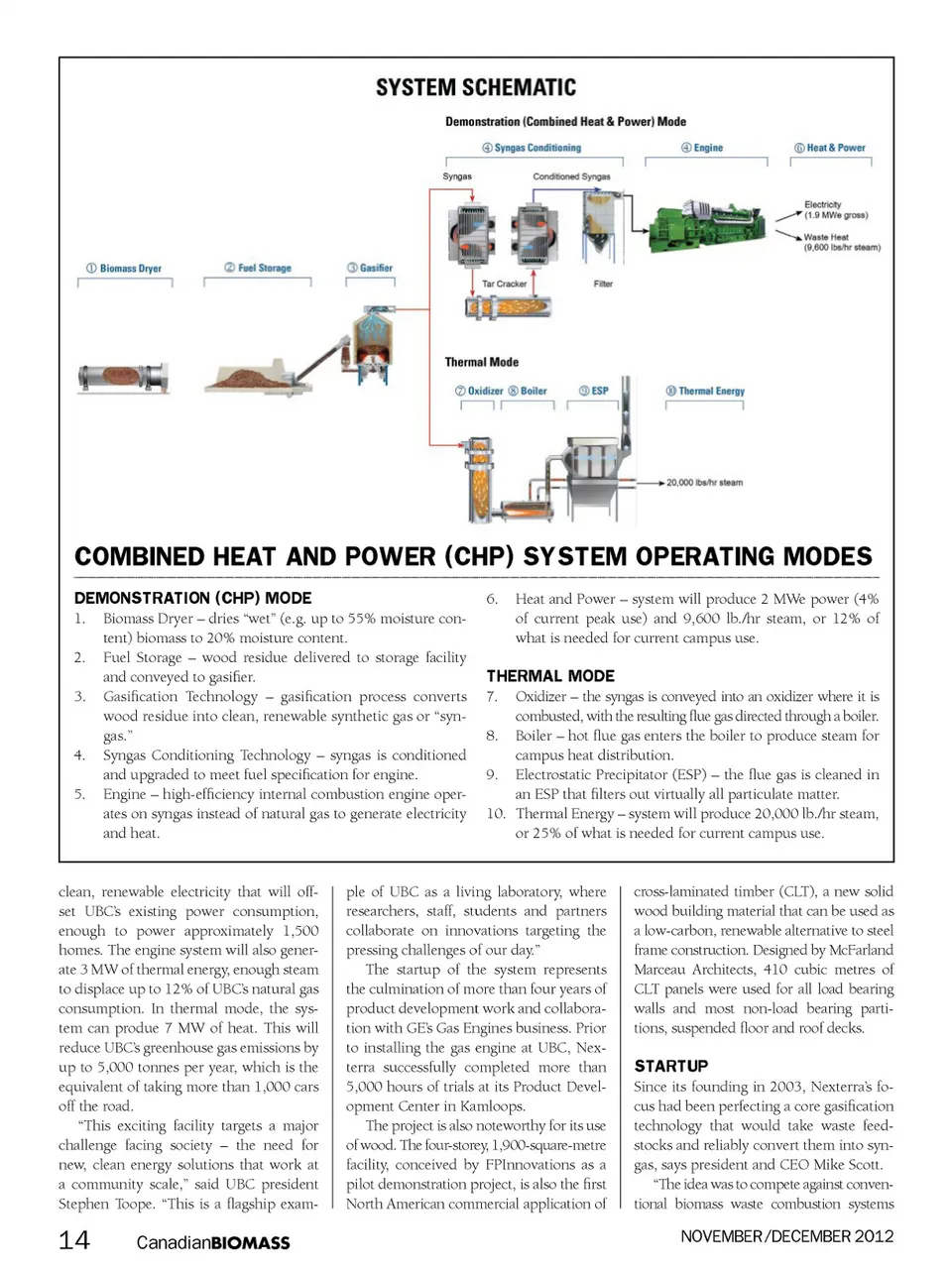
COMBINED HEAT AND POWER (CHP) SYSTEM OPERATING MODES DEMONSTRATION (CHP) MODE 6. 1. 2. 3. 4. 5. Biomass Dryer – dries “wet” (e.g. up to 55% moisture con-tent) biomass to 20% moisture content. Fuel Storage – wood residue delivered to storage facility and conveyed to gasifier. Gasification Technology – gasification process converts wood residue into clean, renewable synthetic gas or “syn-gas.” Syngas Conditioning Technology – syngas is conditioned and upgraded to meet fuel specification for engine. Engine – high-efficiency internal combustion engine oper-ates on syngas instead of natural gas to generate electricity and heat. Heat and Power – system will produce 2 MWe power (4% of current peak use) and 9,600 lb./hr steam, or 12% of what is needed for current campus use. THERMAL MODE 7. Oxidizer – the syngas is conveyed into an oxidizer where it is combusted, with the resulting flue gas directed through a boiler. 8. Boiler – hot flue gas enters the boiler to produce steam for campus heat distribution. 9. Electrostatic Precipitator (ESP) – the flue gas is cleaned in an ESP that filters out virtually all particulate matter. 10. Thermal Energy – system will produce 20,000 lb./hr steam, or 25% of what is needed for current campus use. clean, renewable electricity that will off-set UBC’s existing power consumption, enough to power approximately 1,500 homes. The engine system will also gener-ate 3 MW of thermal energy, enough steam to displace up to 12% of UBC’s natural gas consumption. In thermal mode, the sys-tem can produe 7 MW of heat. This will reduce UBC’s greenhouse gas emissions by up to 5,000 tonnes per year, which is the equivalent of taking more than 1,000 cars off the road. “This exciting facility targets a major challenge facing society – the need for new, clean energy solutions that work at a community scale,” said UBC president Stephen Toope. “This is a flagship exam-ple of UBC as a living laboratory, where researchers, staff, students and partners collaborate on innovations targeting the pressing challenges of our day.” The startup of the system represents the culmination of more than four years of product development work and collabora-tion with GE’s Gas Engines business. Prior to installing the gas engine at UBC, Nex-terra successfully completed more than 5,000 hours of trials at its Product Devel-opment Center in Kamloops. The project is also noteworthy for its use of wood. The four-storey, 1,900-square-metre facility, conceived by FPInnovations as a pilot demonstration project, is also the first North American commercial application of cross-laminated timber (CLT), a new solid wood building material that can be used as a low-carbon, renewable alternative to steel frame construction. Designed by McFarland Marceau Architects, 410 cubic metres of CLT panels were used for all load bearing walls and most non-load bearing parti-tions, suspended floor and roof decks. STARTUP Since its founding in 2003, Nexterra’s fo-cus had been perfecting a core gasification technology that would take waste feed-stocks and reliably convert them into syn-gas, says president and CEO Mike Scott. “The idea was to compete against conven-tional biomass waste combustion systems NOVEMBER/DECEMBER 2012 14 Canadian BIOMASS
Canadian Biomass November/December 2012: Page 14