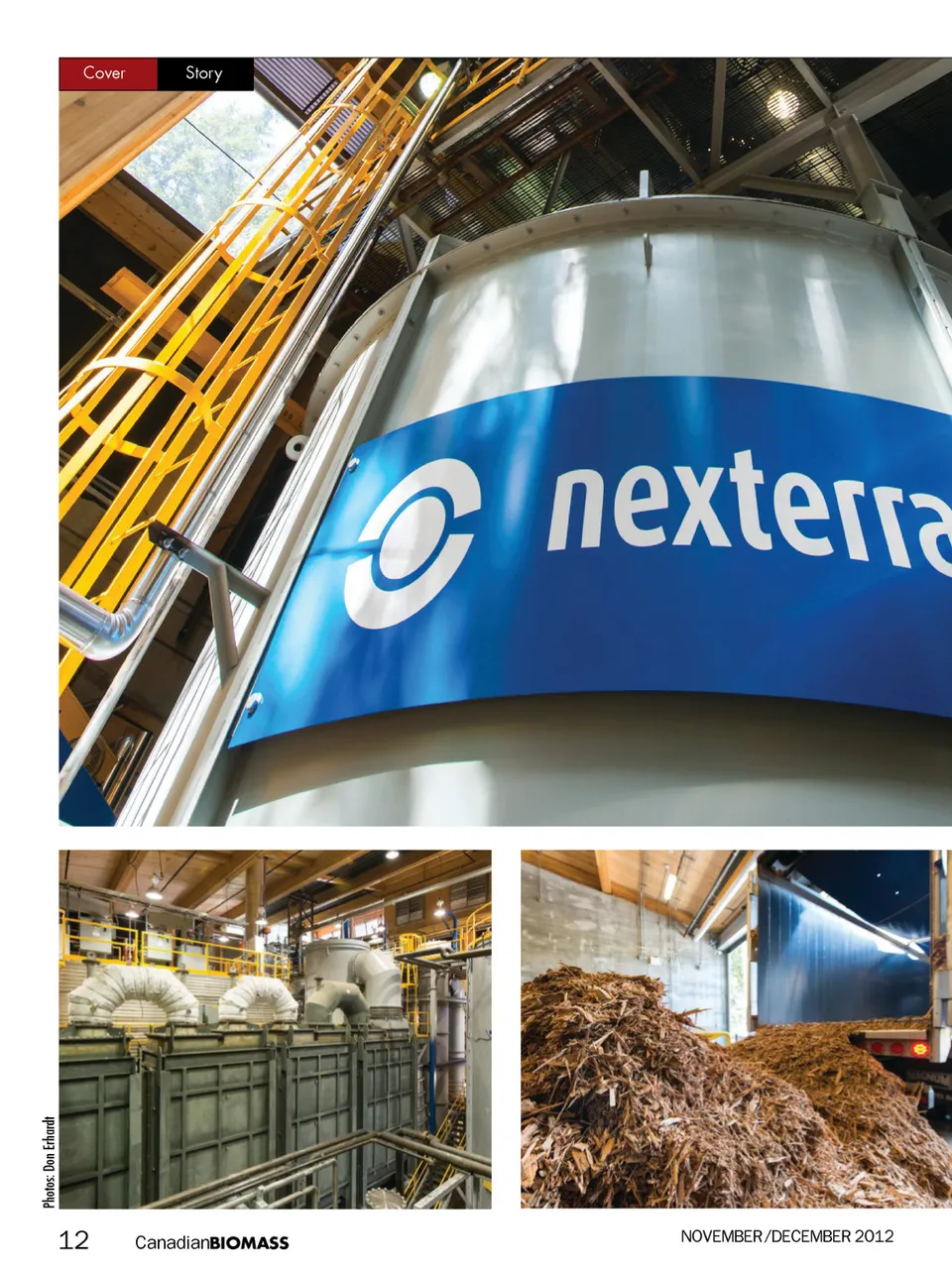
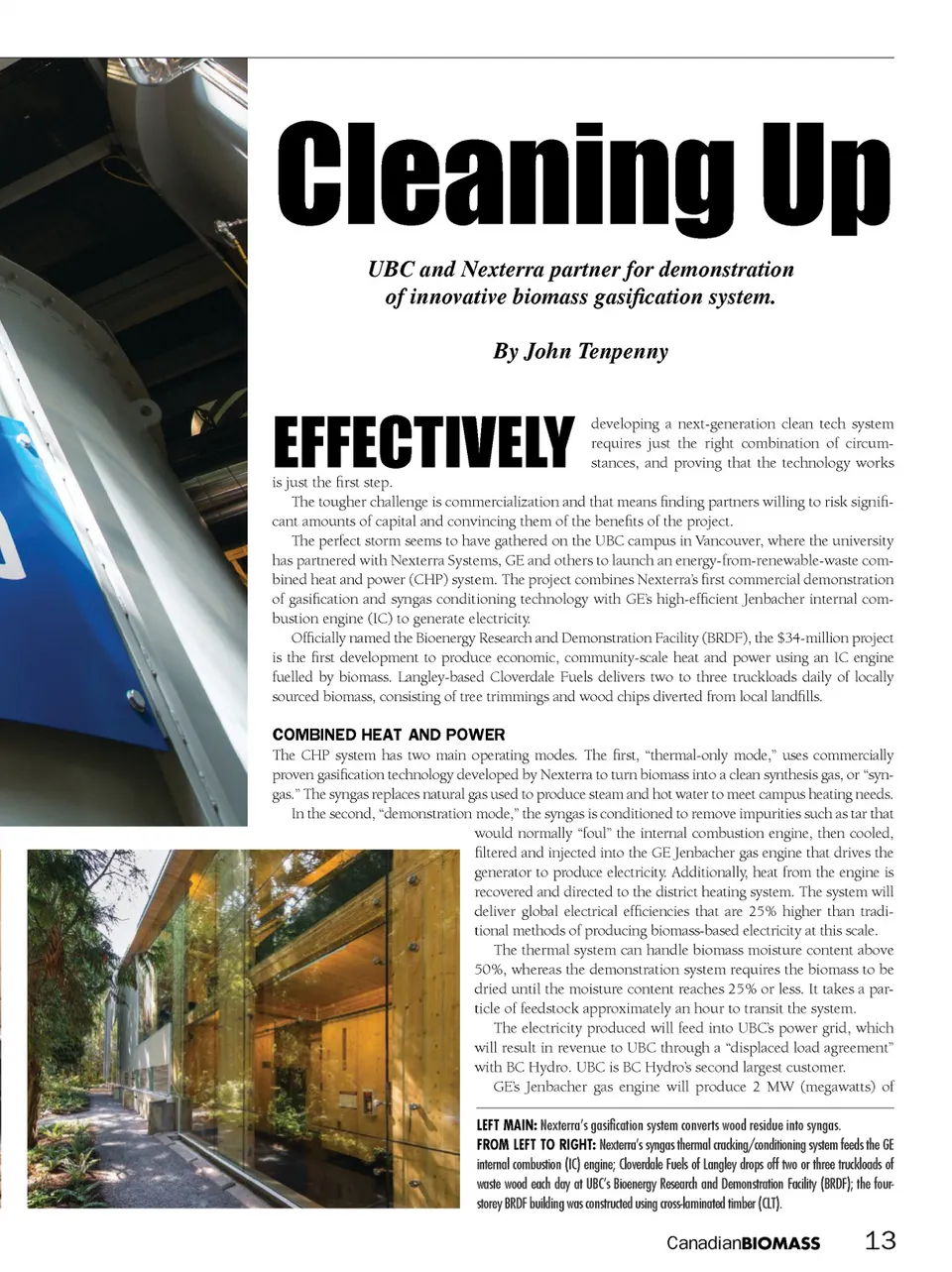
Cleaning Up UBC and Nexterra partner for demonstration of innovative biomass gasification system. By John Tenpenny EFFECTIVELY developing a next-generation clean tech system requires just the right combination of circum-stances, and proving that the technology works is just the first step. The tougher challenge is commercialization and that means finding partners willing to risk signifi-cant amounts of capital and convincing them of the benefits of the project. The perfect storm seems to have gathered on the UBC campus in Vancouver, where the university has partnered with Nexterra Systems, GE and others to launch an energy-from-renewable-waste com-bined heat and power (CHP) system. The project combines Nexterra’s first commercial demonstration of gasification and syngas conditioning technology with GE’s high-efficient Jenbacher internal com-bustion engine (IC) to generate electricity. Officially named the Bioenergy Research and Demonstration Facility (BRDF), the $34-million project is the first development to produce economic, community-scale heat and power using an IC engine fuelled by biomass. Langley-based Cloverdale Fuels delivers two to three truckloads daily of locally sourced biomass, consisting of tree trimmings and wood chips diverted from local landfills. COMBINED HEAT AND POWER The CHP system has two main operating modes. The first, “thermal-only mode,” uses commercially proven gasification technology developed by Nexterra to turn biomass into a clean synthesis gas, or “syn-gas.” The syngas replaces natural gas used to produce steam and hot water to meet campus heating needs. In the second, “demonstration mode,” the syngas is conditioned to remove impurities such as tar that would normally “foul” the internal combustion engine, then cooled, filtered and injected into the GE Jenbacher gas engine that drives the generator to produce electricity. Additionally, heat from the engine is recovered and directed to the district heating system. The system will deliver global electrical efficiencies that are 25% higher than tradi-tional methods of producing biomass-based electricity at this scale. The thermal system can handle biomass moisture content above 50%, whereas the demonstration system requires the biomass to be dried until the moisture content reaches 25% or less. It takes a par-ticle of feedstock approximately an hour to transit the system. The electricity produced will feed into UBC’s power grid, which will result in revenue to UBC through a “displaced load agreement” with BC Hydro. UBC is BC Hydro’s second largest customer. GE’s Jenbacher gas engine will produce 2 MW (megawatts) of LEFT MAIN: Nexterra’s gasification system converts wood residue into syngas. FROM LEFT TO RIGHT: Nexterra’s syngas thermal cracking/conditioning system feeds the GE internal combustion (IC) engine; Cloverdale Fuels of Langley drops off two or three truckloads of waste wood each day at UBC’s Bioenergy Research and Demonstration Facility (BRDF); the four-storey BRDF building was constructed using cross-laminated timber (CLT). Canadian BIOMASS 13
Canadian Biomass November/December 2012: Page 13