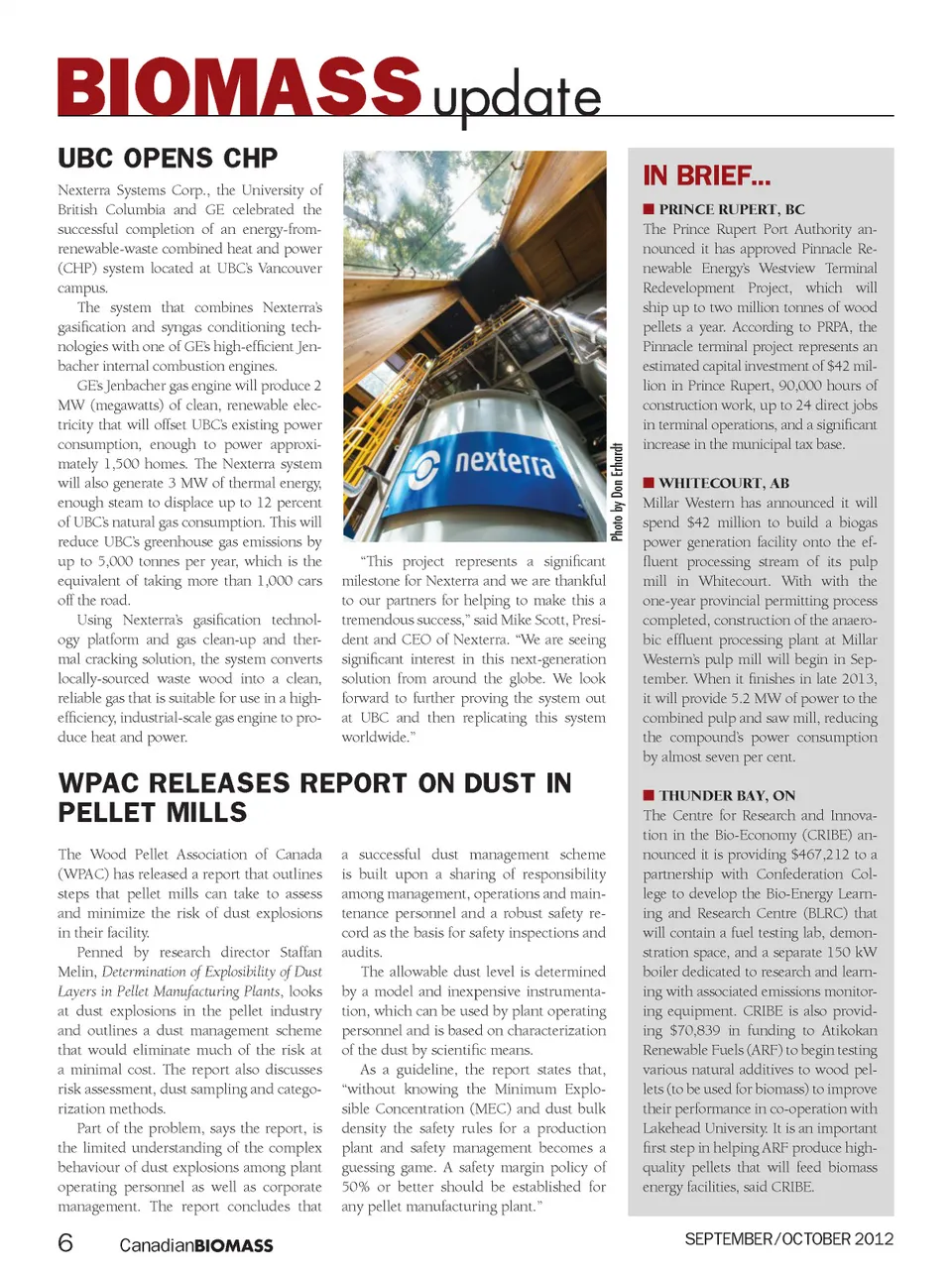
BIOMASS update BIOFUEL FROM BIOMASS ONE STEP CLOSER Biofuel from biomass one step closer to real-ity thanks to discovery by University of Geor-gia researchers to manipulate ‘hot’ microbes. The single most important barrier to the use of lignocellulosic biomass such as switch-grass, populous, sorghum and miscanthus for production of biofuels is the resistant na-ture of the biomass itself. The problem lies in the conversion or degradation of complex biomass to make products of interest. New research from scientists at the University of Georgia who are members of Department of Energy’s BioEnergy Science Center (BESC) provides a genetic method for manipulating a group of organisms, called Caldicellulosiruptor, that have the Janet Westpheling, centre, works regularly with fellow researchers Dae-hwan Chung, left, and Minseok Cha. ability to use biomass directly at tempera-tures over 160 Fahrenheit. The ability to modify the microbes to make the needed fuel products is a required of genetics in the UGA Franklin College of Arts and Sciences and first step for modern industrial fermentations. This allows research-a scientist of BESC. “Plants have evolved over millions of years to ers to combine the natural ability to consume renewable plant ma-resist degradation by microbes, and that is exactly what we want to do. The ability to manipulate the genetics of organisms that can terials with an altered, improved ability to make what is needed. “The most formidable barrier to the use of biomass, such as use biomass directly is essential to making them useful. We began switchgrass, to biofuels is the ability to break down the biomass,” with a group of bacteria that can use biomass for growth and will said Janet Westpheling, a microbial geneticist in the department use genetics to teach them to make ethanol.” 7^dbVhhEgdXZhh^c\HnhiZbh A^WZgVi^c\JciVeeZY:cZg\n AY`_V+$$'a;#&#e;%((% 2h`c]UhZUV]VRUVcZ_dZkVcVUfTeZ`_eVTY_`]`Xjd;GVT`a]R_h`c\dhZeYZ_UZgZUfR] Tfde`^Vcde`UVdZX_d;V_XZ_VVcd;^R_fWRTefcVR_UZ^a]V^V_eeVTY_`]`XZTR]]j RUgR_TVUd;^ReVcZR]daVTZWZTd;R_URaa]ZTReZ`_daVTZWZTdYcVUUZ_Xd;WVcc`fdR_U_`_e; WVcc`fdcV^`gR]d;dZkVR_UUV_dZejdVaRcReZ`_d;dTcVV_Z_XR_UT]RddZWZTReZ`_ eVTY_`]`XZVdR_UViecV^V]jVWWZTZV_eT`_gVj`cR_USf]\^ReVcZR]YR_U]Z_Xd; ^VeVcZ_Xd;de`cRXVR_Uf_]`RUZ_XeVTY_`]`XZVdf; 4`_eRTeGVT`a]R_e`URje`]VRc_^`cVRS`fe`fcViZdeZ_XdjdeV^d `ce`RccR_XVRgZdZee``_Vd;`cdVgVcR]d;`W`fcZ_deR]]ReZ`_df; gVT`a]R_]]Tf;T`^ Canadian BIOMASS 7 Photo by University of Georgia
Canadian Biomass September/October 2012: Page 7