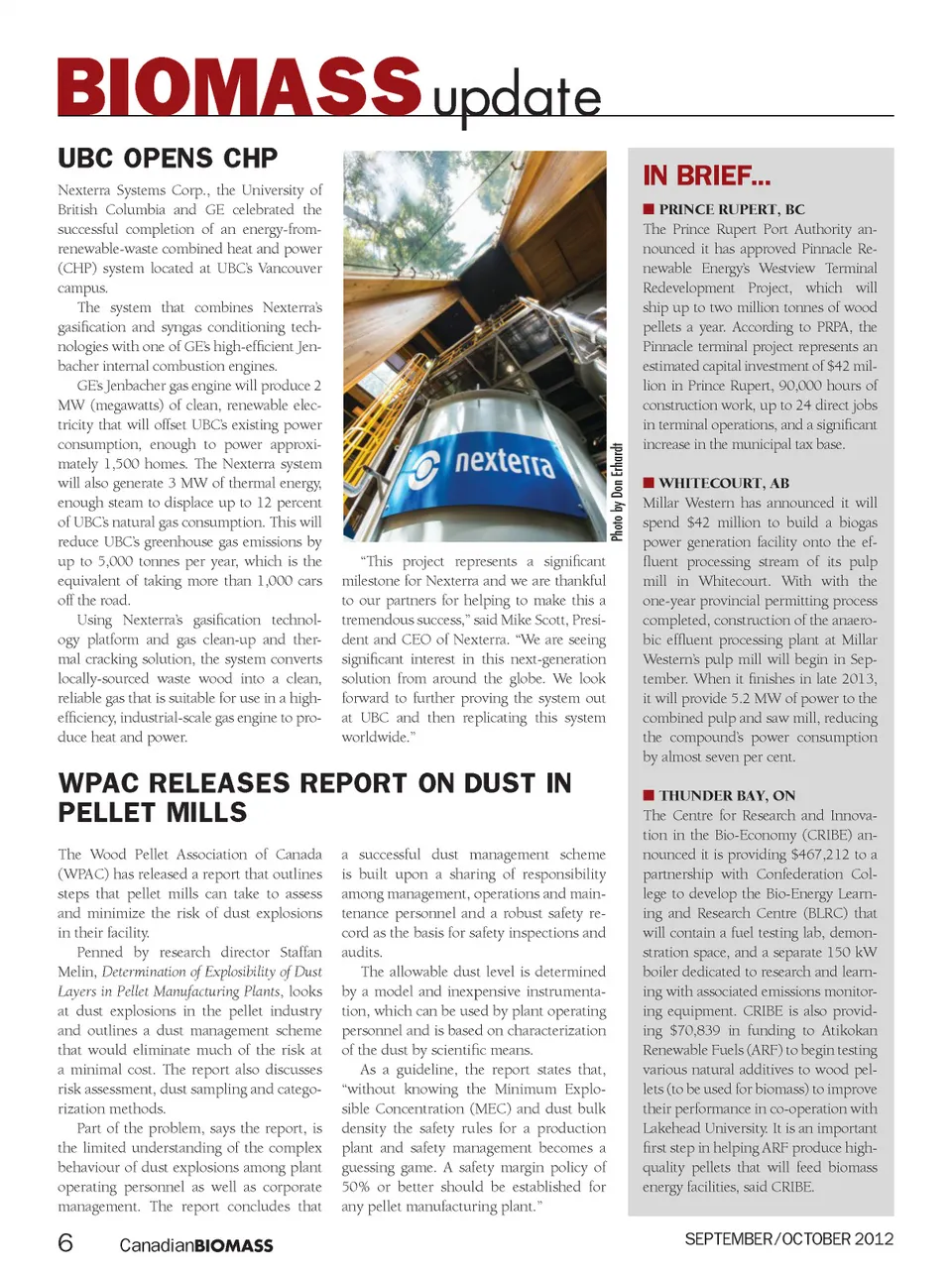
BIOMASS update UBC OPENS CHP Nexterra Systems Corp., the University of British Columbia and GE celebrated the successful completion of an energy-from-renewable-waste combined heat and power (CHP) system located at UBC’s Vancouver campus. The system that combines Nexterra’s gasification and syngas conditioning tech-nologies with one of GE’s high-efficient Jen-bacher internal combustion engines. GE’s Jenbacher gas engine will produce 2 MW (megawatts) of clean, renewable elec-tricity that will offset UBC’s existing power consumption, enough to power approxi-mately 1,500 homes. The Nexterra system will also generate 3 MW of thermal energy, enough steam to displace up to 12 percent of UBC’s natural gas consumption. This will reduce UBC’s greenhouse gas emissions by up to 5,000 tonnes per year, which is the equivalent of taking more than 1,000 cars off the road. Using Nexterra’s gasification technol-ogy platform and gas clean-up and ther-mal cracking solution, the system converts locally-sourced waste wood into a clean, reliable gas that is suitable for use in a high-efficiency, industrial-scale gas engine to pro-duce heat and power. IN BRIEF... Q PRINCE RUPERT, BC The Prince Rupert Port Authority an-nounced it has approved Pinnacle Re-newable Energy’s Westview Terminal Redevelopment Project, which will ship up to two million tonnes of wood pellets a year. According to PRPA, the Pinnacle terminal project represents an estimated capital investment of $42 mil-lion in Prince Rupert, 90,000 hours of construction work, up to 24 direct jobs in terminal operations, and a significant increase in the municipal tax base. Q WHITECOURT, AB Millar Western has announced it will spend $42 million to build a biogas power generation facility onto the ef-fluent processing stream of its pulp mill in Whitecourt. With with the one-year provincial permitting process completed, construction of the anaero-bic effluent processing plant at Millar Western’s pulp mill will begin in Sep-tember. When it finishes in late 2013, it will provide 5.2 MW of power to the combined pulp and saw mill, reducing the compound’s power consumption by almost seven per cent. Q THUNDER BAY, ON The Centre for Research and Innova-tion in the Bio-Economy (CRIBE) an-nounced it is providing $467,212 to a partnership with Confederation Col-lege to develop the Bio-Energy Learn-ing and Research Centre (BLRC) that will contain a fuel testing lab, demon-stration space, and a separate 150 kW boiler dedicated to research and learn-ing with associated emissions monitor-ing equipment. CRIBE is also provid-ing $70,839 in funding to Atikokan Renewable Fuels (ARF) to begin testing various natural additives to wood pel-lets (to be used for biomass) to improve their performance in co-operation with Lakehead University. It is an important first step in helping ARF produce high-quality pellets that will feed biomass energy facilities, said CRIBE. SEPTEMBER/OCTOBER 2012 “This project represents a significant milestone for Nexterra and we are thankful to our partners for helping to make this a tremendous success,” said Mike Scott, Presi-dent and CEO of Nexterra. “We are seeing significant interest in this next-generation solution from around the globe. We look forward to further proving the system out at UBC and then replicating this system worldwide.” WPAC RELEASES REPORT ON DUST IN PELLET MILLS The Wood Pellet Association of Canada (WPAC) has released a report that outlines steps that pellet mills can take to assess and minimize the risk of dust explosions in their facility. Penned by research director Staffan Melin, Determination of Explosibility of Dust Layers in Pellet Manufacturing Plants , looks at dust explosions in the pellet industry and outlines a dust management scheme that would eliminate much of the risk at a minimal cost. The report also discusses risk assessment, dust sampling and catego-rization methods. Part of the problem, says the report, is the limited understanding of the complex behaviour of dust explosions among plant operating personnel as well as corporate management. The report concludes that a successful dust management scheme is built upon a sharing of responsibility among management, operations and main-tenance personnel and a robust safety re-cord as the basis for safety inspections and audits. The allowable dust level is determined by a model and inexpensive instrumenta-tion, which can be used by plant operating personnel and is based on characterization of the dust by scientific means. As a guideline, the report states that, “without knowing the Minimum Explo-sible Concentration (MEC) and dust bulk density the safety rules for a production plant and safety management becomes a guessing game. A safety margin policy of 50% or better should be established for any pellet manufacturing plant.” 6 Canadian BIOMASS Photo by Don Erhardt
Canadian Biomass September/October 2012: Page 6