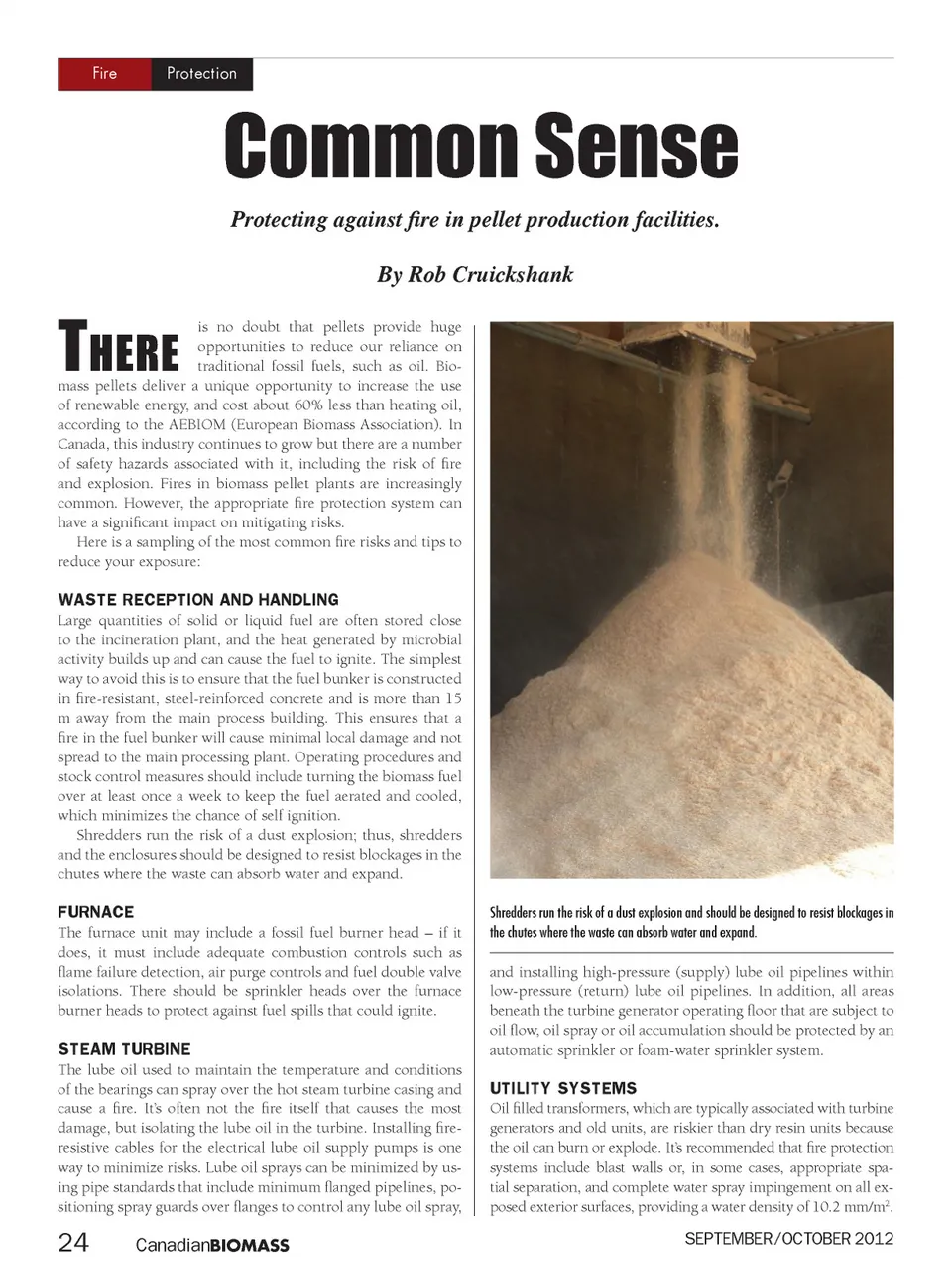
Fire Protection Common Sense Protecting against fire in pellet production facilities. By Rob Cruickshank T HERE is no doubt that pellets provide huge opportunities to reduce our reliance on traditional fossil fuels, such as oil. Bio-mass pellets deliver a unique opportunity to increase the use of renewable energy, and cost about 60% less than heating oil, according to the AEBIOM (European Biomass Association). In Canada, this industry continues to grow but there are a number of safety hazards associated with it, including the risk of fire and explosion. Fires in biomass pellet plants are increasingly common. However, the appropriate fire protection system can have a significant impact on mitigating risks. Here is a sampling of the most common fire risks and tips to reduce your exposure: WASTE RECEPTION AND HANDLING Large quantities of solid or liquid fuel are often stored close to the incineration plant, and the heat generated by microbial activity builds up and can cause the fuel to ignite. The simplest way to avoid this is to ensure that the fuel bunker is constructed in fire-resistant, steel-reinforced concrete and is more than 15 m away from the main process building. This ensures that a fire in the fuel bunker will cause minimal local damage and not spread to the main processing plant. Operating procedures and stock control measures should include turning the biomass fuel over at least once a week to keep the fuel aerated and cooled, which minimizes the chance of self ignition. Shredders run the risk of a dust explosion; thus, shredders and the enclosures should be designed to resist blockages in the chutes where the waste can absorb water and expand. FURNACE Shredders run the risk of a dust explosion and should be designed to resist blockages in the chutes where the waste can absorb water and expand. The furnace unit may include a fossil fuel burner head – if it does, it must include adequate combustion controls such as flame failure detection, air purge controls and fuel double valve isolations. There should be sprinkler heads over the furnace burner heads to protect against fuel spills that could ignite. STEAM TURBINE and installing high-pressure (supply) lube oil pipelines within low-pressure (return) lube oil pipelines. In addition, all areas beneath the turbine generator operating floor that are subject to oil flow, oil spray or oil accumulation should be protected by an automatic sprinkler or foam-water sprinkler system. UTILITY SYSTEMS The lube oil used to maintain the temperature and conditions of the bearings can spray over the hot steam turbine casing and cause a fire. It’s often not the fire itself that causes the most damage, but isolating the lube oil in the turbine. Installing fire-resistive cables for the electrical lube oil supply pumps is one way to minimize risks. Lube oil sprays can be minimized by us-ing pipe standards that include minimum flanged pipelines, po-sitioning spray guards over flanges to control any lube oil spray, Oil filled transformers, which are typically associated with turbine generators and old units, are riskier than dry resin units because the oil can burn or explode. It’s recommended that fire protection systems include blast walls or, in some cases, appropriate spa-tial separation, and complete water spray impingement on all ex-posed exterior surfaces, providing a water density of 10.2 mm/m 2 . SEPTEMBER/OCTOBER 2012 24 Canadian BIOMASS
Canadian Biomass September/October 2012: Page 24