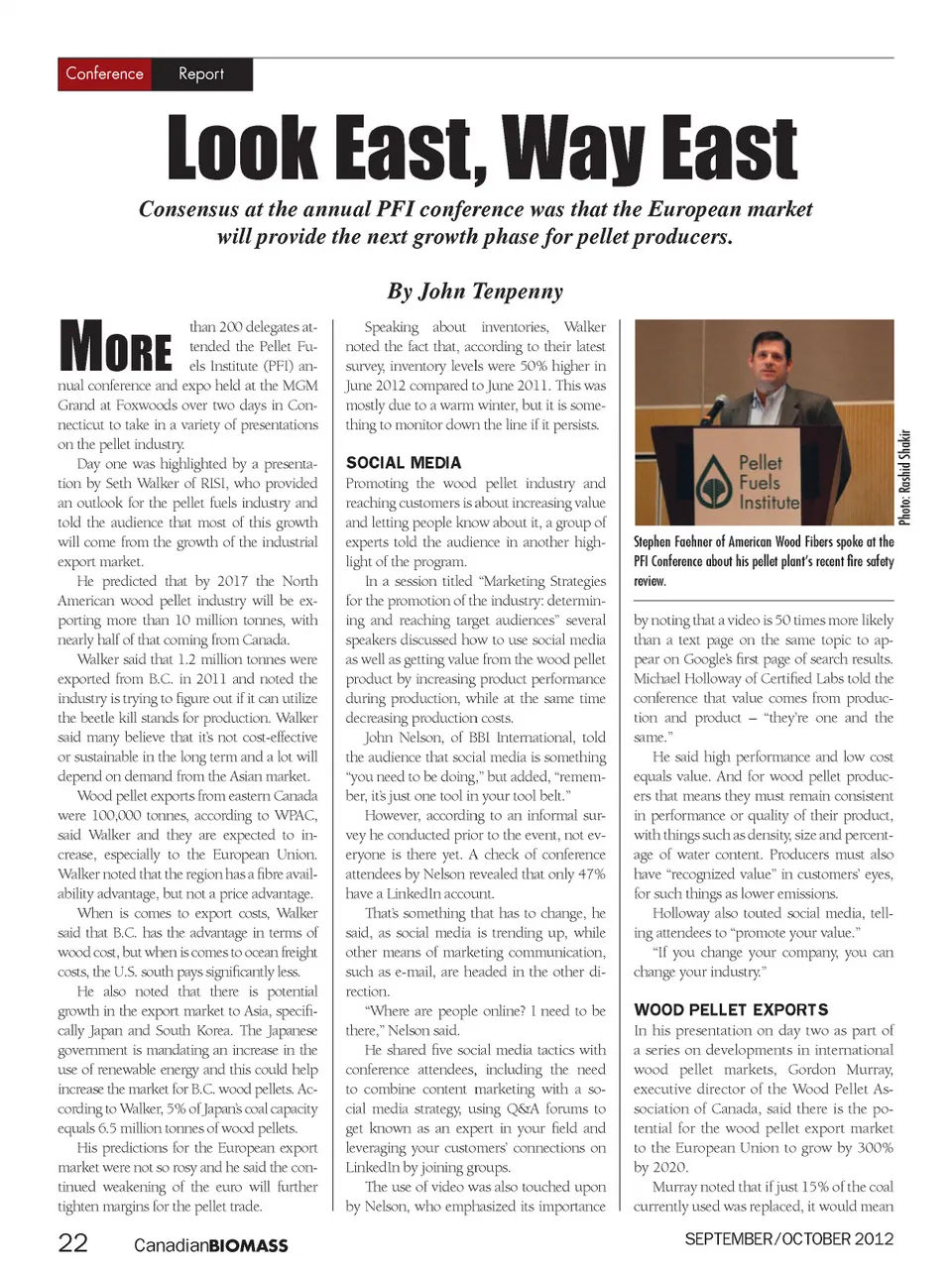
Conference Report Look East, Way East Consensus at the annual PFI conference was that the European market will provide the next growth phase for pellet producers. By John Tenpenny M ORE than 200 delegates at-tended the Pellet Fu-els Institute (PFI) an-nual conference and expo held at the MGM Grand at Foxwoods over two days in Con-necticut to take in a variety of presentations on the pellet industry. Day one was highlighted by a presenta-tion by Seth Walker of RISI, who provided an outlook for the pellet fuels industry and told the audience that most of this growth will come from the growth of the industrial export market. He predicted that by 2017 the North American wood pellet industry will be ex-porting more than 10 million tonnes, with nearly half of that coming from Canada. Walker said that 1.2 million tonnes were exported from B.C. in 2011 and noted the industry is trying to figure out if it can utilize the beetle kill stands for production. Walker said many believe that it’s not cost-effective or sustainable in the long term and a lot will depend on demand from the Asian market. Wood pellet exports from eastern Canada were 100,000 tonnes, according to WPAC, said Walker and they are expected to in-crease, especially to the European Union. Walker noted that the region has a fibre avail-ability advantage, but not a price advantage. When is comes to export costs, Walker said that B.C. has the advantage in terms of wood cost, but when is comes to ocean freight costs, the U.S. south pays significantly less. He also noted that there is potential growth in the export market to Asia, specifi-cally Japan and South Korea. The Japanese government is mandating an increase in the use of renewable energy and this could help increase the market for B.C. wood pellets. Ac-cording to Walker, 5% of Japan’s coal capacity equals 6.5 million tonnes of wood pellets. His predictions for the European export market were not so rosy and he said the con-tinued weakening of the euro will further tighten margins for the pellet trade. SOCIAL MEDIA Promoting the wood pellet industry and reaching customers is about increasing value and letting people know about it, a group of experts told the audience in another high-light of the program. In a session titled “Marketing Strategies for the promotion of the industry: determin-ing and reaching target audiences” several speakers discussed how to use social media as well as getting value from the wood pellet product by increasing product performance during production, while at the same time decreasing production costs. John Nelson, of BBI International, told the audience that social media is something “you need to be doing,” but added, “remem-ber, it’s just one tool in your tool belt.” However, according to an informal sur-vey he conducted prior to the event, not ev-eryone is there yet. A check of conference attendees by Nelson revealed that only 47% have a LinkedIn account. That’s something that has to change, he said, as social media is trending up, while other means of marketing communication, such as e-mail, are headed in the other di-rection. “Where are people online? I need to be there,” Nelson said. He shared five social media tactics with conference attendees, including the need to combine content marketing with a so-cial media strategy, using Q&A forums to get known as an expert in your field and leveraging your customers’ connections on LinkedIn by joining groups. The use of video was also touched upon by Nelson, who emphasized its importance Stephen Faehner of American Wood Fibers spoke at the H>A;gf^]j]f[]YZgml`akh]dd]lhdYflkj][]flÚj]kY^]lq review. by noting that a video is 50 times more likely than a text page on the same topic to ap-pear on Google’s first page of search results. Michael Holloway of Certified Labs told the conference that value comes from produc-tion and product – “they’re one and the same.” He said high performance and low cost equals value. And for wood pellet produc-ers that means they must remain consistent in performance or quality of their product, with things such as density, size and percent-age of water content. Producers must also have “recognized value” in customers’ eyes, for such things as lower emissions. Holloway also touted social media, tell-ing attendees to “promote your value.” “If you change your company, you can change your industry.” WOOD PELLET EXPORTS In his presentation on day two as part of a series on developments in international wood pellet markets, Gordon Murray, executive director of the Wood Pellet As-sociation of Canada, said there is the po-tential for the wood pellet export market to the European Union to grow by 300% by 2020. Murray noted that if just 15% of the coal currently used was replaced, it would mean SEPTEMBER/OCTOBER 2012 22 Canadian BIOMASS Photo: Rashid Shakir Speaking about inventories, Walker noted the fact that, according to their latest survey, inventory levels were 50% higher in June 2012 compared to June 2011. This was mostly due to a warm winter, but it is some-thing to monitor down the line if it persists.
Canadian Biomass September/October 2012: Page 22