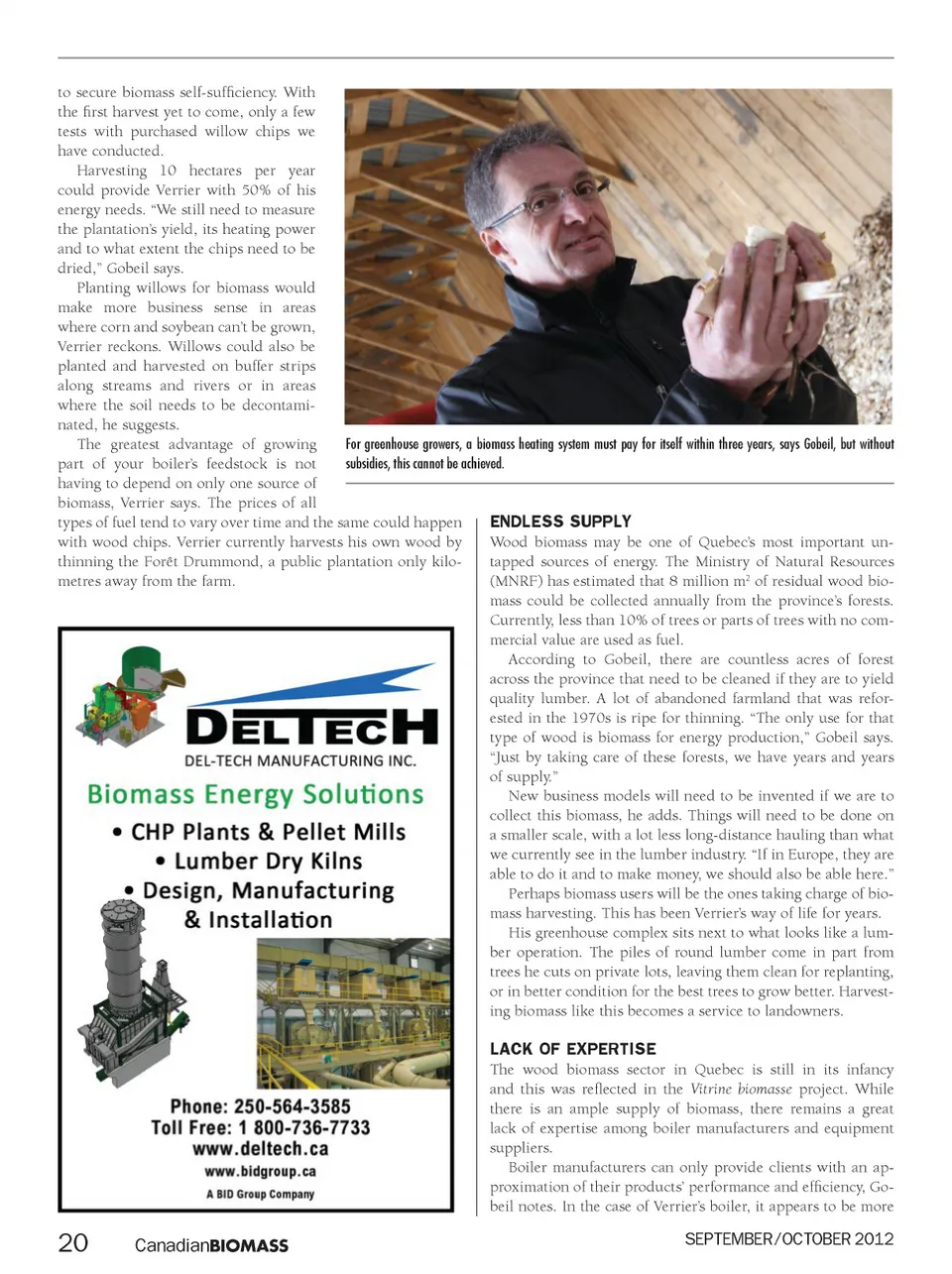
to secure biomass self-sufficiency. With the first harvest yet to come, only a few tests with purchased willow chips we have conducted. Harvesting 10 hectares per year could provide Verrier with 50% of his energy needs. “We still need to measure the plantation’s yield, its heating power and to what extent the chips need to be dried,” Gobeil says. Planting willows for biomass would make more business sense in areas where corn and soybean can’t be grown, Verrier reckons. Willows could also be planted and harvested on buffer strips along streams and rivers or in areas where the soil needs to be decontami-nated, he suggests. The greatest advantage of growing For greenhouse growers, a biomass heating system must pay for itself within three years, says Gobeil, but without part of your boiler’s feedstock is not subsidies, this cannot be achieved. having to depend on only one source of biomass, Verrier says. The prices of all types of fuel tend to vary over time and the same could happen ENDLESS SUPPLY with wood chips. Verrier currently harvests his own wood by Wood biomass may be one of Quebec’s most important un-thinning the Forêt Drummond, a public plantation only kilo-tapped sources of energy. The Ministry of Natural Resources metres away from the farm. (MNRF) has estimated that 8 million m 2 of residual wood bio-mass could be collected annually from the province’s forests. Currently, less than 10% of trees or parts of trees with no com-mercial value are used as fuel. According to Gobeil, there are countless acres of forest across the province that need to be cleaned if they are to yield quality lumber. A lot of abandoned farmland that was refor-ested in the 1970s is ripe for thinning. “The only use for that type of wood is biomass for energy production,” Gobeil says. “Just by taking care of these forests, we have years and years of supply.” New business models will need to be invented if we are to collect this biomass, he adds. Things will need to be done on a smaller scale, with a lot less long-distance hauling than what we currently see in the lumber industry. “If in Europe, they are able to do it and to make money, we should also be able here.” Perhaps biomass users will be the ones taking charge of bio-mass harvesting. This has been Verrier’s way of life for years. His greenhouse complex sits next to what looks like a lum-ber operation. The piles of round lumber come in part from trees he cuts on private lots, leaving them clean for replanting, or in better condition for the best trees to grow better. Harvest-ing biomass like this becomes a service to landowners. LACK OF EXPERTISE The wood biomass sector in Quebec is still in its infancy and this was reflected in the Vitrine biomasse project. While there is an ample supply of biomass, there remains a great lack of expertise among boiler manufacturers and equipment suppliers. Boiler manufacturers can only provide clients with an ap-proximation of their products’ performance and efficiency, Go-beil notes. In the case of Verrier’s boiler, it appears to be more 20 Canadian BIOMASS SEPTEMBER/OCTOBER 2012
Canadian Biomass September/October 2012: Page 20