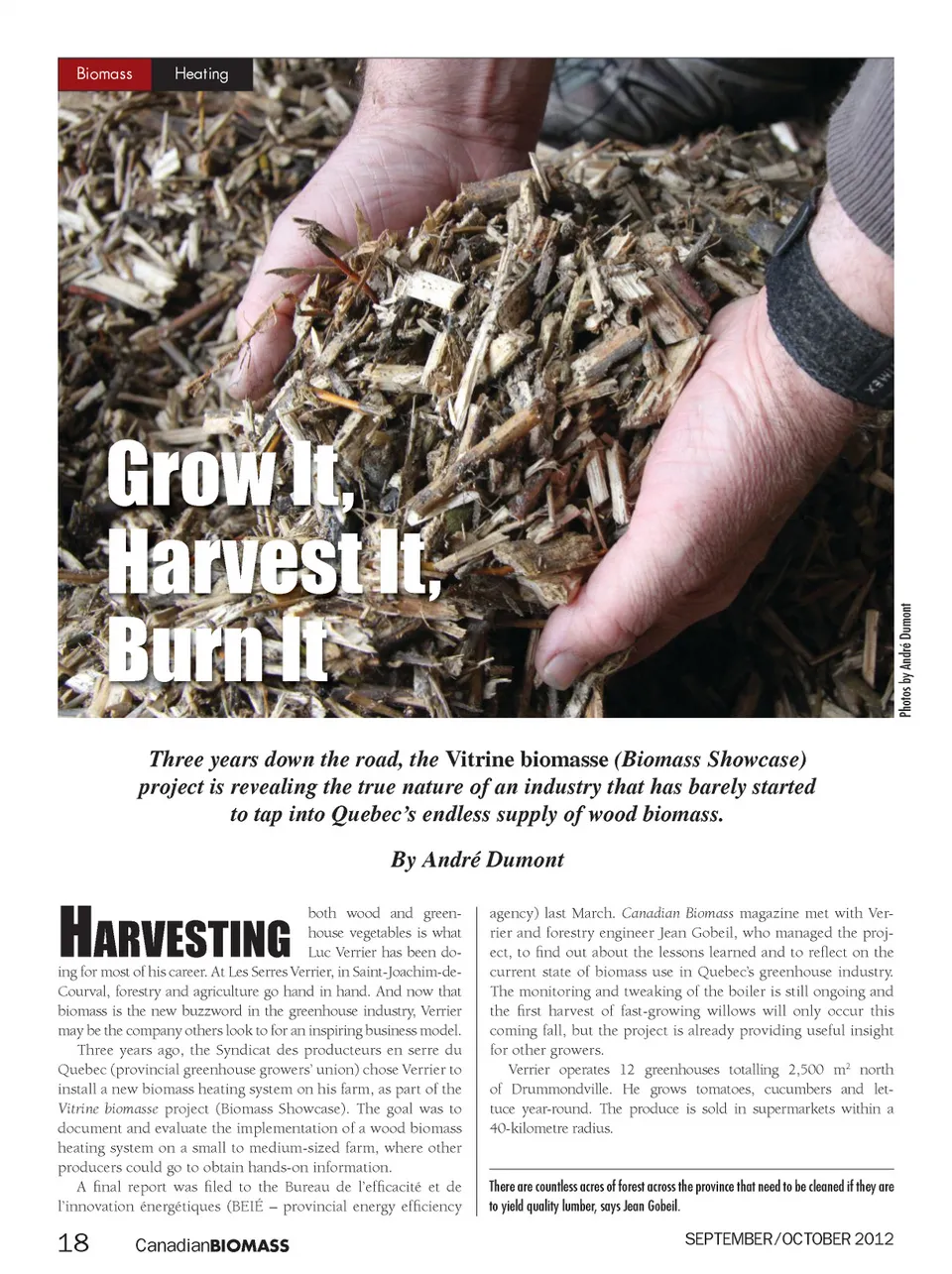
Biomass Heating Three years down the road, the Vitrine biomasse (Biomass Showcase) project is revealing the true nature of an industry that has barely started to tap into Quebec’s endless supply of wood biomass. By André Dumont both wood and green-house vegetables is what Luc Verrier has been do-ing for most of his career. At Les Serres Verrier, in Saint-Joachim-de-Courval, forestry and agriculture go hand in hand. And now that biomass is the new buzzword in the greenhouse industry, Verrier may be the company others look to for an inspiring business model. Three years ago, the Syndicat des producteurs en serre du Quebec (provincial greenhouse growers’ union) chose Verrier to install a new biomass heating system on his farm, as part of the Vitrine biomasse project (Biomass Showcase). The goal was to document and evaluate the implementation of a wood biomass heating system on a small to medium-sized farm, where other producers could go to obtain hands-on information. A final report was filed to the Bureau de l’efficacité et de l’innovation énergétiques (BEIÉ – provincial energy efficiency H ARVESTING agency) last March. Canadian Biomass magazine met with Ver-rier and forestry engineer Jean Gobeil, who managed the proj-ect, to find out about the lessons learned and to reflect on the current state of biomass use in Quebec’s greenhouse industry. The monitoring and tweaking of the boiler is still ongoing and the first harvest of fast-growing willows will only occur this coming fall, but the project is already providing useful insight for other growers. Verrier operates 12 greenhouses totalling 2,500 m 2 north of Drummondville. He grows tomatoes, cucumbers and let-tuce year-round. The produce is sold in supermarkets within a 40-kilometre radius. There are countless acres of forest across the province that need to be cleaned if they are to yield quality lumber, says Jean Gobeil. SEPTEMBER/OCTOBER 2012 18 Canadian BIOMASS Photos by André Dumont Grow It, Harvest It, Burn It
Canadian Biomass September/October 2012: Page 18