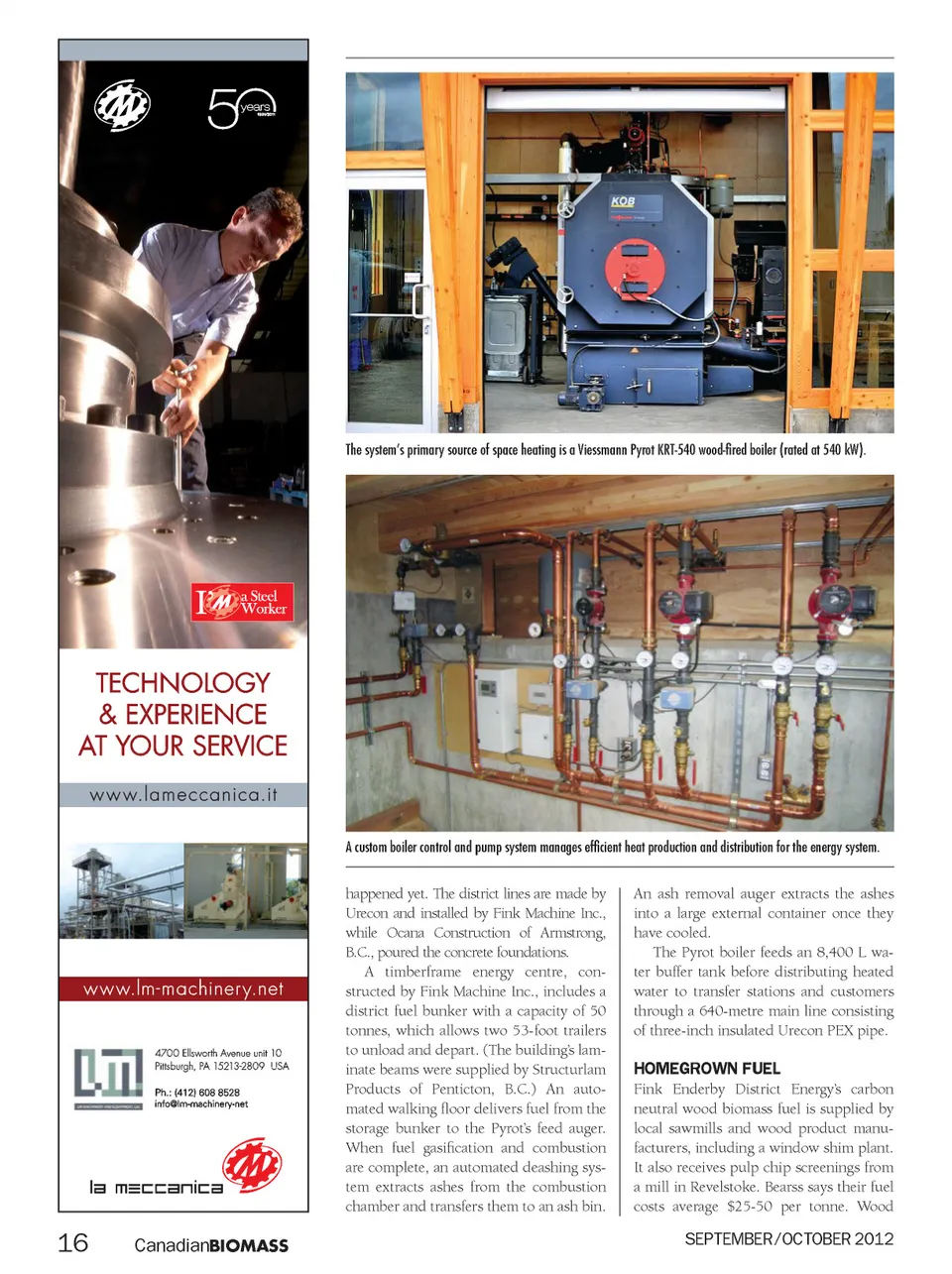
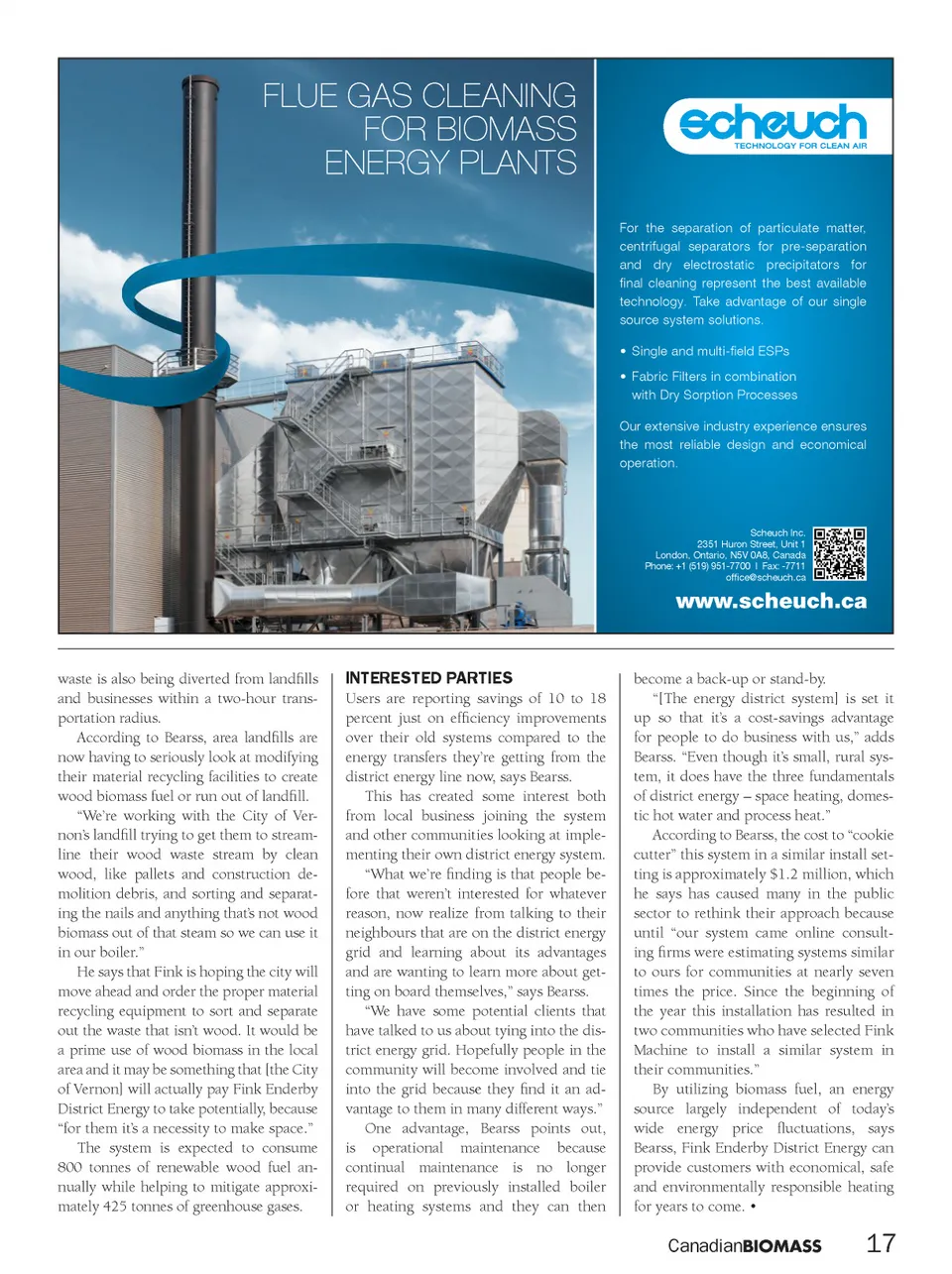
L`]kqkl]ekhjaeYjqkgmj[]g^khY[]`]Ylaf_akYNa]kkeYffHqjglCJL%-,(ogg\%Új]\Zgad]j jYl]\Yl-,(cO!& 9[mklgeZgad]j[gfljgdYf\hmehkqkl]eeYfY_]k]^Ú[a]fl`]Ylhjg\m[lagfYf\\akljaZmlagf^gjl`]]f]j_qkqkl]e& happened yet. The district lines are made by Urecon and installed by Fink Machine Inc., while Ocana Construction of Armstrong, B.C., poured the concrete foundations. A timberframe energy centre, con-structed by Fink Machine Inc., includes a district fuel bunker with a capacity of 50 tonnes, which allows two 53-foot trailers to unload and depart. (The building’s lam-inate beams were supplied by Structurlam Products of Penticton, B.C.) An auto-mated walking floor delivers fuel from the storage bunker to the Pyrot’s feed auger. When fuel gasification and combustion are complete, an automated deashing sys-tem extracts ashes from the combustion chamber and transfers them to an ash bin. An ash removal auger extracts the ashes into a large external container once they have cooled. The Pyrot boiler feeds an 8,400 L wa-ter buffer tank before distributing heated water to transfer stations and customers through a 640-metre main line consisting of three-inch insulated Urecon PEX pipe. HOMEGROWN FUEL Fink Enderby District Energy’s carbon neutral wood biomass fuel is supplied by local sawmills and wood product manu-facturers, including a window shim plant. It also receives pulp chip screenings from a mill in Revelstoke. Bearss says their fuel costs average $25-50 per tonne. Wood SEPTEMBER/OCTOBER 2012 16 Canadian BIOMASS
Canadian Biomass September/October 2012: Page 16