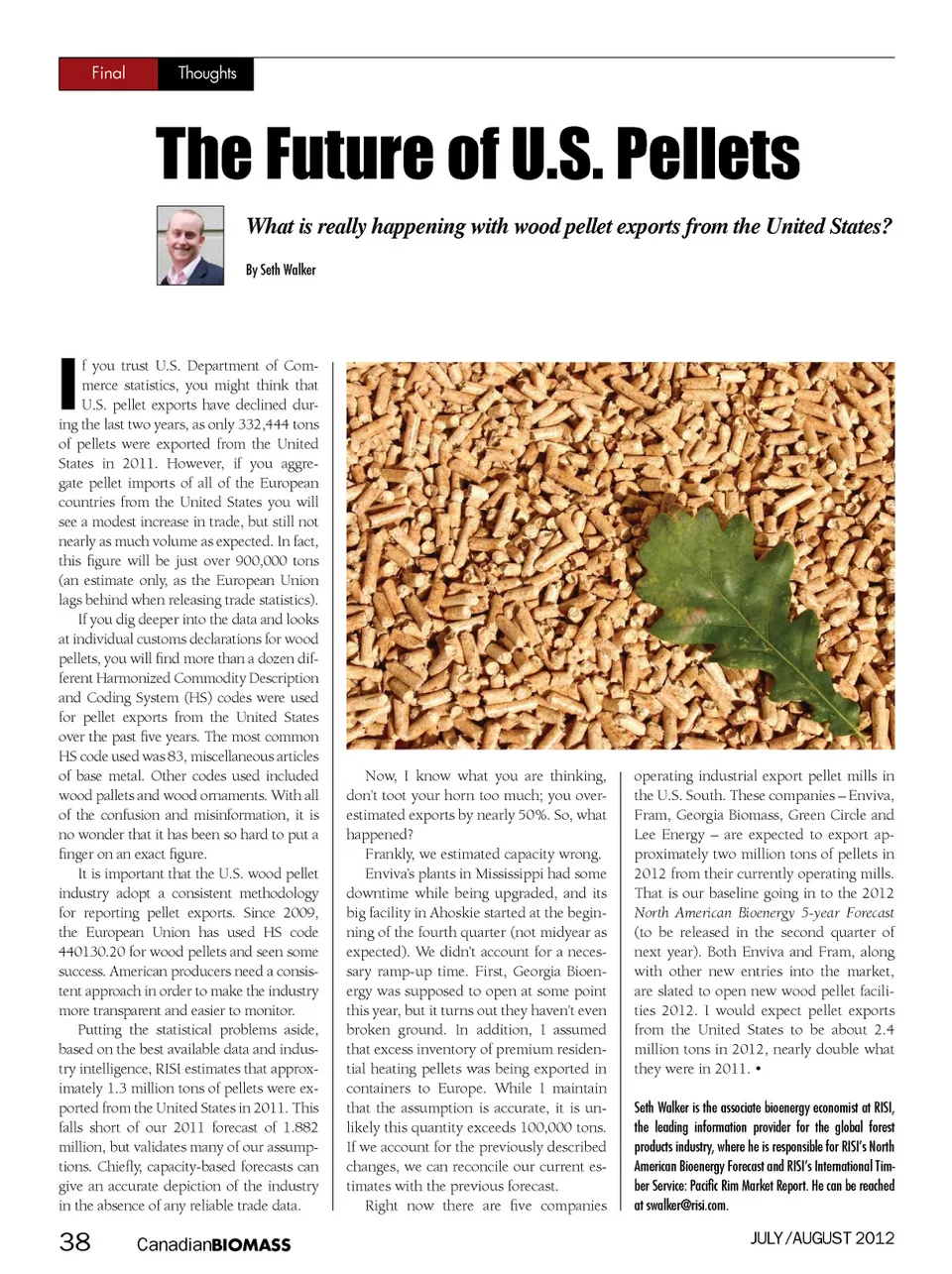
Final Thoughts The Future of U.S. Pellets What is really happening with wood pellet exports from the United States? By Seth Walker I f you trust U.S. Department of Com-merce statistics, you might think that U.S. pellet exports have declined dur-ing the last two years, as only 332,444 tons of pellets were exported from the United States in 2011. However, if you aggre-gate pellet imports of all of the European countries from the United States you will see a modest increase in trade, but still not nearly as much volume as expected. In fact, this figure will be just over 900,000 tons (an estimate only, as the European Union lags behind when releasing trade statistics). If you dig deeper into the data and looks at individual customs declarations for wood pellets, you will find more than a dozen dif-ferent Harmonized Commodity Description and Coding System (HS) codes were used for pellet exports from the United States over the past five years. The most common HS code used was 83, miscellaneous articles of base metal. Other codes used included wood pallets and wood ornaments. With all of the confusion and misinformation, it is no wonder that it has been so hard to put a finger on an exact figure. It is important that the U.S. wood pellet industry adopt a consistent methodology for reporting pellet exports. Since 2009, the European Union has used HS code 440130.20 for wood pellets and seen some success. American producers need a consis-tent approach in order to make the industry more transparent and easier to monitor. Putting the statistical problems aside, based on the best available data and indus-try intelligence, RISI estimates that approx-imately 1.3 million tons of pellets were ex-ported from the United States in 2011. This falls short of our 2011 forecast of 1.882 million, but validates many of our assump-tions. Chiefly, capacity-based forecasts can give an accurate depiction of the industry in the absence of any reliable trade data. Now, I know what you are thinking, don’t toot your horn too much; you over-estimated exports by nearly 50%. So, what happened? Frankly, we estimated capacity wrong. Enviva’s plants in Mississippi had some downtime while being upgraded, and its big facility in Ahoskie started at the begin-ning of the fourth quarter (not midyear as expected). We didn’t account for a neces-sary ramp-up time. First, Georgia Bioen-ergy was supposed to open at some point this year, but it turns out they haven’t even broken ground. In addition, I assumed that excess inventory of premium residen-tial heating pellets was being exported in containers to Europe. While I maintain that the assumption is accurate, it is un-likely this quantity exceeds 100,000 tons. If we account for the previously described changes, we can reconcile our current es-timates with the previous forecast. Right now there are five companies operating industrial export pellet mills in the U.S. South. These companies – Enviva, Fram, Georgia Biomass, Green Circle and Lee Energy – are expected to export ap-proximately two million tons of pellets in 2012 from their currently operating mills. That is our baseline going in to the 2012 North American Bioenergy 5-year Forecast (to be released in the second quarter of next year). Both Enviva and Fram, along with other new entries into the market, are slated to open new wood pellet facili-ties 2012. I would expect pellet exports from the United States to be about 2.4 million tons in 2012, nearly double what they were in 2011. • Seth Walker is the associate bioenergy economist at RISI, the leading information provider for the global forest products industry, where he is responsible for RISI’s North American Bioenergy Forecast and RISI’s International Tim -ber Service: Pacific Rim Market Report. He can be reached at [email protected]. JULY/AUGUST 2012 38 Canadian BIOMASS
Canadian Biomass July/August 2012: Page 38