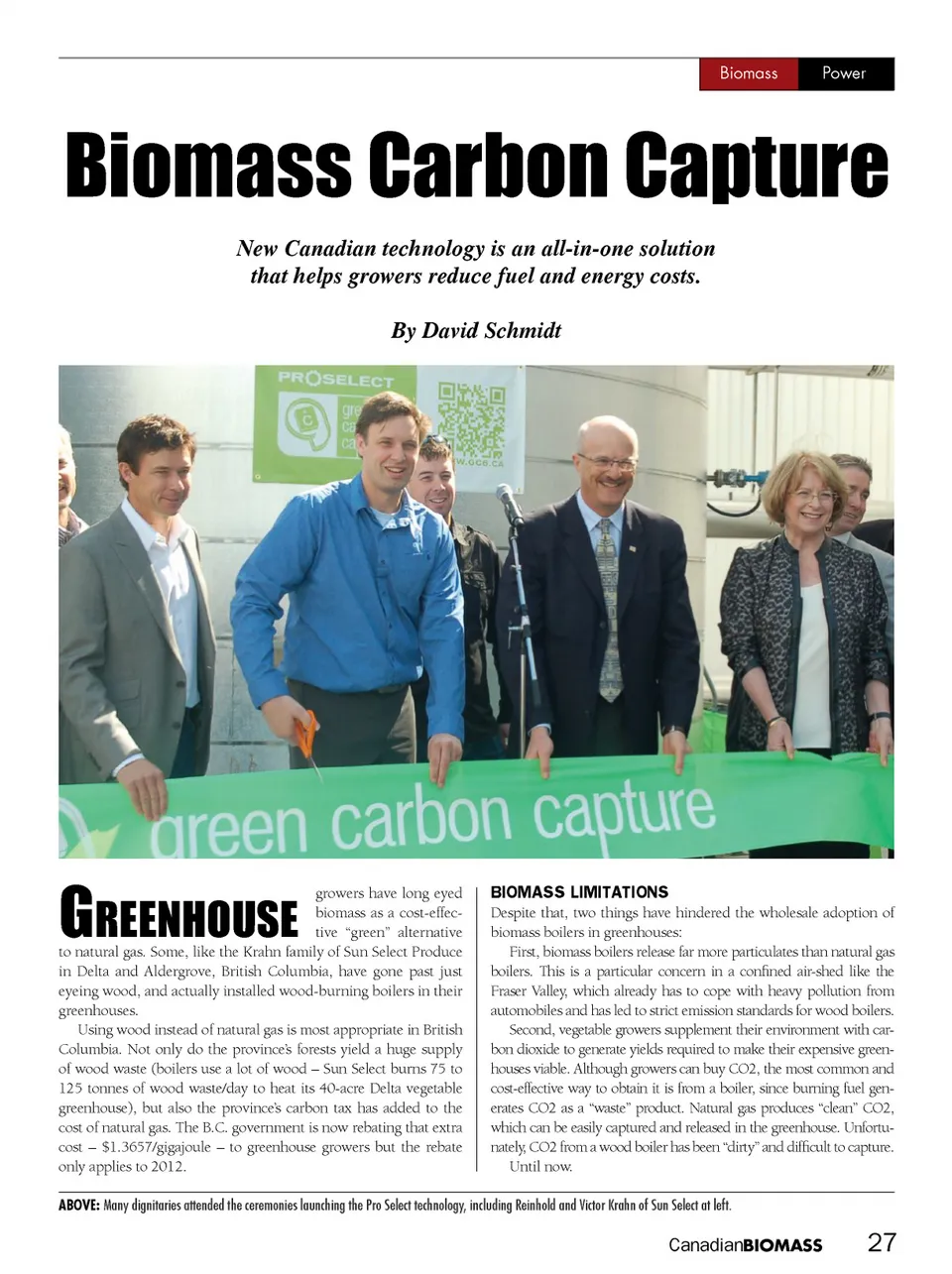
Biomass Power Biomass Carbon Capture New Canadian technology is an all-in-one solution that helps growers reduce fuel and energy costs. By David Schmidt G reenhouse growers have long eyed biomass as a cost-effec-tive “green” alternative to natural gas. Some, like the Krahn family of Sun Select Produce in Delta and Aldergrove, British Columbia, have gone past just eyeing wood, and actually installed wood-burning boilers in their greenhouses. Using wood instead of natural gas is most appropriate in British Columbia. Not only do the province’s forests yield a huge supply of wood waste (boilers use a lot of wood – Sun Select burns 75 to 125 tonnes of wood waste/day to heat its 40-acre Delta vegetable greenhouse), but also the province’s carbon tax has added to the cost of natural gas. The B.C. government is now rebating that extra cost – $1.3657/gigajoule – to greenhouse growers but the rebate only applies to 2012. BIOMASS LIMITATIONS Despite that, two things have hindered the wholesale adoption of biomass boilers in greenhouses: First, biomass boilers release far more particulates than natural gas boilers. This is a particular concern in a confined air-shed like the Fraser Valley, which already has to cope with heavy pollution from automobiles and has led to strict emission standards for wood boilers. Second, vegetable growers supplement their environment with car-bon dioxide to generate yields required to make their expensive green-houses viable. Although growers can buy CO2, the most common and cost-effective way to obtain it is from a boiler, since burning fuel gen-erates CO2 as a “waste” product. Natural gas produces “clean” CO2, which can be easily captured and released in the greenhouse. Unfortu-nately, CO2 from a wood boiler has been “dirty” and difficult to capture. Until now. ABOVE: Many dignitaries attended the ceremonies launching the Pro Select technology, including Reinhold and Victor Krahn of Sun Select at left. Canadian BIOMASS 27
Canadian Biomass July/August 2012: Page 27