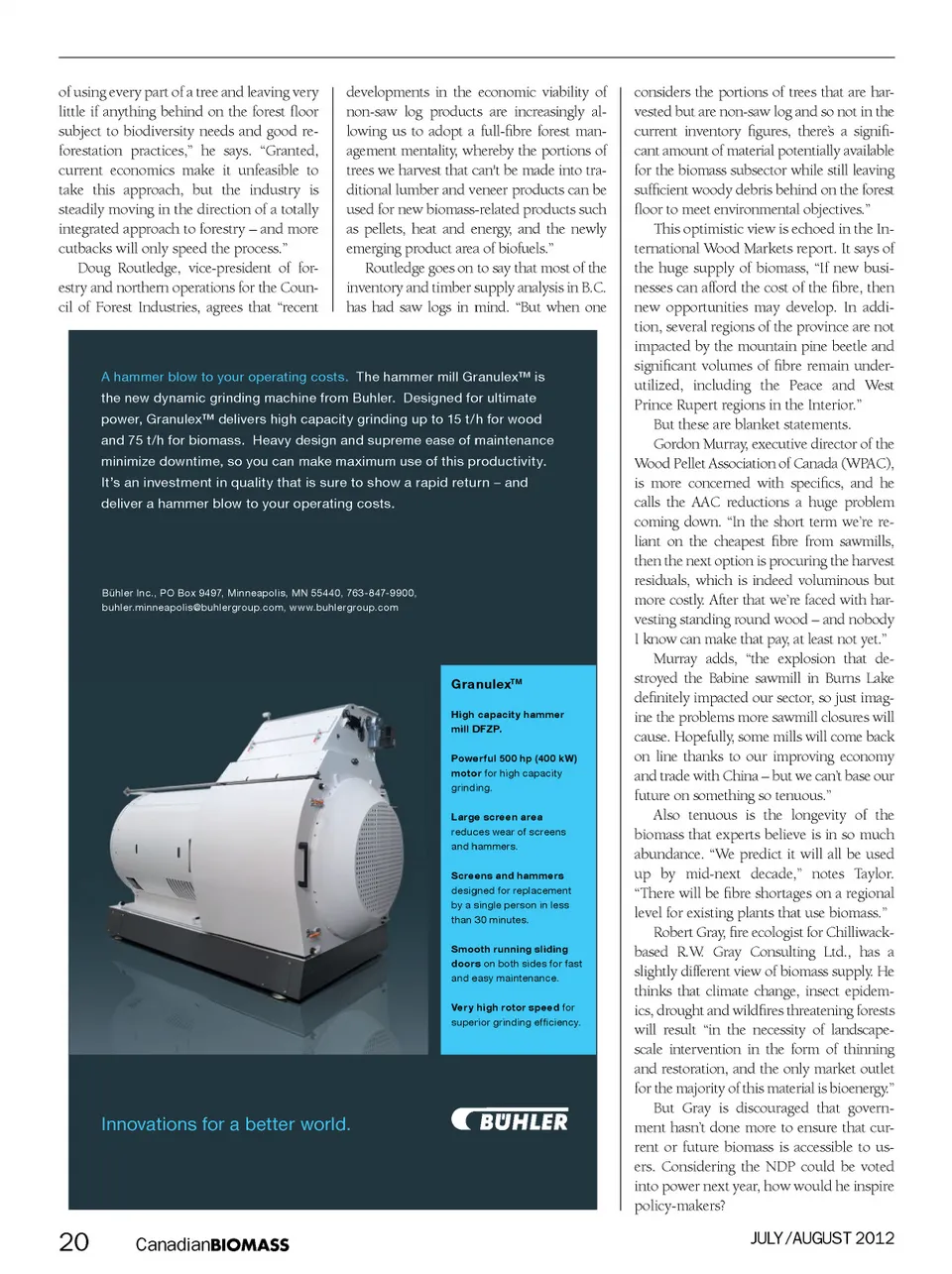
of using every part of a tree and leaving very little if anything behind on the forest floor subject to biodiversity needs and good re-forestation practices,” he says. “Granted, current economics make it unfeasible to take this approach, but the industry is steadily moving in the direction of a totally integrated approach to forestry – and more cutbacks will only speed the process.” Doug Routledge, vice-president of for-estry and northern operations for the Coun-cil of Forest Industries, agrees that “recent developments in the economic viability of non-saw log products are increasingly al-lowing us to adopt a full-fibre forest man-agement mentality, whereby the portions of trees we harvest that can't be made into tra-ditional lumber and veneer products can be used for new biomass-related products such as pellets, heat and energy, and the newly emerging product area of biofuels.” Routledge goes on to say that most of the inventory and timber supply analysis in B.C. has had saw logs in mind. “But when one A hammer blow to your operating costs. The hammer mill Granulex™ is the new dynamic grinding machine from Buhler. Designed for ultimate power, Granulex™ delivers high capacity grinding up to 15 t/h for wood and 75 t/h for biomass. Heavy design and supreme ease of maintenance minimize downtime, so you can make maximum use of this productivity. It’s an investment in quality that is sure to show a rapid return – and deliver a hammer blow to your operating costs. Bühler Inc., PO Box 9497, Minneapolis, MN 55440, 763-847-9900, [email protected], www.buhlergroup.com Granulex TM High capacity hammer mill DFZP. Powerful 500 hp (400 kW) motor for high capacity grinding. Large screen area reduces wear of screens and hammers. Screens and hammers designed for replacement by a single person in less than 30 minutes. Smooth running sliding doors on both sides for fast and easy maintenance. Very high rotor speed for superior grinding effi ciency. Innovations for a better world. considers the portions of trees that are har-vested but are non-saw log and so not in the current inventory figures, there’s a signifi-cant amount of material potentially available for the biomass subsector while still leaving sufficient woody debris behind on the forest floor to meet environmental objectives.” This optimistic view is echoed in the In-ternational Wood Markets report. It says of the huge supply of biomass, “If new busi-nesses can afford the cost of the fibre, then new opportunities may develop. In addi-tion, several regions of the province are not impacted by the mountain pine beetle and significant volumes of fibre remain under-utilized, including the Peace and West Prince Rupert regions in the Interior.” But these are blanket statements. Gordon Murray, executive director of the Wood Pellet Association of Canada (WPAC), is more concerned with specifics, and he calls the AAC reductions a huge problem coming down. “In the short term we’re re-liant on the cheapest fibre from sawmills, then the next option is procuring the harvest residuals, which is indeed voluminous but more costly. After that we’re faced with har-vesting standing round wood – and nobody I know can make that pay, at least not yet.” Murray adds, “the explosion that de-stroyed the Babine sawmill in Burns Lake definitely impacted our sector, so just imag-ine the problems more sawmill closures will cause. Hopefully, some mills will come back on line thanks to our improving economy and trade with China – but we can’t base our future on something so tenuous.” Also tenuous is the longevity of the biomass that experts believe is in so much abundance. “We predict it will all be used up by mid-next decade,” notes Taylor. “There will be fibre shortages on a regional level for existing plants that use biomass.” Robert Gray, fire ecologist for Chilliwack-based R.W . Gray Consulting Ltd., has a slightly different view of biomass supply. He thinks that climate change, insect epidem-ics, drought and wildfires threatening forests will result “in the necessity of landscape-scale intervention in the form of thinning and restoration, and the only market outlet for the majority of this material is bioenergy.” But Gray is discouraged that govern-ment hasn’t done more to ensure that cur-rent or future biomass is accessible to us-ers. Considering the NDP could be voted into power next year, how would he inspire policy-makers? JULY/AUGUST 2012 DFZP_CanBio_2012.indd 1 20 Canadian BIOMASS 5/15/2012 11:35:56 AM
Canadian Biomass July/August 2012: Page 20