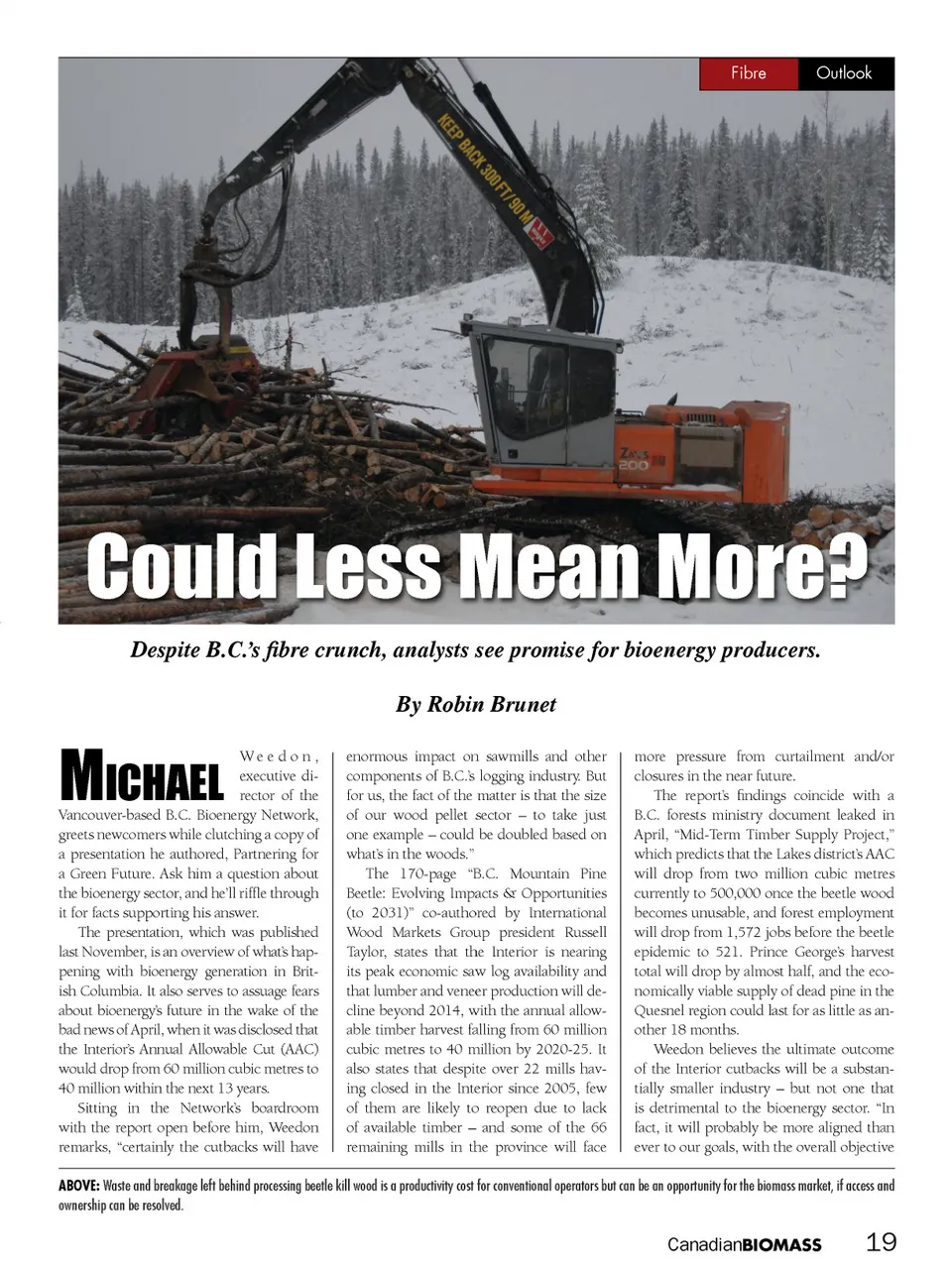
Fibre Outlook Could Less Mean More? Despite B.C.’s fibre crunch, analysts see promise for bioenergy producers. By Robin Brunet M ichael W eedon, executive di-rector of the Vancouver-based B.C. Bioenergy Network, greets newcomers while clutching a copy of a presentation he authored, Partnering for a Green Future. Ask him a question about the bioenergy sector, and he’ll riffle through it for facts supporting his answer. The presentation, which was published last November, is an overview of what’s hap-pening with bioenergy generation in Brit-ish Columbia. It also serves to assuage fears about bioenergy’s future in the wake of the bad news of April, when it was disclosed that the Interior’s Annual Allowable Cut (AAC) would drop from 60 million cubic metres to 40 million within the next 13 years. Sitting in the Network’s boardroom with the report open before him, Weedon remarks, “certainly the cutbacks will have enormous impact on sawmills and other components of B.C.’s logging industry. But for us, the fact of the matter is that the size of our wood pellet sector – to take just one example – could be doubled based on what’s in the woods.” The 170-page “B.C. Mountain Pine Beetle: Evolving Impacts & Opportunities (to 2031)” co-authored by International Wood Markets Group president Russell Taylor, states that the Interior is nearing its peak economic saw log availability and that lumber and veneer production will de-cline beyond 2014, with the annual allow-able timber harvest falling from 60 million cubic metres to 40 million by 2020-25. It also states that despite over 22 mills hav-ing closed in the Interior since 2005, few of them are likely to reopen due to lack of available timber – and some of the 66 remaining mills in the province will face more pressure from curtailment and/or closures in the near future. The report’s findings coincide with a B.C. forests ministry document leaked in April, “Mid-Term Timber Supply Project,” which predicts that the Lakes district’s AAC will drop from two million cubic metres currently to 500,000 once the beetle wood becomes unusable, and forest employment will drop from 1,572 jobs before the beetle epidemic to 521. Prince George’s harvest total will drop by almost half, and the eco-nomically viable supply of dead pine in the Quesnel region could last for as little as an-other 18 months. Weedon believes the ultimate outcome of the Interior cutbacks will be a substan-tially smaller industry – but not one that is detrimental to the bioenergy sector. “In fact, it will probably be more aligned than ever to our goals, with the overall objective ABOVE: Waste and breakage left behind processing beetle kill wood is a productivity cost for conventional operators but can be an opportunity for the biomass market, if access and ownership can be resolved. Canadian BIOMASS 19
Canadian Biomass July/August 2012: Page 19