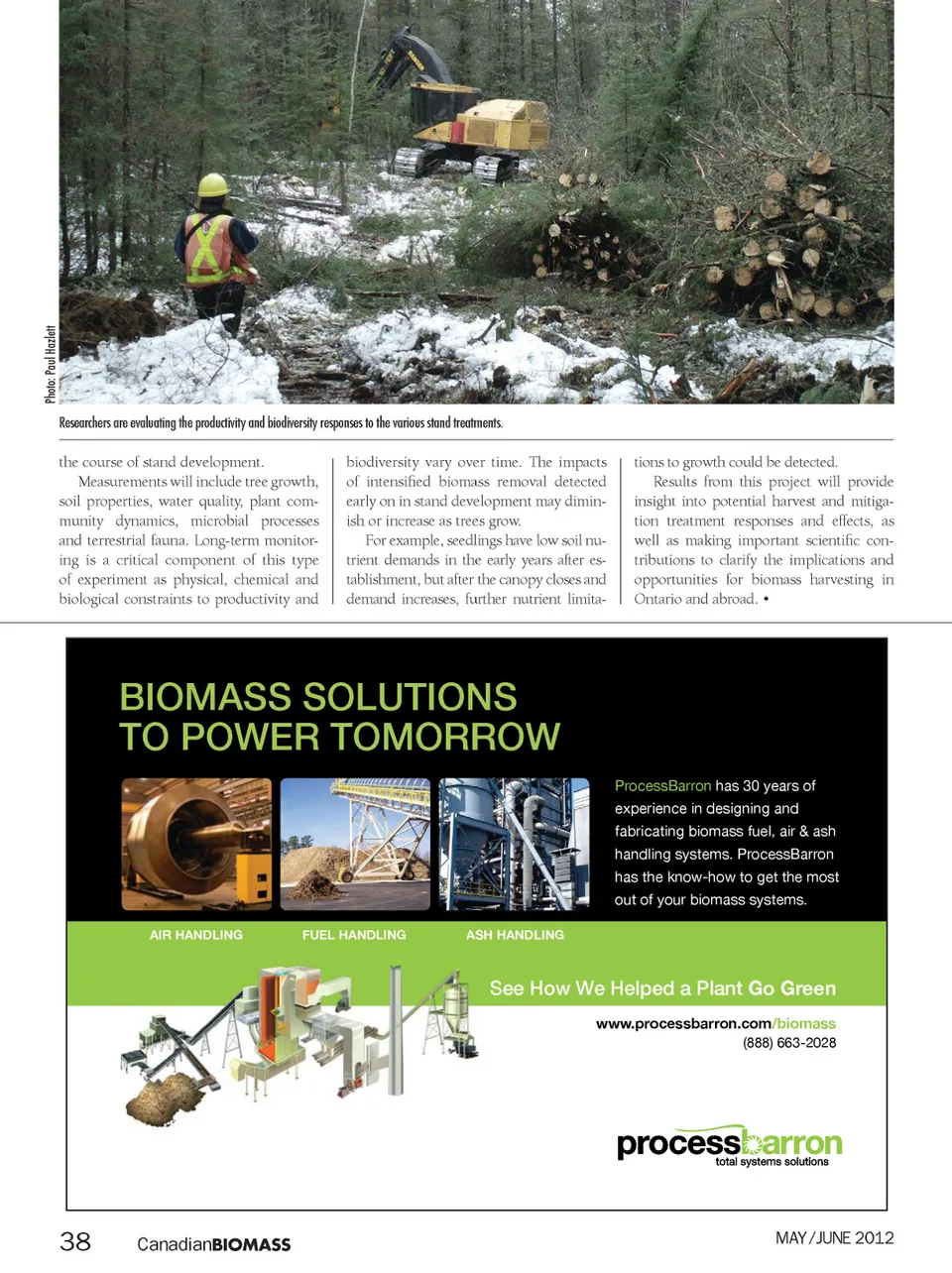
Photo: Paul Hazlett Researchers are evaluating the productivity and biodiversity responses to the various stand treatments. the course of stand development. Measurements will include tree growth, soil properties, water quality, plant com-munity dynamics, microbial processes and terrestrial fauna. Long-term monitor-ing is a critical component of this type of experiment as physical, chemical and biological constraints to productivity and biodiversity vary over time. The impacts of intensified biomass removal detected early on in stand development may dimin-ish or increase as trees grow. For example, seedlings have low soil nu-trient demands in the early years after es-tablishment, but after the canopy closes and demand increases, further nutrient limita-tions to growth could be detected. Results from this project will provide insight into potential harvest and mitiga-tion treatment responses and effects, as well as making important scientific con-tributions to clarify the implications and opportunities for biomass harvesting in "Ì>ÀÊ>`Ê>LÀ>`°ÊU BIOMASS SOLUTIONS TO POWER TOMORROW 7YVJLZZ)HYYVUOHZa;`LHYZVM L_WLYPLUJLPUKLZPNUPUNHUK MHIYPJH[PUNIPVTHZZM\LS HPY�d;HZO OHUKSPUNZ`Z[LTZ7YVJLZZ)HYYVU OHZ[OLRUV^OV^[VNL[[OLTVZ[ V\[VM`V\YIPVTHZZZ`Z[LTZ (09/(5+305. -<,3/(5+305. (://(5+305. See How We Helped a Plant  .V.YLLU ^^^WYVJLZZIHYYVUJVTIPVTHZZ �f;f;f;f; d;d;a;f; 38 Canadian BIOMASS MAY/JUNE 2012
Canadian Biomass May/June 2012: Page 38