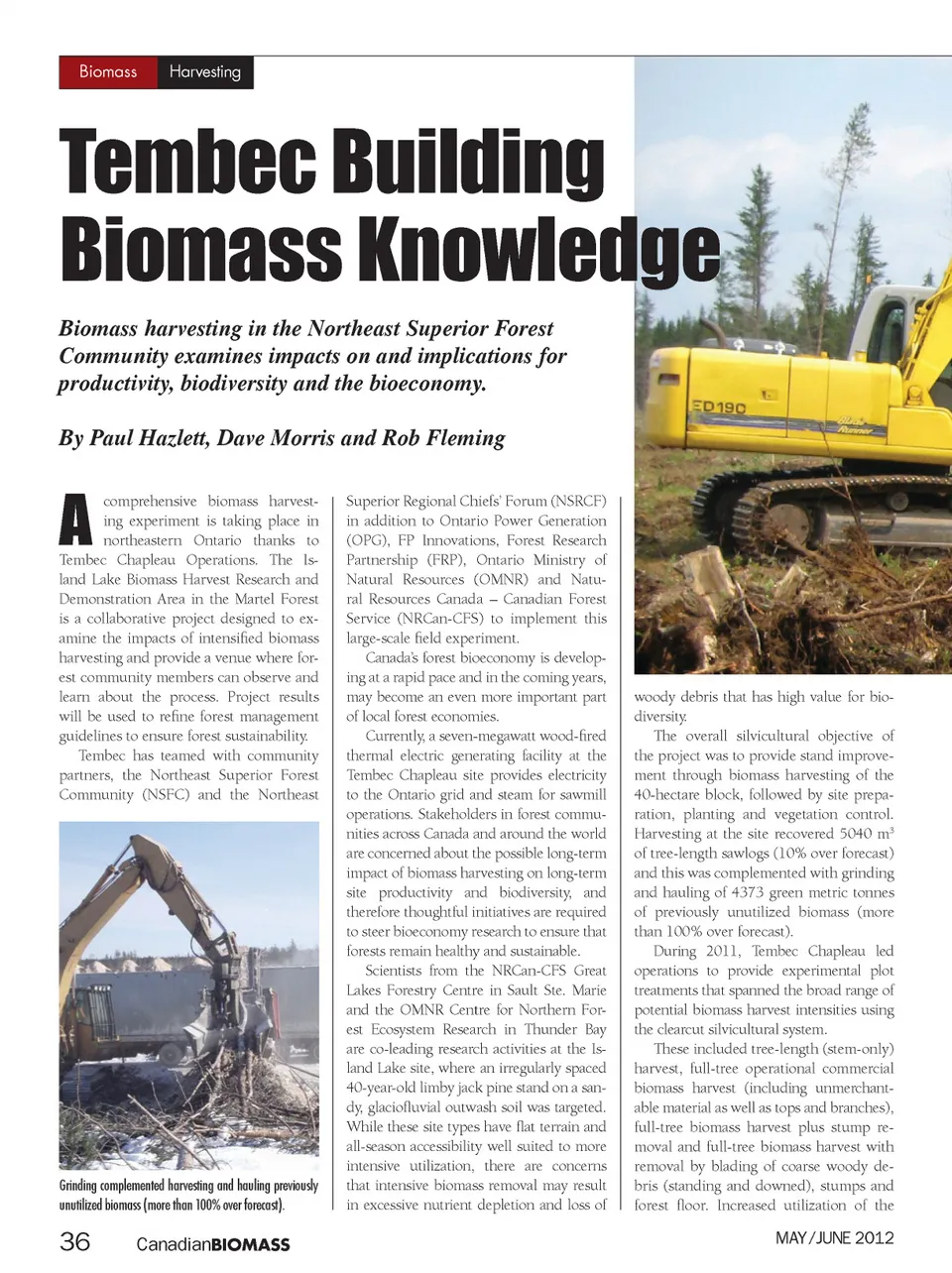
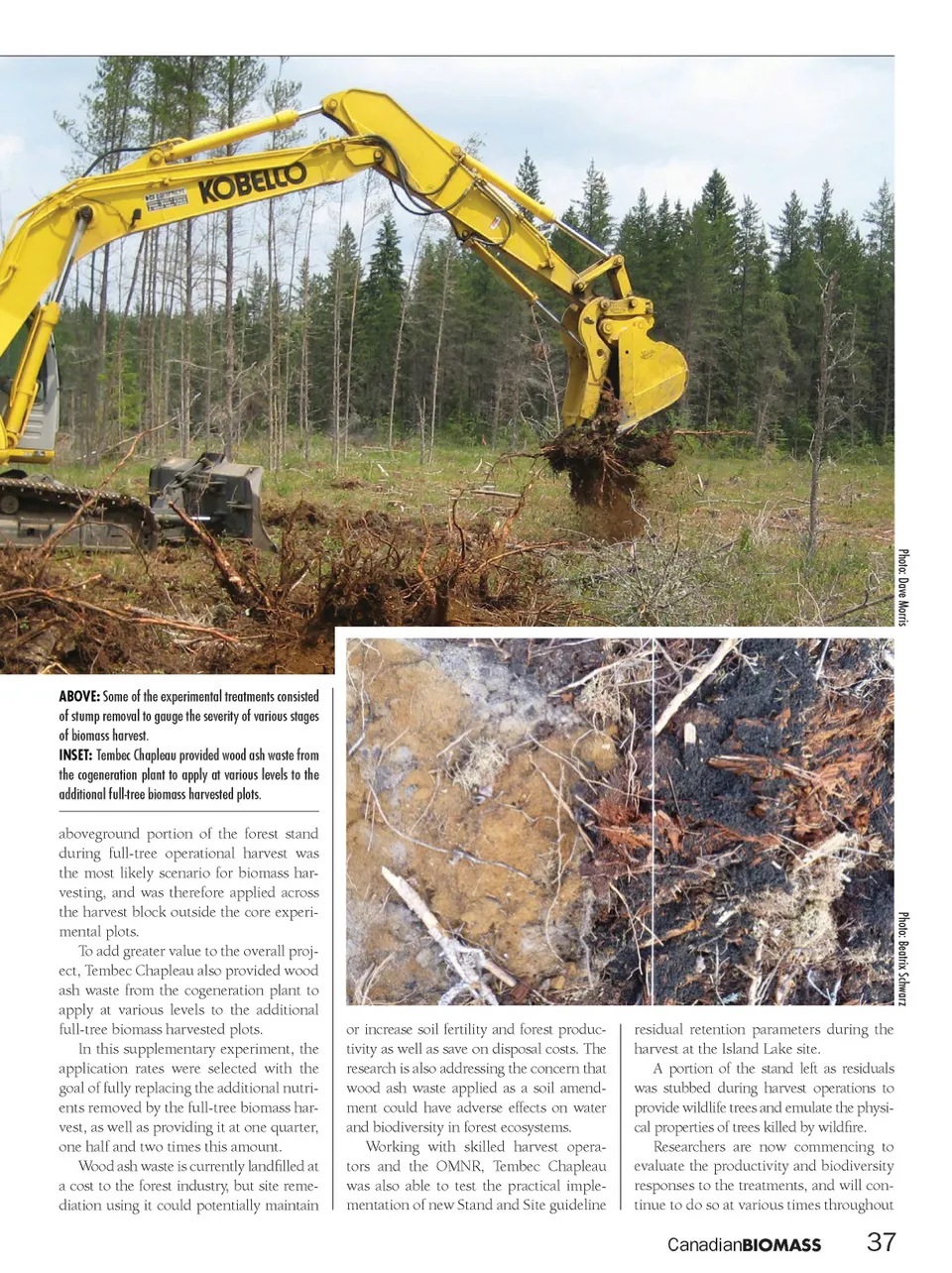
Biomass Harvesting Tembec Building Biomass Knowledge Biomass harvesting in the Northeast Superior Forest Community examines impacts on and implications for productivity, biodiversity and the bioeconomy. By Paul Hazlett, Dave Morris and Rob Fleming A comprehensive biomass harvest-ing experiment is taking place in northeastern Ontario thanks to Tembec Chapleau Operations. The Is-land Lake Biomass Harvest Research and Demonstration Area in the Martel Forest is a collaborative project designed to ex-amine the impacts of intensified biomass harvesting and provide a venue where for-est community members can observe and learn about the process. Project results will be used to refine forest management guidelines to ensure forest sustainability. Tembec has teamed with community partners, the Northeast Superior Forest Community (NSFC) and the Northeast Grinding complemented harvesting and hauling previously mfmladar]\ZageYkk egj]l`Yf)((d;gn]j^gj][Ykl!& Superior Regional Chiefs’ Forum (NSRCF) in addition to Ontario Power Generation (OPG), FP Innovations, Forest Research Partnership (FRP), Ontario Ministry of Natural Resources (OMNR) and Natu-ral Resources Canada – Canadian Forest Service (NRCan-CFS) to implement this large-scale field experiment. Canada’s forest bioeconomy is develop-ing at a rapid pace and in the coming years, may become an even more important part of local forest economies. Currently, a seven-megawatt wood-fired thermal electric generating facility at the Tembec Chapleau site provides electricity to the Ontario grid and steam for sawmill operations. Stakeholders in forest commu-nities across Canada and around the world are concerned about the possible long-term impact of biomass harvesting on long-term site productivity and biodiversity, and therefore thoughtful initiatives are required to steer bioeconomy research to ensure that forests remain healthy and sustainable. Scientists from the NRCan-CFS Great Lakes Forestry Centre in Sault Ste. Marie and the OMNR Centre for Northern For-est Ecosystem Research in Thunder Bay are co-leading research activities at the Is-land Lake site, where an irregularly spaced 40-year-old limby jack pine stand on a san-dy, glaciofluvial outwash soil was targeted. While these site types have flat terrain and all-season accessibility well suited to more intensive utilization, there are concerns that intensive biomass removal may result in excessive nutrient depletion and loss of woody debris that has high value for bio-diversity. The overall silvicultural objective of the project was to provide stand improve-ment through biomass harvesting of the 40-hectare block, followed by site prepa-ration, planting and vegetation control. Harvesting at the site recovered 5040 m 3 of tree-length sawlogs (10% over forecast) and this was complemented with grinding and hauling of 4373 green metric tonnes of previously unutilized biomass (more than 100% over forecast). During 2011, Tembec Chapleau led operations to provide experimental plot treatments that spanned the broad range of potential biomass harvest intensities using the clearcut silvicultural system. These included tree-length (stem-only) harvest, full-tree operational commercial biomass harvest (including unmerchant-able material as well as tops and branches), full-tree biomass harvest plus stump re-moval and full-tree biomass harvest with removal by blading of coarse woody de-bris (standing and downed), stumps and forest floor. Increased utilization of the MAY/JUNE 2012 36 Canadian BIOMASS
Canadian Biomass May/June 2012: Page 36