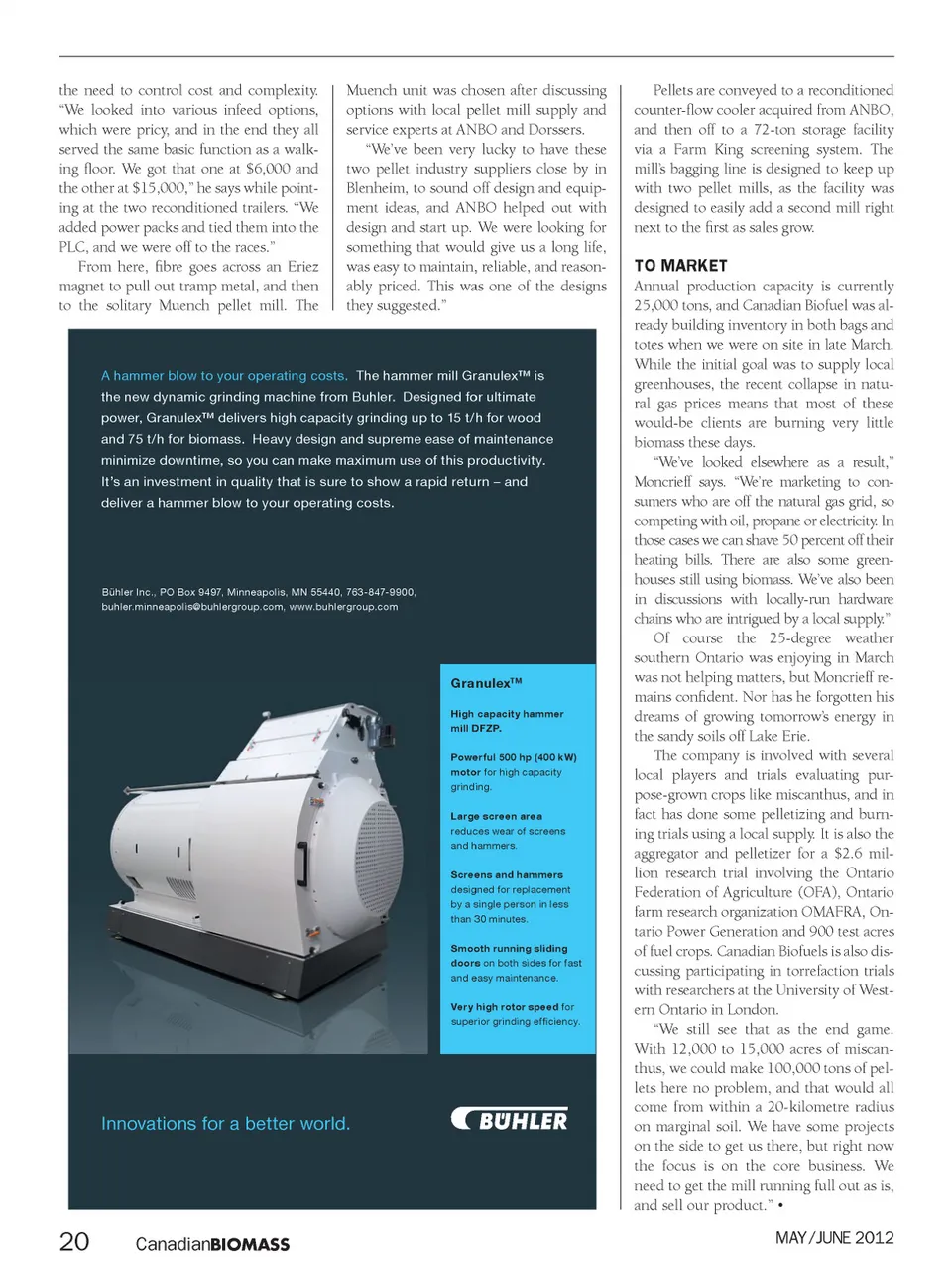
the need to control cost and complexity. “We looked into various infeed options, which were pricy, and in the end they all served the same basic function as a walk-ing floor. We got that one at $6,000 and the other at $15,000,” he says while point-ing at the two reconditioned trailers. “We added power packs and tied them into the PLC, and we were off to the races.” From here, fibre goes across an Eriez magnet to pull out tramp metal, and then to the solitary Muench pellet mill. The Muench unit was chosen after discussing options with local pellet mill supply and service experts at ANBO and Dorssers. “We’ve been very lucky to have these two pellet industry suppliers close by in Blenheim, to sound off design and equip-ment ideas, and ANBO helped out with design and start up. We were looking for something that would give us a long life, was easy to maintain, reliable, and reason-ably priced. This was one of the designs they suggested.” Pellets are conveyed to a reconditioned counter-flow cooler acquired from ANBO, and then off to a 72-ton storage facility via a Farm King screening system. The mill’s bagging line is designed to keep up with two pellet mills, as the facility was designed to easily add a second mill right next to the first as sales grow. TO MARKET A hammer blow to your operating costs. The hammer mill Granulex™ is the new dynamic grinding machine from Buhler. Designed for ultimate power, Granulex™ delivers high capacity grinding up to 15 t/h for wood and 75 t/h for biomass. Heavy design and supreme ease of maintenance minimize downtime, so you can make maximum use of this productivity. It’s an investment in quality that is sure to show a rapid return – and deliver a hammer blow to your operating costs. Bühler Inc., PO Box 9497, Minneapolis, MN 55440, 763-847-9900, [email protected], www.buhlergroup.com Granulex TM High capacity hammer mill DFZP. Powerful 500 hp (400 kW) motor for high capacity grinding. Large screen area reduces wear of screens and hammers. Screens and hammers designed for replacement by a single person in less than 30 minutes. Smooth running sliding doors on both sides for fast and easy maintenance. Very high rotor speed for superior grinding effi ciency. Innovations for a better world. Annual production capacity is currently 25,000 tons, and Canadian Biofuel was al-ready building inventory in both bags and totes when we were on site in late March. While the initial goal was to supply local greenhouses, the recent collapse in natu-ral gas prices means that most of these would-be clients are burning very little biomass these days. “We’ve looked elsewhere as a result,” Moncrieff says. “We’re marketing to con-sumers who are off the natural gas grid, so competing with oil, propane or electricity. In those cases we can shave 50 percent off their heating bills. There are also some green-houses still using biomass. We’ve also been in discussions with locally-run hardware chains who are intrigued by a local supply.” Of course the 25-degree weather southern Ontario was enjoying in March was not helping matters, but Moncrieff re-mains confident. Nor has he forgotten his dreams of growing tomorrow’s energy in the sandy soils off Lake Erie. The company is involved with several local players and trials evaluating pur-pose-grown crops like miscanthus, and in fact has done some pelletizing and burn-ing trials using a local supply. It is also the aggregator and pelletizer for a $2.6 mil-lion research trial involving the Ontario Federation of Agriculture (OFA), Ontario farm research organization OMAFRA, On-tario Power Generation and 900 test acres of fuel crops. Canadian Biofuels is also dis-cussing participating in torrefaction trials with researchers at the University of West-ern Ontario in London. “We still see that as the end game. With 12,000 to 15,000 acres of miscan-thus, we could make 100,000 tons of pel-lets here no problem, and that would all come from within a 20-kilometre radius on marginal soil. We have some projects on the side to get us there, but right now the focus is on the core business. We need to get the mill running full out as is, >`ÊÃiÊÕÀÊ«À`ÕVÌ°»ÊU MAY/JUNE 2012 20 Canadian BIOMASS
Canadian Biomass May/June 2012: Page 20